Extensible Business Reporting Language (XBRL) 2.1
RECOMMENDATION - 2003-12-31 + Corrected Errata - 2005-04-25
This version:
XBRL-RECOMMENDATION-2003-12-31+Corrected-Errata-2005-04-25.htm
is a non-normative version of this specification. The NORMATIVE version is in the file
http://www.xbrl.org/Specification/XBRL-RECOMMENDATION-2003-12-31+Corrected-Errata-2005-04-25.rtf
Editors
|
Name |
Contact |
Affiliation |
|
Phillip Engel |
KPMG LLP |
|
|
Walter Hamscher[1] |
Standard Advantage |
|
|
Geoffrey Shuetrim |
KPMG LLP |
|
|
David vun Kannon |
KPMG LLP |
|
|
Hugh Wallis |
Standard Dimensions (formerly of Hyperion Solutions Corporation) |
Contributors
|
Name |
Contact |
Affiliation |
|
Charles Hoffman |
UBmatrix |
|
|
Campbell Pryde |
KPMG LLP |
Status of this document
This document is an update to the RECOMMENDATION document dated 2003-12-31 and incorporates all errata corrections that have been approved by the XBRL International Specification Working Group as of the date of publication. The International Steering Committee of XBRL International approved this document for publication as an update to the RECOMMENDATION on 2005-04-25.
Each erratum correction is listed in Appendix D but in this version there is no indication of the details of the corrections since the “track changes” mechanism used to identify those details has had “all changes accepted”. The details of the changes will be found by examining the version marked as “redlined”. Links to discussions surrounding these corrections are included but it should be noted that some of these are to “members only” mailing lists. Readers are invited to submit, with their comments, notification of any relevant patent rights of which they are aware and to provide supporting documentation.
While excerpts from XBRL schemas are given throughout this document the complete normative versions of the schemas are included in Appendix A. Non-normative versions are also available as separate .xsd files from www.xbrl.org, the XBRL International web site. The (non-normative) schema maintenance mechanism for schemas on the web is briefly described in Appendix A of this document.
Abstract
XBRL is the specification for the eXtensible Business Reporting Language. XBRL allows software vendors, programmers, intermediaries in the preparation and distribution process and end users who adopt it as a specification to enhance the creation, exchange, and comparison of business reporting information. Business reporting includes, but is not limited to, financial statements, financial information, non-financial information, general ledger transactions and regulatory filings, such as annual and quarterly reports.
This document defines XML elements and attributes that can be used to express information used in the creation, exchange, and comparison tasks of business reporting. XBRL consists of a core language of XML elements and attributes used in XBRL instances as well as a language used to define new elements and taxonomies of elements referred to in XBRL instances, and to express constraints among the contents of elements in those XBRL instances.
Table of contents
1.3 Relationship to other work
1.6 Namespace prefix conventions
2 Changes from the previous published version
2.2 Changes in XBRL taxonomies
3.1 Overview of XBRL taxonomies
3.2 Overview of XBRL instances
3.3 Data integrity and confidentiality
3.5.1.1 The xlink:type attribute on simple links
3.5.1.2 The xlink:href attribute on simple links
3.5.1.3 The xlink:role attribute on simple links (optional)
3.5.1.4 The xlink:arcrole attribute on simple links (optional)
3.5.1.5 The xml:base attribute on simple links (optional)
3.5.2.1 The id attribute on linkbase elements (optional)
3.5.2.2 The xml:base attribute on linkbase elements (optional)
3.5.2.3 Documentation elements in linkbase elements (optional)
3.5.2.4 The roleRef element (optional)
3.5.2.5 The arcroleRef element (optional)
3.5.3.1 The id attribute on extended links (optional)
3.5.3.2 The xlink:type attribute on extended links
3.5.3.3 The xlink:role attribute on extended links
3.5.3.4 The xml:base attribute on extended links (optional)
3.5.3.5 Documentation elements in extended links (optional)
3.5.3.6 Titles in extended links (optional)
3.5.4 Use of XPointer in URI fragment identifiers
4.1.1 The id attribute on xbrl elements (optional)
4.1.2 The xml:base attribute on xbrl elements (optional)
4.2 The schemaRef element in XBRL Instances
4.2.1 The xlink:type attribute on schemaRef elements
4.2.2 The xlink:href attribute on schemaRef elements
4.2.3 The xlink:arcrole attribute on schemaRef elements (optional)
4.2.4 The xlink:role attribute on schemaRef elements (optional)
4.2.5 The xml:base attribute on schemaRef elements (optional)
4.3 The linkbaseRef element in XBRL instances 43
4.3.1 The xlink:type attribute on linkbaseRef elements
4.3.2 The xlink:href attribute on linkbaseRef elements
4.3.3 The xlink:arcrole attribute on linkbaseRef elements
4.3.4 The xlink:role attribute on linkbaseRef elements (optional)
4.3.5 The xml:base attribute on linkbaseRef elements (optional)
4.4 The roleRef element in XBRL instances (optional)
4.5 The arcroleRef element in XBRL instances (optional)
4.6.1 The contextRef attribute
4.6.3 Usage of precision and decimals attributes
4.6.4 The precision attribute (optional)
4.6.5 The decimals attribute (optional)
4.6.7 Definitions pertaining to accuracy
4.6.7.1 “Correct to n Significant Figures”, “Rounding” and “Truncation”
4.6.7.2 “Correct to n Decimal Places”
4.7.3.2 The segment element (optional)
4.7.4 The scenario element (optional)
4.8.4 The unitNumerator and unitDenominator elements
4.10 Equality predicates relevant to detecting duplicate items and tuples
4.11.1 The footnoteLink element
4.11.1.1 Locators in footnoteLink elements
4.11.1.3 The footnoteArc element
5.1.1.1 The periodType attribute
5.1.1.2 The balance attribute (optional)
5.1.3 Defining custom role types – the roleType element
5.1.3.2 The id attribute on roleType elements (optional)
5.1.3.3 The definition element in roleType elements (optional)
5.1.3.4 The usedOn element in roleType elements
5.1.4 Defining custom arc role types – the arcroleType element
5.1.4.1 The arcroleURI attribute
5.1.4.2 The id attribute on arcroleType elements (optional)
5.1.4.3 The cyclesAllowed attribute
5.1.4.4 The definition element on arcroleType elements (optional)
5.1.4.5 The usedOn element on arcroleType elements
5.2.2.1 Locators in labelLink elements
5.2.3 The referenceLink element
5.2.3.1 Locators in referenceLink elements
5.2.3.3 The referenceArc element
5.2.4 The presentationLink element
5.2.4.1 Locators in presentationLink elements
5.2.4.2 The presentationArc element
5.2.5 The calculationLink element
5.2.5.1 Locators in calculationLink elements
5.2.5.2 The calculationArc element
5.2.6 The definitionLink element
5.2.6.1 Locators in definitionLink elements
5.2.6.2 The definitionArc element
xbrl-instance-2003-12-31.xsd (normative)
xbrl-linkbase-2003-12-31.xsd (normative)
xlink-2003-12-31.xsd (normative)
B. Document history and acknowledgments (non-normative)
C. Intellectual property status (non‑normative)
D. Errata Corrections incorporated in this document
List of tables
Table 1. Terms and definitions.
Table 2. Roles in the linkbaseRef element
Table 3. Unit restrictions based on item types.
Table 4. Equality predicate definitions.
Table 5. Correct signage in an XBRL instance. 79
Table 6. Constraints among the balance attribute and calculation arc weights
Table 8. Standard label role attribute values.
Table 9. Reference role attribute values.
List of examples
Example 1. A skeletal linkbase
Example 2. One-to-One arc relationships [XLINK]
Example 3. One-to-Many arc relationships [XLINK]
Example 4. Many-to-Many arc relationships [XLINK]
Example 5. Correct use of arcs according to [XLINK]
Example 6. Prohibiting and overriding relationships
Example 7. Example xlink:href values
Example 8. Use of xbrl as the root element
Example 9. A numeric fact with three significant digits
Example 10. A non-numeric item
Example 11. Precision and lexical representation
Example 12. Decimals and lexical representation
Example 13. Lexical representation, precision and decimals
Example 15. Correct to n decimal places. 52
Example 17. Entity identifiers
Example 18. Using the segment element
Example 19. Use of the scenario element
Example 20. Use of the unit element
Example 21. Simple and complex unit of measure comparison
Example 22. Defining a tuple as a member of the substitutionGroup "tuple"
Example 23. Elements describing business properties held and disposed
Example 24. Hierarchy in a tuple
Example 25. Duplicate items, tuples and contexts
Example 26. Predicates for detecting duplicates
Example 27. A footnote in an XBRL instance
Example 28. A skeletal taxonomy schema showing linkbase references
Example 29. Typical element definitions in a taxonomy schema
Example 30. Instant and duration concept definitions
Example 31. Using the balance element to indicate normal debit and credit balances
Example 32. A concept appearing with positive and negative values in an XBRL instance
Example 33. Deriving an enumerated item type
Example 34. Representing fractions
Example 35. Defining a custom role type
Example 36. Defining a custom arc role value
Example 37. Using relationship prohibition to insert a new sub-total into a calculation network
Example 39. Elements of a financial reporting taxonomy
Example 40. Hierarchy in a calculation linkbase
Example 41. Hierarchy of general-special arcs in a definition linkbase
Example 42. Hierarchy in a presentation linkbase
Example 43. Label resource examples
Example 44. Arc between a concept and one of its labels
Example 45. Sample values of xlink:role for several referenceLink elements
Example 46. Arc between a concept and supporting references
Example 47. Reference resource
Example 48. A presentation arc
Example 49. An abstract concept definition
Example 50. Calculations involving decimals and precision
Example 51. Syntax of a calculationArc
Example 52. Cash, equivalent to cash as totalled by branch location and account type
Example 53. XBRL instance fragment with nested tuples
Example 54. A general-special arc
Example 55. Inference of values for non-numeric items with concepts connected by essence-alias arcs
Example 56. Inference of values for numeric items with concepts connected by essence-alias arcs
1 Introduction
XBRL is the specification for the eXtensible Business Reporting Language. XBRL allows software vendors, programmers and end users to enhance the creation, exchange, and comparison of business reporting information. Business reporting includes, but is not limited to, financial statements, financial information, non-financial information and regulatory filings such as annual and quarterly financial statements.
This document defines XML elements and attributes that can be used to express information used in the creation, exchange and comparison tasks of business reporting. XBRL consists of a core language of XML elements and attributes used in document instances. Abstract elements in this core language are replaced by concrete elements in XBRL instances. These abstract elements are defined in taxonomies. XBRL consists of a language used to define new elements and taxonomies of elements referred to in document instances and the relationships between taxonomy elements.
All parts of this document not explicitly identified as non-normative are normative. In the event of any conflict or apparent conflict between the English language text of this document and/or schema fragments included in the main body of this document and the normative schemas contained herein (Appendix A), the more restrictive interpretation that is possible from the information provided by the English language text and that provided by the normative schemas (Appendix A) SHALL prevail. The schema fragments incorporated into the body of the text are non-normative and are generally indicated as such by means of shading such as that defined in section 1.1. It is important to note that the normative schemas (Appendix A) do not necessarily always provide the most restrictive interpretation, either because it is not possible to express certain limitations using the syntax of XML Schema [SCHEMA‑1] [SCHEMA-2] or because, as at the time of publication of this specification, some commonly available commercial implementations of XML Schema do not implement otherwise necessary features correctly or fully. For example, the schema specification of the abstract element tuple (Appendix A) does not restrict its content model as much as the English language text in section 4.9. The text of section 4.9 SHALL prevail in this case. Another, converse, example is the order of the sub-elements of the context element. In this case the schema (Appendix A) dictates a specific ordering of these sub-elements yet this is not explicitly articulated in the text of section 4.7. The schema (Appendix A) provides the more restrictive interpretation and thus it SHALL prevail over any alternative possible interpretation of the English language text in this case.
The schemas and other documents published separately and contemporaneously with the specification are non-normative and are provided for the convenience of users of this specification.
1.1 Documentation conventions
The following highlighting is used to present non-normative technical material in this document:
|
|
The following highlighting is used for non-normative commentary in this document:
|
|
Non-normative editorial comments are denoted by indentation and the prefix “NOTE:”:
NOTE: This is a non-normative editorial comment.
Italics are used for rhetorical emphasis only and do not convey any special normative meaning.
1.2 Purpose
The XBRL specification is intended to benefit four categories of users: 1) business information preparers, 2) intermediaries in the preparation and distribution process, 3) users of this information and 4) the vendors who supply software and services to one or more of these three types of user. The overall intention is to balance the needs of these groups creating a standard that benefits to all four groups.
The needs of end users of business information have generally taken precedence over other needs when it has been necessary to make specification design decisions that might benefit one community at the expense of another.
A major goal of XBRL is to improve the business report product. It facilitates current practice; it does not change or set new accounting or other business domain standards. However, XBRL should facilitate changes in reporting over the long term.
XBRL provides users with a standard format in which to prepare reports that can subsequently be presented in a variety of ways. XBRL provides users with a standard format in which information can be exchanged between different software applications. XBRL permits the automated, efficient and reliable extraction of information by software applications. XBRL facilitates the automated comparison of financial and other business information, accounting policies, notes to financial statements between companies, and other items about which users may wish make comparisons that today are performed manually.
XBRL facilitates "drill down" to detailed information, authoritative literature, audit and accounting working papers. XBRL includes specifications for as much information about the reporting entity as may be relevant and useful to the process of financial and business reporting and the interpretation of the information.
XBRL supports international accounting and other standards as well as languages other than the various dialects of English.
XBRL is extensible by any adopter to increase its breadth of applicability, and its design encourages reuse via incremental extensions. For example, XBRL specifies the format of information that would reasonably be expected in an electronic format for securities filings by public entities. XBRL facilitates business reporting in general, and is not limited to financial and accounting reporting.
XBRL focuses on the genuine information needs of the user and adheres to the spirit of reporting standards that avoid the use of bold, italics, and other stylistic techniques that may distract from a true and fair presentation of results. Therefore, there is no functional requirement that XBRL documents support any particular text formatting conventions.
The purpose of XBRL instances is the transmission of a set of facts. There is no constraint on how much or how little they contain. A single fact can form the entire content of a valid XBRL instance, for example, when the information being conveyed is limited to what “Cost of Goods Sold” was last quarter or an XBRL instance can be a database dump, containing huge numbers of facts. It can also be anything in between. This provides a great deal of flexibility and is meant specifically to achieve the goals of allowing XBRL to be reused within other specifications and for application software needing to extract data from otherwise arbitrarily formatted documents. It is expected that, for most uses of XBRL, many XML XBRL instances will be created that consist almost exclusively of facts.
1.3 Relationship to other work
XBRL uses several World Wide Web Consortium (W3C) recommendations, XML 1.0 [XML], Namespaces in XML [NAMESPACES], and refers directly to XML Linking[XLINK] and others listed in Section 6 References. It also relies extensively on the XML Schema [SCHEMA‑1] and [SCHEMA-2] recommendation.
Discussions have taken place with other bodies issuing XML specifications in the financial arena, including OAG (Open Applications Group), OMG (Object Management Group), FpML (Financial Products Markup Language), finXML (Financial XML), OFX/IFX (Open Financial Exchange) and ebXML (e-Business XML). The scope of XBRL does not include transaction protocols. It includes financial reporting and contemplates extensive detail in the representation and use of accounting conventions, which distinguishes it from these other efforts.
1.4 Terminology
The terminology used in XBRL frequently overlaps with terminology from other fields, and the following list is provided to reduce the possibility of ambiguity and confusion (see also the references in section 6 below).
Table 1. Terms and definitions.
|
Term |
Definition |
||||||||||||||||
|
An element for which the attribute abstract in its XML schema declaration has the value "true" and which, therefore, cannot be used in an XML instance. |
|||||||||||||||||
|
The concept at the “to” end of a definition arc with arc role http://www.xbrl.org/2003/arcrole/essence‑alias. Alias and essence concepts are definitionally equivalent in the sense that valid values for an alias concept are always valid values for essence concepts to which they are related by an essence-alias relationship. |
|||||||||||||||||
|
An item in an instance whose element is an alias concept. |
|||||||||||||||||
|
Arcs relate concepts to each other by associating their locators. Arcs also associate concepts with resources by connecting the concept locators to the resources themselves. Arcs are also used to connect fact locators to footnote resources in footnote extended links. Arcs have a set of attributes that document the nature of the relationships expressed in extended links. Importantly all arcs have an xlink:arcrole attribute that determines the semantics of the relationship they describe. |
|||||||||||||||||
|
Context-equal: Items or sets or sequences of items having the same item type in s-equal contexts. For a formal definition, see Section 4.10 below. |
|||||||||||||||||
|
ancestor, child, descendant, grandparent, parent, sibling, uncle |
Relationships among elements in an XBRL instance: using the terminology of [XPATH], for any element E, another element F is its:
· ancestor if and only if F appears on the ancestor axis of E · child if and only if F appears on the child axis of E · descendant if and only if F appears on the descendant axis of E · grandparent if and only if F is the parent of the parent of E · parent if and only if F appears on the parent axis of E · sibling if and only if F appears on the child axis of the parent of E and is not E itself · uncle if and only if F is a sibling of the parent of E
|
||||||||||||||||
|
Concepts are defined in two equivalent ways. In a syntactic sense, a concept is an XML Schema element definition, defining the element to be in the item element substitution group or in the tuple element substitution group. At a semantic level, a concept is a definition of kind of fact that can be reported about the activities or nature of a business activity. |
|||||||||||||||||
|
An element for which the attribute abstract in its XML schema declaration has the value "false" and which, therefore, may appear in an XML instance. |
|||||||||||||||||
|
Contexts are elements that occur as children of the root element in XBRL instances. They document the entity, the period and the scenario that collectively give the appropriate context for understanding the values of items. |
|||||||||||||||||
|
A DTS is a collection of taxonomy schemas and linkbases. The bounds of a DTS are such that the DTS includes all taxonomy schemas and linkbases that can be discovered by following links or references in the taxonomy schemas and linkbases included in the DTS. At least one taxonomy schema in a DTS must import the xbrl-instance-2003-12-31.xsd schema. See Section 3 for details on the discovery process. |
|||||||||||||||||
|
Two items of the same concept in the same context under the same parent. For a formal definition see duplicate item in section 4.10. |
|||||||||||||||||
|
Two occurrences of a tuple with all their descendants having the same content; more precisely: tuples that are p-equal, all of whose tuple children have a duplicate (except for being p-equal) in the other tuple, and all of whose item children have a duplicate (except for being p-equal) in the other tuple. For a formal definition see duplicate tuple in section 4.10. |
|||||||||||||||||
|
An XML element defined using XML Schema. |
|||||||||||||||||
|
A business entity, the subject of XBRL items. Where the [XML]/[SGML] concept of syntactic "entity" is meant, this will be pointed out. |
|||||||||||||||||
|
The concept at the “from” end of a definition arc with arc role http://www.xbrl.org/2003/arcrole/essence‑alias. Alias and essence concepts are definitionally equivalent in the sense that valid values for an alias concept are always valid values for essence concepts to which they are related by an essence-alias relationship. |
|||||||||||||||||
|
An item in an instance whose element is an essence concept. |
|||||||||||||||||
|
An extended link is an element identified as an extended link using the syntax defined in the XML Linking Language [XLINK]. Extended links represent a set of relationships between information that they contain and information contained in third party documents. See Section 3.5.2.4 for more details.
|
|||||||||||||||||
|
Facts can be simple, in which case their values must be expressed as simple content (except in the case of simple facts whose values are expressed as a ratio), and facts can be compound, in which case their value is made up from other simple and/or compound facts. Simple facts are expressed using items (and are referred to as items in this specification) and compound facts are expressed using tuples (and are referred to as tuples in this specification). |
|||||||||||||||||
|
The namespace used for XBRL 2.1 instances, http://www.xbrl.org/2003/instance |
|||||||||||||||||
|
An item is an element in the substitution group for the XBRL item element. It contains the value of the simple fact and a reference to the context (and unit for numeric items) needed to correctly interpret that fact. When items occur as children of a tuple, they must also be interpreted in light of the other items and tuples that are children of the same tuple. There are numeric items and non-numeric items, with numeric items being required to document their measurement accuracy and units of measurement. |
|||||||||||||||||
|
In an instance, the element that is an ancestor of two elements and has no child that also appears on the ancestor axis [XPATH] of those same two elements. |
|||||||||||||||||
|
A linkbase is a collection of XML Linking Language [XLINK] extended links that document the semantics of concepts in a taxonomy. |
|||||||||||||||||
|
The namespace of XBRL 2.1 linkbases, http://www.xbrl.org/2003/linkbase |
|||||||||||||||||
|
Locators supply an XPointer [XPTR] reference to the taxonomy schema element definitions that uniquely identify each concept. They provide an anchor for extended link arcs. See Section 3.5.3.7 for more details. |
|||||||||||||||||
|
must, must not, required, shall, shall not, should, should not, may, optional |
See [RFC2119] for definitions of these and other terms as used in this specification. These include:
|
||||||||||||||||
|
An item that is not a numeric item as defined below. Dates, in particular, are not numeric. |
|||||||||||||||||
|
An item whose simple content is derived by restriction from the XML Schema primitive types decimal, float or double, or complex content derived by restriction from the XBRL defined type fractionItemType (See Section 5.1.1.3 for details on item types). |
|||||||||||||||||
|
An instant or duration of time. In business reporting, financial numbers and other facts are reported “as of” an instant or for a period of certain duration. Facts about instants and durations are both common. |
|||||||||||||||||
|
Parent-equal: instance items or tuples having the same parent. For a formal definition, see Section 4.10 below. |
|||||||||||||||||
|
Resources are XML fragments, contained within extended links that provide additional information about concepts or items. See Section 3.5.3.8 for details. |
|||||||||||||||||
|
The root of an XBRL instance is the xbrl element. In principle, it is possible to embed an XBRL instance in any XML document. In this case, the xbrl element is the container for the XBRL instance. |
|||||||||||||||||
|
Structure-equal: XML nodes that are either equal in the XML value space, or whose XBRL-relevant sub-elements and attributes are s-equal. For a formal definition, see Section 4.10 below. |
|||||||||||||||||
|
A taxonomy is an XML schema and the set of XBRL linkbases that it references using linkbaseRef elements and the linkbases that are nested within it. |
|||||||||||||||||
|
A taxonomy schema is an XML Schema [SCHEMA‑1]. A large part of many taxonomy schemas is given over to the definition of the syntax for the concepts in that taxonomy. Sections 3.1, 5 and 5.1 address this in more detail. |
|||||||||||||||||
|
A tuple is an element in the substitution group for the XBRL tuple element. Tuples are used to bind together the parts of a compound fact. Those constituent parts are themselves, facts but they must be interpreted in light of each-other. For example, the name, age and compensation of a director of a company need to be grouped together to be correctly understood. |
|||||||||||||||||
|
Units are XML fragments that occur as children of the root element in XBRL instances. They document the unit of measure for numeric items. Each unit element is only capable of documenting a single unit of measurement. |
|||||||||||||||||
|
u-equal |
Unit-equal. u-equal numeric items having the same units of measurement. For a formal definition, see Section 4.10 below. |
||||||||||||||||
|
Value-equal: c-equal items having either the same non-numeric value, or numeric values that are equal within some tolerance defined by the lesser of their respective precision, implied precision or decimals attributes. For a formal definition see Section 4.10 below. |
|||||||||||||||||
|
XBRL instances are XML fragments with root element, xbrl. XBRL instances contain business report facts, with each fact corresponding to a concept defined in their supporting DTS. XBRL instances also contain contexts and units that provide additional information needed to interpret the facts in the instance. |
|||||||||||||||||
|
[XPATH]-equal: The XPath "=" operator returns the value true. For a formal definition, see Section 4.10 below. |
1.5 Levels of conformance
This specification describes two levels of conformance for XBRL aware processors. The first is required of all XBRL processors. Support for the other level of conformance will depend on the purpose of the processor.
Minimally conforming XBRL processors MUST completely and correctly implement all of the syntactic restrictions embodied in this specification.
Fully conforming XBRL processors MUST be minimally conforming and, in addition, they MUST completely and correctly implement all of the semantic restrictions relating to linkbases and XBRL instances.
All restrictions embodied in this specification apply to minimally conforming processors unless otherwise stated.
1.6 Namespace prefix conventions
This specification uses a number of namespace prefixes when describing elements and attributes. The namespace prefix convention used is as follows:
link http://www.xbrl.org/2003/linkbase
xbrli http://www.xbrl.org/2003/instance
xl http://www.xbrl.org/2003/XLink
xlink http://www.w3.org/1999/xlink
xml http://www.w3.org/XML/1998/namespace
xsi http://www.w3.org/2001/XMLSchema-instance
Note that the xml prefix is reserved as defined in [NAMESPACES]; specifically at http://www.w3.org/TR/REC-xml-names/#nsc-NSDeclared.
Some elements and attributes defined in this specification are described without use of a namespace prefix or namespace. The normative namespaces for all elements and attributes defined in this spec are determined by the normative schemas contained herein (Appendix A).
2 Changes from the previous published version
Changes from the previous, December 2001 version of [XBRL] (and the interim 2.0a “patch” release in November 2002) were driven by two factors. Several implementations of XML Schema required the removal of an ambiguous content model from the definition of contexts. This was done without changing the language recognised by the schema. Further implementation experience within the XBRL community, including the publication of the XBRL General Ledger taxonomy, motivated many other changes. A number of business requirements documented by the XBRL International Domain working group have been incorporated.
2.1 Changes in XBRL instances
The group element has been eliminated. It has been replaced with the xbrl element, which acts as the root element of an XBRL instance.
The set of taxonomy schemas and linkbases supporting an XBRL instance has been formally defined (as a Discoverable Taxonomy Set (DTS)). XBRL instances now identify their supporting DTS using a new schemaRef element, which points to supporting taxonomy schemas and using the existing linkbaseRef element, which points to supporting linkbases. The XML Schema Instance schemaLocation attribute is no longer required in the DTS discovery process.
The schemaRef elements must now appear first in an XBRL instance. The linkbaseRef elements must appear after the schemaRef elements and before all other elements in an XBRL instance.
Guidance has been included on the entry of numerical quantities in XBRL instances for the common case of elements from accounting related taxonomies (elements using the optional “balance” attribute in their definition). The duration element has been eliminated from context periods so durations now have to be represented using startDate and endDate. There is also additional guidance on entering data to define a period of time.
The content of the unit element has been simplified to facilitate more straightforward detection of equivalent units of measurement.
The precision attribute on numericContext has been eliminated in favour of more detailed documentation at the level of the numeric items. The CWA attribute on the numericContext element has been eliminated. The unit element has been separated from the numericContext element to enable numeric and non-numeric items to use the same context structures. The numericContext element and the nonNumericContext element have been replaced with a context element that documents only entity, period and scenario.
An additional mechanism has been introduced to enable XBRL instance preparers to make statements about the numerical accuracy of the facts reported. Specifically, a new decimals attribute has been allowed on items of numeric type to provide an alternative way to document accuracy in terms of the number of decimal places to which a numerical fact is accurate. Rules for handling precision and decimals attributes have been provided.
To specify that numbers are stated exactly in an XBRL instance, two new types have been defined for use by the decimals and precision attributes. These types enable XBRL instances to specify that numbers are represented to an infinite number of significant figures or number of decimal places.
The definition of a duplicate item has been changed to include reference to the content of any tuple structures that contain the items being compared.
2.2 Changes in XBRL taxonomies
Some of the arc role values and role values previously suggested are now normative and additional arc role values and role values have been defined. Some of the previously suggested arc role values have been removed. A new mechanism to define custom arc role values and role values has been added. The essence-alias arc in definition extended links has superseded the element-dimension relationship in calculation extended links. The parent-child arc no longer exists in the calculation extended link and has been replaced by summation-item arc. The parent-child arc no longer exists in the definition extended link and has been replaced by the general-special arc and by the XML Schema approach to content modelling for tuples. Because the parent-child arc in definition extended links has two possible replacements, this is one area where complete backward compatibility with 2.0 has not been achieved. Some manual intervention may be required when converting these relationships expressed in 2.0 taxonomies to 2.1. Some networks of relationships are no longer allowed to contain directed or undirected cycles.
Tuples may now have a complex content model, but MUST only use a restricted set of XML Schema constructs to describe this content model. Tuple content model definitions MUST NOT permit descendant elements for the tuple that are not in the item substitution group or in the tuple substitution group. This implies that the declarations of the descendant elements for tuples MUST be references to globally declared elements [SCHEMA‑1].
Calculations have been constrained to apply only within the scope of a tuple for items within a tuple.
The number of available item types has been expanded to include all of the appropriate built-in data types of XML Schema [SCHEMA-2].
A new type for items has been defined to allow the specification of facts that are reported as fractions (such as 22.5/77.5). The fraction type is not among the built-in data types of XML Schema [SCHEMA-2]. Since fractions have two parts, denominator and numerator, it has complex content.
Derivation of new item and tuple types from those defined by XBRL itself has been limited so that item types MUST be defined by restriction from the set of item types provided by XBRL. This set contains item types that are derived by extension from all the appropriate built-in simple types of XML Schema and a special purpose type with complex content, the fractionItemType.
The suggested xlink:role attribute on extended link locators, that indicated the root element of a relationship hierarchy, has been eliminated.
Clarity has been provided around the possibility for linkbases to be contained in taxonomy schemas.
A mandatory periodType attribute has been added to concept definitions to constrain the type of period that can be attached to items based on concepts.
3 XBRL framework
XBRL defines a syntax in which a fact can be reported as the value of a well defined reporting concept within a particular context. The syntax enables software to efficiently and reliably find, extract and interpret those facts. The XBRL framework splits business reporting information into two components: XBRL instances and taxonomies.
XBRL instances contain the facts being reported while the taxonomies define the concepts being communicated by the facts. The combination of an XBRL instance and its supporting taxonomies, and additional linkbases constitute an XBRL business report.
3.1 Overview of XBRL taxonomies
A taxonomy is comprised of an XML Schema [SCHEMA‑1] and all of the linkbases contained in that schema or directly referenced by that schema. The XML schema is known as a taxonomy schema.
In XBRL terminology, a concept is a definition of a reporting term. Concepts manifest as XML Schema [SCHEMA‑1] element definitions. In the taxonomy schema a concept is given a concrete name and a type. The type defines the kind of data types allowed for facts measured according to the concept definition. For example, a “cash” concept would typically have a monetary type. This declares that when cash is reported, its value will be monetary. In contrast, a “accountingPoliciesNote” concept would typically have a string type so that, when the “accountingPoliciesNote” is reported in an XBRL instance, its value would be interpreted as a string of characters. Additional constraints on how concepts can be used are documented by additional XBRL attributes on the XML Schema [SCHEMA‑1] element definitions that correspond to the concepts. See Section 5.1.1 for details.
The linkbases in a taxonomy further document the meaning of the concepts by expressing relationships between concepts (inter-concept relationships) and by relating concepts to their documentation. See Section 5.2 for details.
A linkbase is a collection of extended links. There are five different kinds of extended links used in taxonomies to document concepts: definition, calculation, presentation, label and reference. The first three types of extended link express inter-concept relationships, and the last two express relationships between concept and their documentation.
The linkbases MAY be contained in a separate document from the taxonomy schema, and they MAY be embedded in the taxonomy schema. When a linkbase is not embedded in a taxonomy schema, the taxonomy schema MUST contain a linkbaseRef to point to the linkbase document if the linkbase is to be part of the taxonomy built around the taxonomy schema.
3.2 Overview of XBRL instances
While a taxonomy defines reporting concepts, it does not contain the actual values of facts based on the defined concepts. The fact values are contained in XBRL instances and are referred to as “facts”. Besides the actual value of a fact, such as “cash is 500,000”, the XBRL instance provides contextual information necessary for interpreting the fact values. For numeric facts, the XBRL instance also documents measurement accuracy and measurement units.
An XBRL instance can be supported by more than one taxonomy. Also, taxonomies can be interconnected, extending and modifying each other in various ways. Generally, it is necessary to consider multiple related taxonomies together when interpreting an XBRL instance. The set of related taxonomies is called a Discoverable Taxonomy Set (DTS). A DTS is a collection of taxonomy schemas and linkbases. The bounds of a DTS are determined by starting from some set of documents (instance, taxonomy schema, or linkbase) and following DTS discovery rules. Although an XBRL instance can be the starting point for DTS discovery, the XBRL instance itself is not part of the DTS. Taxonomy schemas and linkbases that are used as starting points for DTS discovery are part of the DTS that they discover.
DTS rules of discovery:
Taxonomy schemas in the DTS are those:
1. referenced directly from an XBRL instance using the schemaRef, roleRef or arcroleRef element. The xlink:href attribute on the schemaRef, roleRef or arcroleRef element contains the URL of the taxonomy schema that is discovered. Every taxonomy schema that is referenced by the schemaRef, roleRef or arcroleRef element MUST be discovered.
2. referenced from a discovered taxonomy schema via an XML Schema import or include element. Every taxonomy schema that is referenced by an import or include element in a discovered taxonomy schema MUST be discovered.
NOTE: since <redefine> is prohibited in taxonomy schemas it cannot play a role in DTS discovery.
3. referenced from a discovered linkbase document via a loc element. Every taxonomy schema that is referenced by an xlink:href attribute on a loc element in a discovered linkbase MUST be discovered.
4. referenced from a discovered linkbase document via a roleRef element. Every taxonomy schema that is referenced by an xlink:href attribute on a roleRef element in a discovered linkbase MUST be discovered.
5. referenced from a discovered linkbase document via an arcroleRef element. Every taxonomy schema that is referenced by an xlink:href attribute on an arcroleRef element in a discovered linkbase MUST be discovered.
Linkbase documents in the DTS are those:
1. referenced directly from an XBRL instance via the linkbaseRef element. The xlink:href attribute contains the URL of the linkbase document being discovered. Every linkbase that is referenced by the linkbaseRef element MUST be discovered.
2. referenced from a discovered taxonomy schema via the linkbaseRef element. The xlink:href attribute contains the URL of the linkbase being discovered. Every linkbase that is referenced by the linkbaseRef element MUST be discovered.
3. that occur at the XPath "schema/annotation/appinfo/*" in a discovered taxonomy schema (Throughout this specification, schema, annotation and appinfo are all elements defined in the XML Schema namespace).
4. referenced from a discovered linkbase document via a loc element. Every linkbase that contains a resource that is referenced by an xlink:href attribute on a loc element in a discovered linkbase MUST be discovered.
For example, the “Financial Reporting for Commercial and Industrial Companies, US GAAP DTS” consists of well-defined concepts within the US Generally Accepted Accounting Principles (GAAP) when those principles are applied to Commercial and Industrial (C&I) companies. This DTS contains an “expense” concept.
A hospital XBRL instance may use these concepts from the US GAAP C&I DTS as well as an additional concept “physician salaries” that is defined in a separate taxonomy. This taxonomy would include linkbases that relate the “physician salaries” concept to the “expense” concept in the US GAAP C&I DTS. The hospital XBRL instance would have a schemaRef element pointing to the hospital taxonomy. This XBRL instance would be the starting place for determining the DTS that supports the XBRL instance. The discovery starts by following the schemaRef element to the hospital taxonomy. In the hospital taxonomy there would be a linkbaseRef element pointing to its linkbases. One of the linkbases contains a loc element pointing to the “expense” concept in one the US GAAP C&I taxonomies. The taxonomy that contains the “expense” concept would point to the other taxonomies in the US GAAP C&I DTS. Following this discovery process, all necessary taxonomies would be discovered and the result would be a DTS that includes the US GAAP C&I DTS and the hospital specific taxonomy.
As this example shows, DTSs can also be used as “building blocks” to create larger, more sophisticated DTSs. Users MAY compose groups of existing DTSs into higher-level DTSs and MAY selectively add concepts and concept relationships via extension taxonomies.
While some consuming applications might be able to perform processing on an XBRL data file without referring to a DTS, normally, the interpretation and processing of any given XBRL fact is relative to the contents of a DTS.
For example, given an XBRL instance, to correctly produce a list of facts with the entries in the list corresponding to an ordered set of concepts, it is necessary to find the label corresponding to each fact being listed. The labels are contained in label extended links. The locations of the label extended links may be specified by linkbaseRef elements in the taxonomy schemas that have been identified as supporting the facts being presented. The label extended link locations may also be specified by linkbaseRef elements in the XBRL instance itself.
When processing an XBRL instance, consuming applications MUST use all of the linkbases referenced directly or indirectly in this way, if they are relevant to the processing activities. All references to taxonomy schemas and linkbases MUST be resolved when determining the DTS supporting an XBRL instance.
3.3 Data integrity and confidentiality
There are many applications that require business information to be transmitted securely, with a particular emphasis on data integrity (leading to the use of hash totals, etc.) and with confidentiality (leading to the use of cryptographic means of protection). XBRL deliberately provides neither of these mechanisms, since its focus is on transmission of actual content in an agreed-upon format. it is assumed that, like any other block of data, data integrity can be enhanced by adding redundant error correction bytes, by cryptographic hashing and signing with a private key, etc. These mechanisms are all outside the scope of XBRL.
An XBRL instance does not have to be aware of whether all or some of it has been manipulated to be signed, encrypted, canonicalised, compressed, etc. By the time XBRL processing has to take place, all of those manipulations will have been unwound, and the XBRL payload will be free of any evidence of those operations.
3.4 Validation
XBRL instances, XBRL linkbases and XBRL taxonomy schemas MUST comply with the syntax requirements imposed in this specification. Many of these syntax requirements are expressed using XML Schemas so a part of the validation process can be performed using XML Schema validation software. Some of these syntax requirements are not or cannot be expressed using XML Schemas and so, MUST be handled using other validation technologies.
Consuming applications MAY also check that the data in an XBRL instance is consistent with the semantics expressed in the DTS supporting the instance. Semantic inconsistencies do not invalidate the XBRL instances in which they occur. However, this specification identifies the semantic inconsistencies that can be tested for by fully conformant XBRL processors.
3.5 XLink in XBRL
Links between XML fragments occur in many forms in XBRL. There are links between XBRL instances and their supporting DTS. There are links between XBRL instance facts and the footnotes that describe relationships between those facts. There are links between concept syntax definitions and their semantics, defined in linkbases. The semantics themselves are expressed in the networks of links that constitute the linkbases. XBRL expresses all of these links using the syntax defined in the XLink specification [XLINK]. XBRL uses both the simple links and the extended links defined in the [XLINK] specification.
The [XLINK] specification establishes the syntax and semantics for a set of attributes in the [XLINK] namespace, http://www.w3.org/1999/xlink. These attributes can then be used on elements defined in another namespace to document various kinds of links between XML fragments. Many of these attributes are used extensively in XBRL. Others have no semantics that are relevant to the links defined by XBRL. These other attributes are permitted by the XML Schema syntax constraints but they are not documented or given any specific semantics in this specification. Examples include the xlink:show and the xlink:actuate attributes.
This section documents the generic forms of the simple links and the extended links used in XBRL. Specific elements that use the simple link or extended link syntax are documented in detail in the relevant sections of this specification dealing with the syntax of XBRL instances or the syntax of XBRL taxonomies.
The syntax of the generic [XLINK] structures used by XBRL is constrained by two XML Schemas: the xlink-2003-12-31.xsd (normative) that defines the syntax for the [XLINK] attributes; and the xl-2003-12-31.xsd (normative) that defines the content models for the various kinds of link-related elements defined by this specification.
3.5.1 Simple links
A simple link is a link that points from one resource to another [XLINK] http://www.w3.org/TR/xlink/#simple-links. Some examples of how XBRL uses simple links are:
· to point to linkbases from XBRL instances and from taxonomy schemas (See Section 4.2.5)
· to point to taxonomy schemas from XBRL instances (See Section 4.2).
The XML Schema constraints on the simple links used by XBRL are shown below.
|
<schema targetNamespace="http://www.xbrl.org/2003/XLink" xmlns:xlink="http://www.w3.org/1999/xlink" xmlns:xl="http://www.xbrl.org/2003/XLink" xmlns="http://www.w3.org/2001/XMLSchema" elementFormDefault="qualified" attributeFormDefault="unqualified">
<complexType name="simpleType"> <annotation> <documentation> Type for the simple links defined in XBRL </documentation> </annotation> <complexContent> <restriction base="anyType"> <attributeGroup ref="xlink:simpleType"/> <attribute ref="xlink:href" use="required" /> <attribute ref="xlink:arcrole" use="optional" /> <attribute ref="xlink:role" use="optional" /> <attribute ref="xlink:title" use="optional" /> <attribute ref="xlink:show" use="optional" /> <attribute ref="xlink:actuate" use="optional" /> <anyAttribute namespace="http://www.w3.org/XML/1998/namespace" processContents="lax" /> </restriction> </complexContent> </complexType> <element name="simple" type="xl:simpleType" abstract="true"> <annotation> <documentation> The abstract element at the head of the simple link substitution group. </documentation> </annotation> </element>
</schema> |
3.5.1.1 The xlink:type attribute on simple links
The xlink:type attribute MUST occur and MUST have the fixed content “simple”.
3.5.1.2 The xlink:href attribute on simple links
A simple link MUST have an xlink:href attribute. The xlink:href attribute MUST be a URI. The URI MUST point to an XML document or to an XML fragment within an XML document. If the URI is relative, it MUST be resolved to obtain an absolute URI as specified in XML Base specification [XML Base]. For details on the allowable forms of XPointer [XPTR] syntax in the URI see section 3.5.4
3.5.1.3 The xlink:role attribute on simple links (optional)
The optional xlink:role attribute MUST take URI values. If it is provided, the xlink:role attribute MUST NOT be empty.
3.5.1.4 The xlink:arcrole attribute on simple links (optional)
If it occurs, the xlink:arcrole attribute MUST NOT be an empty string.
3.5.1.5 The xml:base attribute on simple links (optional)
The xml:base attribute [XML Base] MAY appear on the simple links, participating in the resolution of relative URIs specified in their xlink:href attributes.
3.5.2 The linkbase element
The [XLINK] specification defines linkbases in the following way: “documents containing collections of inbound and third-party links are called link databases, or linkbases” [XLINK] (http://www.w3.org/TR/2001/REC-xlink-20010627/#dt-linkbase). While the syntax for concepts is defined in taxonomy schemas, the semantics of those concepts are defined in XBRL linkbases. Linkbases are extended links or they are elements that contain extended links. Linkbases MAY also contain documentation elements.
The linkbase element is intended to be used as a linkbase container. The XML Schema constraints on the linkbase element are shown below.
|
<schema targetNamespace="http://www.xbrl.org/2003/linkbase" xmlns="http://www.w3.org/2001/XMLSchema" xmlns:link="http://www.xbrl.org/2003/linkbase" xmlns:xl="http://www.xbrl.org/2003/XLink" xmlns:xlink="http://www.w3.org/1999/xlink" elementFormDefault="qualified">
<element name="linkbase"> <annotation> <documentation> Definition of the linkbase element. Used to contain a set of zero or more extended link elements. </documentation> </annotation> <complexType> <choice minOccurs="0" maxOccurs="unbounded"> <element ref="link:documentation"/> <element ref="link:roleRef"/> <element ref="link:arcroleRef"/> <element ref="xl:extended"/> </choice> <attribute name="id" type="ID" use="optional"/> <anyAttribute namespace="http://www.w3.org/XML/1998/namespace" processContents="lax" /> </complexType> </element>
</schema> |
Example 1. A skeletal linkbase
|
<linkbase xmlns="http://www.xbrl.org/2003/linkbase" xmlns:samp="http://www.xbrl.org/sample" xmlns:xlink="http://www.w3.org/1999/xlink" xmlns:xsi="http://www.w3.org/2001/XMLSchema-instance" xsi:schemaLocation="http://www.xbrl.org/sample samp001.xsd" xml:base="http://www.xbrl.org/sample">
<calculationLink xlink:role="http://www.xbrl.org/2003/role/link" xlink:type="extended"> <!-- ... --> </calculationLink>
</linkbase> |
|
Meaning: Use of linkbase as the root element, holding namespace prefix definitions and the schemaLocation attribute. The “xml:” prefix need not be declared. One extended link element, the calculationLink, is contained in the linkbase. |
3.5.2.1 The id attribute on linkbase elements (optional)
The linkbase element MAY have an id attribute. The value of the id attribute MUST conform to the [XML] rules for attributes with the ID type (http://www.w3.org/TR/REC-xml#NT-TokenizedType).
3.5.2.2 The xml:base attribute on linkbase elements (optional)
The xml:base attribute [XML Base] MAY appear on the linkbase element, participating in the resolution of relative URIs in the contained extended links.
3.5.2.3 Documentation elements in linkbase elements (optional)
All linkbase elements MAY also contain documentation elements.
The XML Schema constraints on the documentation element are shown below.
|
<schema targetNamespace="http://www.xbrl.org/2003/XLink" xmlns:xlink="http://www.w3.org/1999/xlink" xmlns:xl="http://www.xbrl.org/2003/XLink" xmlns="http://www.w3.org/2001/XMLSchema" elementFormDefault="qualified" attributeFormDefault="unqualified">
<complexType name="documentationType"> <annotation> <documentation> Element type to use for documentation of extended links and linkbases. </documentation> </annotation> <simpleContent> <extension base="string"> <anyAttribute namespace="##other" processContents="lax"/> </extension> </simpleContent> </complexType>
<element name="documentation" type="xl:documentationType" abstract="true"> <annotation> <documentation> Abstract element to use for documentation of extended links and linkbases. </documentation> </annotation> </element>
</schema>
<schema targetNamespace="http://www.xbrl.org/2003/linkbase" xmlns="http://www.w3.org/2001/XMLSchema" xmlns:link="http://www.xbrl.org/2003/linkbase" xmlns:xl="http://www.xbrl.org/2003/XLink" xmlns:xlink="http://www.w3.org/1999/xlink" elementFormDefault="qualified">
<element name="documentation" type="xl:documentationType" substitutionGroup="xl:documentation"> <annotation> <documentation> Concrete element to use for documentation of extended links and linkbases. </documentation> </annotation> </element>
</schema> |
The documentation element MUST have string content. The documentation element MAY contain any attribute that is not defined in the XBRL linkbase namespace, http://www.xbrl.org/2003/linkbase. For example, the documentation element MAY use the xml:lang attribute to indicate the language used for the documentation.
3.5.2.4 The roleRef element (optional)
The roleRef element is used to resolve custom xlink:role values that are used in a linkbase or XBRL instance (for footnoteLink and footnote). The roleRef element is a simple link, as defined in Section 3.5.1. The roleRef element points to the roleType element in a taxonomy schema document that declares the xlink:role attribute value (see section 5.1.3). All custom xlink:role attribute values used in a linkbase or XBRL instance on definitionLink, calculationLink, presentationLink, labelLink, referenceLink, footnoteLink, label, reference and footnote elements MUST be resolvable via a roleRef element. The roleRef element MUST apply only to xlink:role attribute values where the xlink:role attribute has an ancestor that is the parent element of the roleRef element.
During DTS discovery, the taxonomy schema that is pointed to by the roleRef element is discovered.
The XML Schema constraints on the roleRef element are shown below.
|
<schema targetNamespace="http://www.xbrl.org/2003/linkbase" xmlns="http://www.w3.org/2001/XMLSchema" xmlns:link="http://www.xbrl.org/2003/linkbase" xmlns:xl="http://www.xbrl.org/2003/XLink" xmlns:xlink="http://www.w3.org/1999/xlink" elementFormDefault="qualified">
<element name="roleRef" substitutionGroup="xl:simple"> <annotation> <documentation> Definition of the roleRef element - used to link to resolve xlink:role attribute values to the roleType element declaration. </documentation> </annotation> <complexType> <complexContent> <extension base="xl:simpleType"> <attribute name="roleURI" type="xlink:nonEmptyURI" use="required"> <annotation> <documentation> This attribute contains the role name. </documentation> </annotation> </attribute> </extension> </complexContent> </complexType> </element>
</schema> |
3.5.2.4.1 The xlink:type attribute on roleRef elements
The xlink:type attribute MUST occur and MUST have the fixed content “simple”.
3.5.2.4.2 The xlink:href attribute on roleRef elements
A roleRef element MUST have an xlink:href attribute. The xlink:href attribute MUST be a URI. The URI MUST point to a roleType element in a taxonomy schema document. If the URI reference is relative, its absolute version MUST be determined as specified in [XML Base] before use. For details on the allowable forms of XPointer [XPTR] syntax in the URI see section 3.5.4.
3.5.2.4.3 The xlink:arcrole attribute on roleRef elements (optional)
The xlink:arcrole attribute MAY be used on the roleRef element. No semantics are defined for the xlink:arcrole attribute when it occurs on the roleRef element.
3.5.2.4.4 The xlink:role attribute on roleRef elements (optional)
The optional xlink:role attribute MUST take URI values. If it is provided, the xlink:role attribute MUST NOT be empty. No semantics are defined for the xlink:role attribute when it occurs on the roleRef element.
3.5.2.4.5 The roleURI attribute
The roleURI attribute MUST occur on the roleRef element. The roleURI attribute identifies the xlink:role attribute value that is defined by the XML resource that is pointed to by the roleRef element. The value of this attribute MUST match the value of the roleURI attribute on the roleType element that the roleRef element is pointing to. Within a linkbase or an XBRL instance there MUST NOT be more than one roleRef element with the same roleURI attribute value.
3.5.2.5 The arcroleRef element (optional)
The arcroleRef element is used to resolve custom xlink:arcrole values that are used in a linkbase or an XBRL instance (for footnoteArc). The arcroleRef element is a simple link, as defined in Section 3.5.1. The arcroleRef element points to the arcroleType element in a taxonomy schema document that declares the xlink:arcrole attribute value (see section 5.1.4). All custom xlink:arcrole attribute values used in a linkbase or an XBRL instance on a definitionArc, calculationArc, presentationArc, labelArc, referenceArc or footnoteArc MUST be resolvable via an arcroleRef element. The arcroleRef element MUST apply only to xlink:arcrole attribute values where the xlink:arcrole attribute has an ancestor that is the parent element of the arcroleRef element.
During DTS discovery, the taxonomy schema that is pointed to by the arcroleRef element is discovered.
The XML Schema definition of the arcroleRef element is shown below.
|
<schema targetNamespace="http://www.xbrl.org/2003/linkbase" xmlns="http://www.w3.org/2001/XMLSchema" xmlns:link="http://www.xbrl.org/2003/linkbase" xmlns:xl="http://www.xbrl.org/2003/XLink" xmlns:xlink="http://www.w3.org/1999/xlink" elementFormDefault="qualified">
<element name="arcroleRef" substitutionGroup="xl:simple"> <annotation> <documentation> Definition of the roleRef element - used to link to resolve xlink:arcrole attribute values to the arcroleType element declaration. </documentation> </annotation> <complexType> <complexContent> <extension base="xl:simpleType"> <attribute name="arcroleURI" type="xlink:nonEmptyURI" use="required"> <annotation> <documentation> This attribute contains the arc role name. </documentation> </annotation> </attribute> </extension> </complexContent> </complexType> </element>
</schema> |
3.5.2.5.1 The xlink:type attribute on arcroleRef elements
The xlink:type attribute MUST occur and MUST have the fixed content “simple”.
3.5.2.5.2 The xlink:href attribute on arcroleRef elements
An arcroleRef element MUST have an xlink:href attribute. The xlink:href attribute MUST be a URI. The URI MUST point to an arcroleType element in a taxonomy schema document. If the URI reference is relative, its absolute version MUST be determined as specified in [XML Base] before use. For details on the allowable forms of XPointer [XPTR] syntax in the URI see section 3.5.4.
3.5.2.5.3 The xlink:arcrole attribute on arcroleRef elements (optional)
The xlink:arcrole attribute MAY be used on the arcroleRef element. No semantics are defined for the xlink:arcrole attribute when it occurs on the arcroleRef element.
3.5.2.5.4 The xlink:role attribute on arcroleRef elements (optional)
The optional xlink:role attribute MUST take URI values. If it is provided, the xlink:role attribute MUST NOT be empty. No semantics are defined for the xlink:role attribute when it occurs on the arcroleRef element.
3.5.2.5.5 The arcroleURI attribute
The arcroleURI attribute MUST occur on the arcroleRef element. The arcroleURI attribute identifies the xlink:arcrole attribute value that is defined by the XML resource that is pointed to by the arcroleRef element. The value of this attribute MUST match the value of the arcroleURI attribute on the arcroleType element that the arcroleRef element is pointing to. Within a linkbase or an XBRL instance there MUST NOT be more than one arcroleRef element with the same arcroleURI attribute value.
3.5.3 Extended links
Extended links are [XLINK] annotated XML fragments that document a set of relationships between resources. XBRL extended links document relationships between resources that are XML fragments.
The generic XML Schema constraints on the extended links used by XBRL are shown below.
|
<schema targetNamespace="http://www.xbrl.org/2003/XLink" xmlns:xlink="http://www.w3.org/1999/xlink" xmlns:xl="http://www.xbrl.org/2003/XLink" xmlns="http://www.w3.org/2001/XMLSchema" elementFormDefault="qualified" attributeFormDefault="unqualified">
<complexType name="extendedType"> <annotation> <documentation> Generic extended link type </documentation> </annotation> <complexContent> <restriction base="anyType"> <choice minOccurs="0" maxOccurs="unbounded"> <element ref="xl:title" /> <element ref="xl:documentation" /> <element ref="xl:locator" /> <element ref="xl:arc" /> <element ref="xl:resource" /> </choice> <attributeGroup ref="xlink:extendedType"/> <attribute ref="xlink:role" use="required" /> <attribute ref="xlink:title" use="optional" /> <attribute name="id" type="ID" use="optional" /> <anyAttribute namespace="http://www.w3.org/XML/1998/namespace" processContents="lax" /> </restriction> </complexContent> </complexType> <element name="extended" type="xl:extendedType" abstract="true"> <annotation> <documentation> Abstract extended link element at head of extended link substitution group. </documentation> </annotation> </element>
</schema> |
XBRL extended links MAY contain five different types of child elements:
· documentation elements;
· title elements (titles);
· locator elements (locators);
· resource elements (resources); and
· arc elements (arcs).
The documentation element is for XBRL documentation purposes only and has no [XLINK]-specific semantics. Titles, locators, resources and arcs are identified by specific [XLINK] attributes. If the titles, locators, resources and arcs are not direct children of an extended element, then they have no [XLINK] specified meaning, and hence have no XBRL-specified meaning.
The attributes for XBRL extended links are described below.
3.5.3.1 The id attribute on extended links (optional)
Extended links MAY have an id attribute. The value of the id attribute MUST conform to the [XML] rules for attributes with the ID type (See http://www.w3.org/TR/REC-xml#NT-TokenizedType for details). The id attribute identifies an extended link (see Section 4.8) so that it may be referenced directly by simple links.
3.5.3.2 The xlink:type attribute on extended links
The xlink:type attribute MUST occur on extended links and MUST have the fixed content “extended”.
3.5.3.3 The xlink:role attribute on extended links
The xlink:role attribute MUST occur on extended links defined in this specification. The content of the xlink:role attribute is referred to as the extended link role value. The extended link role value MUST be used by applications to partition extended links into separate networks of relationships. See Section 5.2 for details on how the semantics embodied in extended link arcs is contingent on extended link arc role values. The xlink:role attribute MUST NOT be empty. The xlink:role attribute value MUST be a URI value as defined by the [XLINK] specification. A standard value that MAY be used for extended link xlink:role attributes, without requiring a custom role type definition (See Section 5.1.3), is:
http://www.xbrl.org/2003/role/link
For the extended link elements defined in this specification (definitionLink, calculationLink, presentationLink, labelLink, referenceLink and footnoteLink), all other xlink:role values MUST be defined with a custom role type definition roleType element (See Section 5.1.3) and resolved via a roleRef element (see Section 3.5.2.4).
3.5.3.4 The xml:base attribute on extended links (optional)
The xml:base attribute [XML Base] MAY appear on the extended links, participating in the resolution of relative URIs that they contain.
3.5.3.5 Documentation elements in extended links (optional)
All XBRL extended links MAY contain documentation elements.
The documentation elements in extended links conform to the same syntax requirements that apply to documentation elements in linkbase elements. See Section 3.5.2.1 for details.
3.5.3.6 Titles in extended links (optional)
All XBRL extended links MAY contain titles. Titles may be used to document extended links, as an alternative to the more limited xlink:title attributes. They are particularly useful where information needs to be provided in multiple languages. Titles have no XBRL specified semantics. To use a title in an extended link, it is necessary to define a new element that is in the substitution group for the abstract title element.
The XML Schema constraints on the titles are shown below.
|
<schema targetNamespace="http://www.xbrl.org/2003/XLink" xmlns:xlink="http://www.w3.org/1999/xlink" xmlns:xl="http://www.xbrl.org/2003/XLink" xmlns="http://www.w3.org/2001/XMLSchema" elementFormDefault="qualified" attributeFormDefault="unqualified">
<complexType name="titleType"> <annotation> <documentation> Type for the abstract title element - used as a title element template. </documentation> </annotation> <complexContent> <restriction base="anyType"> <attributeGroup ref="xlink:titleType"/> </restriction> </complexContent> </complexType> <element name="title" type="xl:titleType" abstract="true"> <annotation> <documentation> Generic title element for use in extended link documentation. Used on extended links, arcs, locators. See http://www.w3.org/TR/xlink/#title-element for details. </documentation> </annotation> </element>
</schema> |
3.5.3.6.1 The xlink:type attribute on titles
The xlink:type attribute MUST occur on all titles and MUST have the fixed content “title”.
3.5.3.7 Locators
Locators are child elements of an extended link that point to resources external to the extended link itself. All XBRL extended links MAY contain locators.
The XML Schema constraints on generic locators are shown below.
|
<schema targetNamespace="http://www.xbrl.org/2003/XLink" xmlns:xlink="http://www.w3.org/1999/xlink" xmlns:xl="http://www.xbrl.org/2003/XLink" xmlns="http://www.w3.org/2001/XMLSchema" elementFormDefault="qualified" attributeFormDefault="unqualified">
<complexType name="locatorType"> <annotation> <documentation> Generic locator type. </documentation> </annotation> <complexContent> <restriction base="anyType"> <sequence> <element ref="xl:title" minOccurs="0" maxOccurs="unbounded" /> </sequence> <attributeGroup ref="xlink:locatorType"/> <attribute ref="xlink:href" use="required" /> <attribute ref="xlink:label" use="required" /> <attribute ref="xlink:role" use="optional" /> <attribute ref="xlink:title" use="optional" /> </restriction> </complexContent> </complexType> <element name="locator" type="xl:locatorType" abstract="true"> <annotation> <documentation> Abstract locator element to be used as head of locator substitution group for all extended link locators in XBRL. </documentation> </annotation> </element>
</schema> |
For consistency, the loc element is the only locator defined for use in XBRL extended links. The loc element is a concrete version of the generic locator. The XML Schema syntax constraints on the loc element are shown below.
|
<schema targetNamespace="http://www.xbrl.org/2003/linkbase" xmlns="http://www.w3.org/2001/XMLSchema" xmlns:link="http://www.xbrl.org/2003/linkbase" xmlns:xl="http://www.xbrl.org/2003/XLink" xmlns:xlink="http://www.w3.org/1999/xlink" elementFormDefault="qualified">
<element name="loc" type="xl:locatorType" substitutionGroup="xl:locator"> <annotation> <documentation> Concrete locator element. The loc element is the XLink locator element for all extended links in XBRL. </documentation> </annotation> </element>
</schema> |
3.5.3.7.1 The xlink:type attribute on locators
The xlink:type attribute MUST occur on all locators and MUST have the fixed content “locator”.
3.5.3.7.2 The xlink:href attribute on locators
A locator MUST have an xlink:href attribute. The xlink:href attribute MUST be a URI. The URI MUST point to an XML document or to one or more XML fragments within an XML document. If the URI is relative, it MUST be resolved to obtain an absolute URI as specified in XML Base specification [XML Base]. For details on the allowable forms of XPointer [XPTR] syntax in the URI see section 3.5.4.
3.5.3.7.3 The xlink:label attribute on locators
The xlink:label attribute on a locator identifies the locator so that arcs in the same extended link can reference it. Multiple locators and resources in an extended link MAY have the same xlink:label attribute value. The xlink:label attribute value MUST be an NCName [XML] (http://www.w3.org/TR/REC-xml-names/#NT-NCName). This requirement means that xlink:label attributes MUST begin with a letter or an underscore.
3.5.3.7.4 Titles on locators (optional)
Locators MAY contain titles. Title children of locators MUST conform to the same restrictions applying to title children of extended links. See Section 3.5.3.6 for details.
3.5.3.8 Resources
Some XBRL extended links MAY contain resources. A resource is an XML fragment in an extended link that is related to other resources in the extended link and to resources outside of the extended link.
The XML Schema constraints on generic resources are shown below.
|
<schema targetNamespace="http://www.xbrl.org/2003/XLink" xmlns:xlink="http://www.w3.org/1999/xlink" xmlns:xl="http://www.xbrl.org/2003/XLink" xmlns="http://www.w3.org/2001/XMLSchema" elementFormDefault="qualified" attributeFormDefault="unqualified">
<complexType name="resourceType"> <annotation> <documentation> Generic type for the resource type element </documentation> </annotation> <complexContent mixed="true"> <restriction base="anyType"> <attributeGroup ref="xlink:resourceType"/> <attribute ref="xlink:label" use="required" /> <attribute ref="xlink:role" use="optional" /> <attribute ref="xlink:title" use="optional" /> <attribute name="id" type="ID" use="optional" /> </restriction> </complexContent> </complexType> <element name="resource" type="xl:resourceType" abstract="true"> <annotation> <documentation> Abstract element to use as head of resource element substitution group. </documentation> </annotation> </element>
</schema> |
The content of generic resources is very loosely constrained. More specific constraints are applied by this specification for specific kinds of resources in specific kinds of extended links.
3.5.3.8.1 The xlink:type attribute on resources
The xlink:type attribute MUST occur on all resources and MUST have the fixed content “resource”.
3.5.3.8.2 The xlink:label attribute on resources
The xlink:label attribute on a resource identifies the resource so that arcs in the same extended link can reference it. The xlink:label attribute on resources conforms to the same requirements applying to the xlink:label attribute on locators. See Section 3.5.3.7.3 for details. Several resources in an extended link MAY have the same label.
3.5.3.8.3 The xlink:role attribute on resources (optional)
The optional xlink:role attribute on a resource is referred to as the resource role value.
Resources MAY contain an xlink:role attribute, which SHOULD distinguish between resources based on the nature of the information that they contain. Some of the resources defined in this specification have a set of standard resource role values defined for them. The xlink:role attribute value MUST be a URI value as defined by the [XLINK] specification. For the resource elements defined in this specification (label, reference and footnote), all xlink:role values that are not standard for the resource element MUST be defined with a custom role type definition roleType element (see Section 5.1.3) and resolved via a roleRef element (see Section 3.5.2.4). Standard xlink:role values are defined in specific section for each resource element.
3.5.3.8.4 The id attribute on resources (optional)
The id attribute MAY occur on all resources in XBRL extended links. The value of the id attribute MUST conform to the [XML] rules for attributes with the ID type (http://www.w3.org/TR/REC-xml#NT-TokenizedType). The id attribute identifies the resource so that it may be referenced by locators in other extended links for the purposes of arc prohibition (See Section 3.5.3.9.5).
3.5.3.9 Arcs
All XBRL extended links MAY contain arcs. Arcs document relationships between resources identified by locators in extended links or occurring as resources in extended links.
The XML Schema constraints on generic arcs are shown below.
|
<schema targetNamespace="http://www.xbrl.org/2003/XLink" xmlns:xlink="http://www.w3.org/1999/xlink" xmlns:xl="http://www.xbrl.org/2003/XLink" xmlns="http://www.w3.org/2001/XMLSchema" elementFormDefault="qualified" attributeFormDefault="unqualified">
<simpleType name="useEnum"> <annotation> <documentation> Enumerated values for the use attribute on extended link arcs. </documentation> </annotation> <restriction base="NMTOKEN"> <enumeration value="optional" /> <enumeration value="prohibited" /> </restriction> </simpleType>
<complexType name="arcType"> <annotation> <documentation> basic extended link arc type - extended where necessary for specific arcs Extends the generic arc type by adding use, priority and order attributes. </documentation> </annotation> <complexContent> <restriction base="anyType"> <sequence> <element ref="xl:title" minOccurs="0" maxOccurs="unbounded" /> </sequence> <attributeGroup ref="xlink:arcType"/> <attribute ref="xlink:from" use="required" /> <attribute ref="xlink:to" use="required" /> <attribute ref="xlink:arcrole" use="required" /> <attribute ref="xlink:title" use="optional" /> <attribute ref="xlink:show" use="optional" /> <attribute ref="xlink:actuate" use="optional" /> <attribute name="order" type="decimal" use="optional" /> <attribute name="use" type="xl:useEnum" use="optional" /> <attribute name="priority" type="integer" use="optional" /> <anyAttribute namespace="##other" processContents="lax" /> </restriction> </complexContent> </complexType> <element name="arc" type="xl:arcType" abstract="true"> <annotation> <documentation> Abstract element to use as head of arc element substitution group. </documentation> </annotation> </element>
</schema> |
Arcs represent relationships between the XML fragments referenced by their [XLINK] attributes: xlink:from and xlink:to. The xlink:from and the xlink:to attributes represent each side of the arc. These two attributes contain the xlink:label attribute values of locators and resources within the same extended link as the arc itself. For a locator, the referenced XML fragments comprise the set of XML elements identified by the xlink:href attribute on the locator. For a resource, the referenced XML fragment is the resource element itself.
An arc MAY reference multiple XML fragments on each side (“from” and “to”) of the arc. This can occur if there are multiple locators and/or resources in the extended link with the same xlink:label attribute value identified by the xlink:from or xlink:to attribute of the arc. Such arcs represent a set of one-to-one relationships between each of the XML fragments on their “from” side and each of the XML fragments on their “to” side.
Example 2. One-to-One arc relationships [XLINK]
|
This presentation link contains an arc that relates one XBRL concept to one other XBRL concept. The XML fragment on the “from” side is the conceptA element definition, found in the example.xsd taxonomy schema. The XML fragment on the “to” side is the conceptB element definition, also found in the example.xsd taxonomy schema. <presentationLink xlink:type="extended" |
Example 3. One-to-Many arc relationships [XLINK]
|
This label link contains a single arc that relates one XBRL concept to two XBRL labels. This is accomplished by giving each of the label resources the same xlink:label attribute value, which, in turn, is the same as the xlink:to attribute value on the arc. The arc represents two relationships, one between conceptA and the standard label (“Concept A”) and another between conceptA and the total label (“Total of Concept A”). <labelLink xlink:type="extended" This extended link could also express the same two relationships but be written with separate xlink:label attribute values for each label and two arcs. <labelLink xlink:type="extended" Semantically, these two extended links represent the same set of relationships between the concept and its labels. |
Example 4. Many-to-Many arc relationships [XLINK]
|
This label link contains a single arc that relates two concepts to two labels. This is accomplished by each of the locators for the concepts having the same xlink:label attribute value, which in turn is the same as the xlink:from attribute value on the arc, and by each of the label resources having the same xlink:label attribute value, which in turn is the same as the xlink:to attribute value. <labelLink xlink:type="extended" The arc represents 4 relationships as follows: 1. between conceptA and the label resource “Concept A or B” 2. between conceptA and the label resource “Total of Concept A or B” 3. between conceptB and the label resource “Concept A or B” 4. between conceptB and the label resource “Total of Concept A or B” Like the one-to-many example, this extended link could be re-written as 4 one-to-one arcs, where each locator and each resource has a unique xlink:label attribute value. It could also be re-written as two one-to-two arcs where the label resources have the same xlink:label attribute value and the locators have unique xlink:label attribute values or vice versa. |
There MUST not be any [XLINK] duplicate arcs within an extended link. [XLINK] duplicate arcs are arcs that have the same pair of values for the xlink:from and xlink:to attributes within an extended link.
Example 5. Correct use of arcs according to [XLINK]
|
[XLINK] forbids duplicate arcs within a single extended link and ignores arcrole in determining duplicates so the following example is invalid (See Section 5.2.6 for details of definitionLink extended links): <definitionLink xlink:type="extended" instead, an alternative construction that is legal according to [XLINK], such as the following, MUST be used: <definitionLink xlink:type="extended" |
3.5.3.9.1 The xlink:type attribute on arcs
The xlink:type attribute MUST occur on all arcs and MUST have the fixed content “arc”.
3.5.3.9.2 The xlink:from attribute
The xlink:from attribute on an arc MUST be equal to the value of an xlink:label attribute of at least one locator or resource in the same extended link element as the arc element itself.
The xlink:from attribute value MUST be an NCName [XML] (http://www.w3.org/TR/REC-xml-names/#NT-NCName). This requirement means that xlink:from attributes MUST begin with a letter or an underscore.
3.5.3.9.3 The xlink:to attribute
The xlink:to attribute on an arc MUST be equal to the value of an xlink:label attribute of at least one locator or resource in the same extended link element as the arc element itself.
The xlink:to attribute value MUST be an NCName [XML] (http://www.w3.org/TR/REC-xml-names/#NT-NCName). This requirement means that xlink:to attributes MUST begin with a letter or an underscore.
3.5.3.9.4 The xlink:arcrole attribute
The xlink:arcrole attribute documents the specific kind of relationship being expressed by the arc. Its value is referred to as an arc role value. A set of standard arc role values are defined and given specific meaning in this specification for each arc element. These are documented in the sections describing the specific XBRL arc elements (labelArc, referenceArc, calculationArc, definitionArc, presentationArc, and footnoteArc) on which they are to be used.
Custom arc role values MAY be defined in taxonomy schemas. The semantics for custom arc role values are defined using the arcroleType element (see Section 5.1.4). An arc role value MUST be an absolute URI that can be resolved to address the fragment of an XML Schema document containing the arcroleType element.
3.5.3.9.5 The order attribute (optional)
The optional order attribute MUST have a decimal value that that indicates the order in which applications MUST display siblings when hierarchical networks of relationships are being displayed. If missing, the order attribute value MUST default to "1". If multiple siblings in the hierarchy have the same order attribute value, the presentation order of those siblings is application dependent. The value of the order attribute is not restricted to integers, which is useful when there is a need to place a new sibling in between two previously defined siblings.
3.5.3.9.6 Titles on arcs (optional)
Arcs MAY contain titles. Title children of arcs MUST conform to the same restrictions applying to title children of extended links. See Section 3.5.3.6 for details.
3.5.3.9.7 Prohibiting and overriding relationships
A taxonomy author will generally not have write permissions on linkbases created by other taxonomy authors. In situations where a taxonomy author needs to modify the relationships expressed in linkbases that they cannot alter directly, they may create new linkbases that contain arcs that represent relationships that prohibit or override the specific relationships that are to be modified. Both overriding and prohibiting an existing relationship is achieved by constructing a new arc.
A prohibiting arc is an arc that represents a prohibiting relationship or a set of prohibiting relationships. A prohibiting relationship is a relationship that negates another relationship. An overriding arc is an arc that represents an overriding relationship or a set of overriding relationships. An overriding relationship is a relationship that supersedes another relationship. Prohibition and overriding are relevant when determining the relationships in a network of relationships represented in a DTS (See Section 3.5.3.9.7.3).
Arcs that represent prohibiting and overriding relationships are controlled by two attributes, use and priority, which are available on all arc elements defined in this specification.
3.5.3.9.7.1 The use attribute (optional)
The optional use attribute MUST take one of two possible values – "optional", or "prohibited".
use="optional" indicates that the arc represents a relationship or set of relationships that MAY participate in a network of relationships represented by arcs in a DTS (See Section 3.5.3.9.7.3 for details on networks of relationships in a DTS). This is the default value that MUST be inferred for the use attribute if the use attribute is not specified.
use="prohibited" indicates that this arc represents a relationship or set of relationships that prohibit themselves and other equivalent relationships from participating in a network of relationships represented by arcs in a DTS (See Section 3.5.3.9.7.4 for details on relationship equivalency). Such relationships are referred to as prohibiting relationships.
3.5.3.9.7.2 The priority attribute (optional)
The content of the priority attribute MUST be an integer. The default value of the priority attribute is “0”. The priority attribute is used when applying the rules of prohibition and overriding in a network of relationships. Each relationship has a priority equal to the value of the priority attribute on the arc that represents the relationship.
3.5.3.9.7.3 Networks of relationships in a DTS
The arcs expressed in the extended links within a DTS describe networks of relationships between XML fragments.
Individually, each arc describes one or more relationships. However, within a DTS, only some of those relationships participate in the networks of relationships described by the DTS.
All relationships in the DTS are candidates for inclusion in the networks of relationships described by the DTS. However, some relationships are excluded from the networks of relationships described by the DTS because they are prohibited or overridden by other relationships.
All arcs in a DTS are grouped into base sets of arcs. All arcs in a base set of arcs:
· have the same local name, namespace and xlink:arcrole attribute value on the arc element; and
· are contained in extended link elements that have the same local name, namespace, and xlink:role attribute value.
Each base set of arcs in a DTS represents the set of candidates for inclusion in a network of relationships. For each base set of arcs in a DTS, the rules of relationship prohibition and overriding determine the subset of relationships in that base set that participate in the corresponding network of relationships represented by arcs in the DTS.
3.5.3.9.7.4 Equivalent relationships
Applying the rules of relationship prohibition and overriding requires a comparison of each relationship represented by arcs in the base set to all other relationships represented by arcs in the base set.
Two relationships represented by arcs in a given base set are equivalent if:
· the value of any non-XLink attribute, except use and priority, on a defining arc is s-equal to the s-equal non-XLink attribute on the other arc or is s-equal to the value that the non-XLink attribute defaults to, if there is no such s-equal non-XLink attribute on the other arc (see section 4.10 for definition of s-equal); and
· the XML fragments on the “from” sides of the relationships are identical as defined in section 4.10 (See Section 3.5.3.9 for an explanation of the XML fragments identified by the xlink:from attribute on arcs); and
· the XML fragments on the “to” sides of the relationships are identical as defined in section 4.10 (See Section 3.5.3.9 for an explanation of the XML fragments identified by the xlink:to attribute on arcs).
3.5.3.9.7.5 Rules of prohibiting and overriding relationships
The rules of prohibiting and overriding relationships employ the use and priority attributes on arcs and the notion of relationship equivalence to determine, for each relationship expressed by arcs in a base set, if that relationship is included in the network of relationships for that base set of arcs.
The rules of prohibition and overriding are applied to each set of equivalent relationships represented by arcs in the base set as follows:
i. None of the prohibiting relationships in the set are ever included in the network of relationships represented by arcs in the base set.
ii. If only one relationship has the highest priority and that relationship is not prohibiting, then that relationship is an overriding relationship and is included in the network of relationships for the base set. All other equivalent relationships are not included in the network of relationships for the base set of arcs.
iii. If there is more than one relationship with the highest priority and none of them are prohibiting, then one of those highest priority relationships MUST be included in the network of relationships for the base set of arcs. The relationship that is chosen for inclusion is an overriding relationship. All of the other equivalent relationships MUST be excluded from the network of relationships (these are overridden relationships) for the base set of arcs. The choice of which relationship is included in the network of relationships for the base set of arcs is application dependent.
iv. If there are one or more relationships with the highest priority and at least one of those relationships is prohibiting, then none of the equivalent relationships are included in the network of relationships (these equivalent relationships, which are not prohibiting relationships, are prohibited relationships) for the base set of arcs.
Example 6. Prohibiting and overriding relationships
|
The following set of examples includes some unlikely but nevertheless possible situations and demonstrates how they are dealt with according to the rules of prohibiting and overriding relationships. These examples anticipate a series of extension taxonomies being created, possibly by different authors who do not have write access to the taxonomies that they are extending. |
|
If the following two arcs in a base set of arcs represent a set of equivalent relationships, then neither of those relationships is included in the network of relationships associated with that base set of arcs. · Arc A with use="optional" and priority="1" represents relationship A · Arc B with use="prohibited" and priority="2" represents relationship B Arc B has the higher priority and represents a prohibiting relationship. Therefore relationship B excludes relationship A from the network of relationships associated with the base set of arcs. Relationship B is prohibiting and so, by definition, is excluded from the network of relationships associated with the base set of arcs (by application of rules i and iv). |
|
If another arc is subsequently introduced into the base set of arcs as follows: · Arc C with use="prohibited" and priority="3" represents relationship C and relationship C is equivalent to the relationships A and B, then, since it has the highest priority, it is a prohibiting relationship. Therefore relationship C excludes relationship A from the network of relationships associated with the base set of arcs. Relationships B and C are prohibiting and so, by definition, are excluded from the network of relationships associated with the base set of arcs (by application of rules i and iv). |
|
If another arc is subsequently introduced into the base set of arcs as follows: · Arc D with use="optional" and priority="4" represents relationship D and relationship D is equivalent to the relationships A, B and C, then, since it has the highest priority, it is an overriding relationship. Relationships A, B and C are therefore not included in the network of relationships associated with the base set of arcs. This relationship D thus effectively overrides the effect of the prohibiting relationships B and C and therefore is included in the network of relationships associated with the base set of arcs (by application of rule ii). |
|
If another arc is subsequently introduced into the base set of arcs as follows: · Arc E with use="optional" and priority="4" represents relationship E and relationship E is equivalent to the relationships A, B, C and D, then, since it has the same priority as D, it is application dependent as to which of D and E is the overriding relationship. Relationships A, B and C are still not included in the network of relationships associated with the base set of arcs (by application of rule iii). Since the relationships are equivalent, the fact that it is application dependent as to which of D and E is the overriding relationship is unimportant because the choice of one over the other does not affect the semantics being expressed. |
|
If another arc is subsequently introduced into the base set of arcs as follows: · Arc F with use="prohibited" and priority="4" represents relationship F and relationship F is equivalent to the relationships A, B, C, D and E, then, since it is one of the relationships with the highest priority, it is a prohibiting relationship and thus none of the equivalent relationships A, B, C, D, E or F are included in the network of relationships associated with the base set of arcs (by application of rule iv). |
The process of dividing all discovered arcs in a DTS into base sets and applying the rules of prohibition and overriding results in a set of networks of relationships, where each network contains relationships that:
· are represented by arcs that have the same local name, namespace and xlink:arcrole attribute value on the arcType element; and
· are represented by arcs that are contained in extendedType elements with the same local name, namespace, and xlink:role attribute value; and
· are not prohibited, prohibiting or overridden relationships.
3.5.4 Use of XPointer in URI fragment identifiers
To point to a particular XML element, URIs used in [XLINK] hrefs MUST end in a fragment identifier. According to the [XLINK] specification, XPointer [XPTR] syntax is allowed in the fragment identifier. The format of the fragment identifier MUST conform to the requirements set out for shorthand pointers (http://www.w3.org/TR/xptr-framework/#shorthand) or to the requirements set out for a scheme-based pointer (http://www.w3.org/TR/xptr-framework/#scheme). The only scheme allowed for scheme-based pointers in XBRL links is the element scheme [ELEMENT].
Example 7. Example xlink:href values
|
Example |
Meaning |
|
#f1 |
The fragment of the current document with an id attribute equal to “f1” |
|
us_bs_v21.xsd#currentAssets |
The element of the document us_bs_v21.xsd with an id attribute equal to ”currentAssets” |
|
us_bs_v21.xsd#element(/1/14) |
The element of the document us_bs_v21.xsd that is the 14 child (in document order) of the root element. |
|
us_bs_v21.xsd#element(currentAssets) |
The element of the document us_bs_v21.xsd with an id attribute equal to ”currentAssets” |
4 XBRL instances
An overview of XBRL instances is provided in Section 3.2.
XBRL instances are XML fragments with root element, xbrl. XBRL instances contain facts, with each fact corresponding to a concept defined in their supporting DTS. XBRL instances also contain context and unit elements that provide additional information needed to interpret the facts in the instance.
Facts can be simple, in which case their values are expressed as simple content (except in the case of simple facts whose values are expressed as a ratio), and facts can be compound, in which case their values are made up from other simple and/or compound facts. Simple facts are expressed using items (and are referred to as items in this specification) and compound facts are expressed using tuples (and are referred to as tuples in this specification).
Although the syntax for any given tuple or item can only be defined in a single taxonomy schema, an XBRL instance MAY contain XBRL items and tuples from any number of taxonomy schemas.
XBRL instances identify the taxonomy schemas and XBRL linkbases that make up the starting points for discovery of the DTS that supports them. Section 3.2 documents how the DTS supporting an XBRL instance is to be determined.
The taxonomy schemas and the linkbases used as starting points in DTS discovery are identified via the schemaRef elements and linkbaseRef elements in XBRL instances respectively. This enables XBRL instances to exert some control over the interpretation of the information that they report.
For example, the same set of elements defined in a taxonomy schema might have Spanish and Portuguese literature references defined in different linkbases (that are not referenced directly from that schema). An instance might provide access to both or neither of these linkbases in order to specify which set of references the producer considers to be more appropriate.
An XBRL instance MUST comply with the rules specified herein. The syntax for XBRL instances is constrained using a set of XML Schemas. Example elements defined in the XBRL instance schema, xbrl-instance-2003-12-31.xsd (normative), include xbrl, item, context, unit, and tuple. All XBRL instances MUST be valid XML documents as defined by XML Schema [SCHEMA‑1].
The semantics of XBRL instances and their contents are specified only insofar as they impact the operation of software applications that use this specification.
4.1 The xbrl element
Expressing even a single fact in an XBRL instance requires multiple elements: at least one item element (see Section 4.1.1) and a context element containing sub-elements (see Section 4.7 below). Therefore, a container element is necessary to serve as the root element of an XBRL instance. This container is the xbrl element. If multiple “data islands” of XBRL mark-up are included in a larger document, the xbrl element is the container for each.
The XML Schema constraints on the xbrl element are shown below.
|
<schema targetNamespace="http://www.xbrl.org/2003/instance" xmlns="http://www.w3.org/2001/XMLSchema" xmlns:xbrli="http://www.xbrl.org/2003/instance" xmlns:link="http://www.xbrl.org/2003/linkbase" elementFormDefault="qualified">
<element name="xbrl"> <annotation> <documentation> XBRL instance root element. </documentation> </annotation> <complexType> <sequence> <element ref="link:schemaRef" minOccurs="1" maxOccurs="unbounded" /> <element ref="link:linkbaseRef" minOccurs="0" maxOccurs="unbounded" /> <element ref="link:roleRef" minOccurs="0" maxOccurs="unbounded" /> <element ref="link:arcroleRef" minOccurs="0" maxOccurs="unbounded" /> <choice minOccurs="0" maxOccurs="unbounded"> <element ref="xbrli:item"/> <element ref="xbrli:tuple"/> <element ref="xbrli:context"/> <element ref="xbrli:unit"/> <element ref="link:footnoteLink"/> </choice> </sequence> <attribute name="id" type="ID" use="optional" /> <anyAttribute namespace="http://www.w3.org/XML/1998/namespace" processContents="lax" /> </complexType> </element>
</schema> |
Example 8. Use of xbrl as the root element
|
<xbrl xmlns="http://www.xbrl.org/2003/instance" xmlns:xlink="http://www.xbrl.org/2001/XLink" xmlns:link="http://www.xbrl.org/2003/linkbase" xmlns:xsi="http://www.w3.org/2001/XMLSchema-instance" xmlns:ci="http://www.xbrl.org/us/gaap/ci/2003/usfr-ci-2003" xsi:schemaLocation=" http://www.xbrl.org/us/fr/ci/2003/usfr-ci-2003 http://www.xbrl.org/us/fr/ci/2000-07-31/usfr-ci-2003.xsd"> <link:schemaRef xlink:type="simple" xlink:href="http://www.xbrl.org/us/fr/ci/2000-07-31/usfr-ci-2003.xsd"/> <ci:assets precision="3" unitRef="u1" contextRef="c1">727</ci:assets> <ci:liabilities precision="3" unitRef="u1" contextRef="c1">635</ci:liabilities> <context id="c1"><!-- ... --></context> <unit id="u1"><!-- ... --></unit> </xbrl> |
|
Meaning: xbrl holds namespace prefix definitions and the schemaLocation attribute. |
4.1.1 The id attribute on xbrl elements (optional)
The xbrl element MAY have an id attribute. The value of the id attribute MUST conform to the [XML] rules for attributes with the ID type (http://www.w3.org/TR/REC-xml#NT-TokenizedType).
4.1.2 The xml:base attribute on xbrl elements (optional)
The xbrl element MAY have an xml:base attribute. The xml:base attribute [XML Base] MAY appear on the xbrl element, participating in the resolution of relative URIs in the XBRL instance.
4.2 The schemaRef element in XBRL Instances
Every XBRL instance MUST contain at least one schemaRef element. The schemaRef element is a simple link, as defined in Section 3.5.1. The schemaRef element MUST occur as a child element of an xbrl element. All schemaRef elements in an XBRL instance MUST occur before other children of the xbrl element, in document order.
In an XBRL instance, the schemaRef element points to a taxonomy schema that becomes part of the DTS supporting that XBRL instance.
NOTE: XBRL instance creators should be aware that, if there are inconsistencies between the information conveyed by a schemaRef element and that conveyed by schemaLocation attributes elsewhere in the instance, processors may have difficulty processing the instance correctly.
The XML Schema definition of the schemaRef element is shown below.
|
<schema targetNamespace="http://www.xbrl.org/2003/XLink" xmlns:xlink="http://www.w3.org/1999/xlink" xmlns:xl="http://www.xbrl.org/2003/XLink" xmlns="http://www.w3.org/2001/XMLSchema" elementFormDefault="qualified" attributeFormDefault="unqualified">
<complexType name="simpleType"> <annotation> <documentation> Type for the simple links defined in XBRL </documentation> </annotation> <complexContent> <restriction base="anyType"> <attributeGroup ref="xlink:simpleType"/> <attribute ref="xlink:href" use="required" /> <attribute ref="xlink:arcrole" use="optional" /> <attribute ref="xlink:role" use="optional" /> <attribute ref="xlink:title" use="optional" /> <attribute ref="xlink:show" use="optional" /> <attribute ref="xlink:actuate" use="optional" /> <anyAttribute namespace="http://www.w3.org/XML/1998/namespace" processContents="lax" /> </restriction> </complexContent> </complexType>
</schema>
|
|
<schema targetNamespace="http://www.xbrl.org/2003/linkbase" xmlns="http://www.w3.org/2001/XMLSchema" xmlns:link="http://www.xbrl.org/2003/linkbase" xmlns:xl="http://www.xbrl.org/2003/XLink" xmlns:xlink="http://www.w3.org/1999/xlink" elementFormDefault="qualified">
<element name="schemaRef" type="xl:simpleType" substitutionGroup="xl:simple"> <annotation> <documentation> Definition of the schemaRef element - used to link to XBRL taxonomy schemas from XBRL instances. </documentation> </annotation> </element>
</schema> |
4.2.1 The xlink:type attribute on schemaRef elements
The xlink:type attribute MUST occur and MUST have the fixed content “simple”.
4.2.2 The xlink:href attribute on schemaRef elements
A schemaRef element MUST have an xlink:href attribute. The xlink:href attribute MUST be a URI. The URI MUST point to an XML Schema. If the URI reference is relative, its absolute version MUST be determined as specified in [XML Base] before use. For details on the allowable forms of XPointer [XPTR] syntax in the URI see section 3.5.4.
4.2.3 The xlink:arcrole attribute on schemaRef elements (optional)
The xlink:arcrole attribute MAY be used on the schemaRef element. It is given no semantics by this specification. The xlink:arcrole attribute value MUST be a URI value as defined by the [XLINK] specification.
4.2.4 The xlink:role attribute on schemaRef elements (optional)
The xlink:role attribute MAY be used on the schemaRef element. No semantics are defined for the xlink:role attribute when it occurs on the schemaRef element. The xlink:role attribute value MUST be a URI value as defined by the [XLINK] specification.
4.2.5 The xml:base attribute on schemaRef elements (optional)
The xml:base attribute [XML Base] MAY appear on schemaRef elements, participating in the resolution of relative URIs specified in their xlink:href attributes.
4.3 The linkbaseRef element in XBRL instances
The [XLINK] specification provides for a standard way of finding linkbases (See http://www.w3.org/TR/xlink/#xlg). The linkbaseRef element conforms to this standard by using a specific xlink:arcrole content value (See Section 4.3.3).
One or more linkbaseRef elements MAY occur as children of the xbrl element (They MAY also occur in taxonomy schemas. See Section 5.1.2 for details). If linkbaseRef elements occur as children of xbrl elements, they MUST follow the schemaRef elements and precede all other elements, in document order.
In an XBRL instance, the linkbaseRef element identifies a linkbase that becomes part of the DTS supporting that XBRL instance.
The XML Schema constraints applying to the linkbaseRef element are shown below.
|
<schema targetNamespace="http://www.xbrl.org/2003/linkbase" xmlns="http://www.w3.org/2001/XMLSchema" xmlns:link="http://www.xbrl.org/2003/linkbase" xmlns:xl="http://www.xbrl.org/2003/XLink" xmlns:xlink="http://www.w3.org/1999/xlink" elementFormDefault="qualified">
<element name="linkbaseRef" substitutionGroup="xl:simple"> <annotation> <documentation> Definition of the linkbaseRef element - used to link to XBRL taxonomy extended links from taxonomy schema documents and from XBRL instances. </documentation> </annotation> <complexType> <complexContent> <restriction base="xl:simpleType"> <attribute ref="xlink:arcrole" use="required"> <annotation> <documentation> This attribute must have the value: http://www.w3.org/1999/xlink/properties/linkbase </documentation> </annotation> </attribute> <anyAttribute namespace="http://www.w3.org/XML/1998/namespace" processContents="lax" /> </restriction> </complexContent> </complexType> </element>
</schema> |
4.3.1 The xlink:type attribute on linkbaseRef elements
The xlink:type attribute MUST occur and MUST have the fixed content “simple”.
4.3.2 The xlink:href attribute on linkbaseRef elements
A linkbaseRef element MUST have an xlink:href attribute. The xlink:href attribute MUST be a URI. The URI MUST point to a linkbase (as defined in Section 3.5.2) that contains the appropriate extended links, as determined by the value of the xlink:role attribute. If the URI reference is relative, its absolute version MUST be determined as specified in [XML Base] before use. For details on the allowable forms of XPointer [XPTR] syntax in the URI see section 3.5.4.
4.3.3 The xlink:arcrole attribute on linkbaseRef elements
To indicate that the linkbaseRef element points to a linkbase, the xlink:arcrole attribute on the linkbaseRef element MUST have the [XLINK]- specified fixed content:
http://www.w3.org/1999/xlink/properties/linkbase
4.3.4 The xlink:role attribute on linkbaseRef elements (optional)
The optional xlink:role attribute constrains the kinds of extended links that are permitted within the linkbase identified by the linkbaseRef element. Table 2 sets out the standard xlink:role attribute values for the xlink:role attribute when it occurs on the linkbaseRef element. Table 2 also documents which kinds of extended links:
· MUST be contained by the linkbase connected to by a linkbaseRef element with each of the standard xlink:role attribute values; and
· MUST NOT be contained by the linkbase connected to by a linkbaseRef element with each of the standard xlink:role attribute values.
If a linkbaseRef element connects to a linkbase containing an extended link that has not been defined in this specification, then a non-standard value of the xlink:role attribute MAY be used or the xlink:role attribute MAY be omitted.
Table 2. Roles in the linkbaseRef element
|
Values of the linkbaseRef xlink:role attribute |
Element pointed to by xlink:href |
|
(unspecified) |
MAY contain any extended link elements |
|
http://www.xbrl.org/2003/role/calculationLinkbaseRef |
MUST contain only calculationLink elements |
|
http://www.xbrl.org/2003/role/definitionLinkbaseRef |
MUST contain only definitionLink elements |
|
http://www.xbrl.org/2003/role/labelLinkbaseRef |
MUST contain only labelLink elements |
|
http://www.xbrl.org/2003/role/presentationLinkbaseRef |
MUST contain only presentationLink elements |
|
http://www.xbrl.org/2003/role/referenceLinkbaseRef |
MUST contain only referenceLink elements |
4.3.5 The xml:base attribute on linkbaseRef elements (optional)
The xml:base attribute [XML Base] MAY appear on linkbaseRef elements, participating in the resolution of relative URIs specified in their xlink:href attributes.
4.4 The roleRef element in XBRL instances (optional)
One or more roleRef elements (defined in Section 3.5.2.4) MAY be used in XBRL instances. If used, they MUST appear immediately after the linkbaseRef elements in the XBRL instance, in document order. roleRef elements are used in XBRL instances to reference the definitions of any custom xlink:role attribute values used in footnote links in the XBRL instance.
4.5 The arcroleRef element in XBRL instances (optional)
One or more arcroleRef elements (defined in Section 3.5.2.5) MAY be used in XBRL instances. If used, they MUST appear immediately after the roleRef elements in the XBRL instance, in document order. arcroleRef elements are used in XBRL instances to reference the definitions of any custom xlink:arcrole attribute values used in footnote links in the XBRL instance.
4.6 Items
As discussed in Section 3 above, an item represents a single fact or business measurement. In the XML Schema for XBRL instances, item is defined as an abstract element. This means that it will never appear in its own right in an XBRL instance. Therefore, all elements representing single facts or business measurements defined in an XBRL taxonomy document and reported in an XBRL instance MUST be either (a) members of the substitution group item; or, (b) members of a substitution group originally based on item. XBRL taxonomies include taxonomy schemas that contain such element definitions. item elements might need to be referenced from elsewhere (such as from a footnote) therefore taxonomy authors SHOULD NOT prohibit the id attribute inherited from the base XBRL item type.
item elements MUST NOT be descendants of other item elements. Structural relationships necessary in an XBRL instance MUST be captured only using tuples (see Section 4.9). The intellectual structure – the relationship of financial concepts to each other in a variety of senses – is captured by the link structure of taxonomy linkbases rather than by nesting of facts in XBRL instances.
The XML Schema definition of the item element and the data types for elements in the item substitution group are given below.
|
<schema targetNamespace="http://www.xbrl.org/2003/instance" xmlns="http://www.w3.org/2001/XMLSchema" xmlns:xbrli="http://www.xbrl.org/2003/instance" xmlns:link="http://www.xbrl.org/2003/linkbase" elementFormDefault="qualified">
<attributeGroup name="numericItemAttrs"> <annotation> <documentation> Group of attributes for numeric items </documentation> </annotation> <attribute name="contextRef" type="IDREF" use="required" /> <attribute name="unitRef" type="IDREF" use="required" /> <attribute name="precision" type="xbrli:precisionType" use="optional" /> <attribute name="decimals" type="xbrli:decimalsType" use="optional" /> <attribute name="id" type="ID" use="optional" /> </attributeGroup>
<attributeGroup name="nonNumericItemAttrs"> <annotation> <documentation> Group of attributes for non-numeric items </documentation> </annotation> <attribute name="contextRef" type="IDREF" use="required" /> <attribute name="id" type="ID" use="optional" /> </attributeGroup>
<annotation> <documentation> XBRL domain numeric item types - for use on concept element definitions The following 4 numeric types are all types that have been identified as having particular relevance to the domain space addressed by XBRL and are hence included in addition to the built-in types from XML Schema. </documentation> </annotation>
<complexType name="monetaryItemType" final="extension"> <simpleContent> <extension base="xbrli:monetary"> <attributeGroup ref="xbrli:numericItemAttrs" /> <anyAttribute namespace="##other" processContents="lax" /> </extension> </simpleContent> </complexType>
<complexType name="sharesItemType" final="extension"> <simpleContent> <extension base="xbrli:shares"> <attributeGroup ref="xbrli:numericItemAttrs" /> <anyAttribute namespace="##other" processContents="lax" /> </extension> </simpleContent> </complexType>
<complexType name="pureItemType" final="extension"> <simpleContent> <extension base="xbrli:pure"> <attributeGroup ref="xbrli:numericItemAttrs" /> <anyAttribute namespace="##other" processContents="lax" /> </extension> </simpleContent> </complexType>
<element name="numerator" type="decimal" /> <element name="denominator" type="xbrli:nonZeroDecimal" /> <complexType name="fractionItemType" final="extension"> <sequence> <element ref="xbrli:numerator" /> <element ref="xbrli:denominator" /> </sequence> <attribute name="contextRef" type="IDREF" use="required" /> <attribute name="unitRef" type="IDREF" use="required" /> <attribute name="id" type="ID" use="optional" /> <anyAttribute namespace="##other" processContents="lax" /> </complexType>
<complexType name="stringItemType" final="extension"> <simpleContent> <extension base="string"> <attributeGroup ref="xbrli:nonNumericItemAttrs" /> <anyAttribute namespace="##other" processContents="lax" /> </extension> </simpleContent> </complexType>
<!-- booleanItemType, hexBinaryItemType, base64BinaryItemType, anyURIItemType, , QNameItemType, durationItemType, dateTimeItemType, timeItemType, dateItemType, gYearMonthItemType, gYearItemType, gMonthDayItemType, gDayItemType, gMonthItemType, normalizedStringItemType, tokenItemType, languageItemType, NameItemType, ... -->
<element name="item" type="anyType" abstract="true"> <annotation> <documentation> Abstract item element used as head of item substitution group </documentation> </annotation> </element>
</schema> |
Example 9. A numeric fact with three significant digits
|
<ci:capitalLeases contextRef="c1" unitRef="u1" precision="3">727432</ci:capitalLeases> |
|
Meaning: The value of Capital Leases in the numeric context labelled c1 is 727000 accurate to 3 significant figures. Note that it will be necessary to consult the context (defined below) in order to determine other details concerning the value such as entity, period, etc. and it will be necessary to consult the referenced unit element to determine the relevant unit information. |
Example 10. A non-numeric item
|
<ci:concentrationsNote contextRef="c1"> Concentration of credit risk with regard to short term investments is not considered to be significant due to the Company's cash management policies. These policies restrict investments to low risk, highly liquid securities (that is, commercial paper, money market instruments, etc.), outline issuer credit requirements, and limit the amount that may be invested in any one issuer. </ci:concentrationsNote> |
|
Meaning: The text of the Concentrations note in the context labelled c1. |
The content of the abstract item element is derived from anyType. Each member of the substitution group of item must have a defined XBRL item type. This allows each substitution for item in the instance to validate against its own data type. There is one defined XBRL item type derived from each of the appropriate built-in types of XML Schema, along with the fractionItemType type. The complete list is in Section 5.1.1.3. An item MUST NOT have complex content unless its item type is derived by restriction from fractionItemType.
The contextRef attribute is an IDREF to the context element (see Section 4.7) that holds additional relevant information about the fact represented. An item MUST contain a contextRef attribute that references a context element in the same XBRL instance. Note that an XBRL instance is an occurrence of the xbrl element, not the entire document. Items whose content is derived from an XML Schema built-in numeric type (decimal, float or double or a built-in type derived from one of them) or fractionItemType by restriction MUST use the contextRef attribute and the unitRef attribute; all others MUST use the contextRef attribute.
The unitRef attribute is an IDREF to the unit element (see Section 4.8) that holds information about units in which numeric facts have been measured. The unitRef attribute MUST NOT occur in non-numeric items. The unitRef attribute MUST occur in numeric items, referencing a unit element in the same XBRL instance.
Two optional attributes, precision and decimals, are available on numeric items (except those with type fractionItemType) to enable the XBRL instance creator to make statements about the accuracy of the facts represented. They are discussed in the following sections.
4.6.1 The contextRef attribute
All items MUST have a context. All tuples MUST NOT have a context. Items identify their contexts using the contextRef attribute. The contextRef attribute is used to identify the context element that is associated with the item on which the contextRef attribute occurs.
The value of the contextRef attribute MUST be equal to the value of an id attribute on a context element in the XBRL instance that contains the item on which the contextRef attribute occurs.
4.6.2 The unitRef attribute
All numeric items MUST have a statement of the units of measurement. All tuples and all non-numeric items MUST NOT have a statement of the units of measurement. Numeric items identify their units using the unitRef attribute. The unitRef attribute is used to identify the unit element that is associated with the item on which the unitRef attribute occurs.
The value of the unitRef attribute MUST be equal to the value of an id attribute on a unit element in the XBRL instance that contains the numeric item on which the unitRef attribute occurs.
4.6.3 Usage of precision and decimals attributes
A numeric item MUST have either a precision attribute or a decimals attribute unless it is of the fractionItemType or of a type that is derived by restriction from fractionItemType or has a nil value, in which case, it MUST NOT have either a precision attribute or a decimals attribute.
A numeric item MUST NOT have both a precision attribute and a decimals attribute.
A non-numeric item MUST NOT have either a precision or a decimals attribute.
When determining whether two numeric items are v-equal (a predicate that is used in the definition of various other equality type predicates) it is necessary to take into consideration the values of precision (or the precision inferred from the value of the decimals attribute) for the two numeric items. The formal definition of v-equal for two numeric items is given in Section 4.10.
4.6.4 The precision attribute (optional)
The precision attribute MUST be a non-negative integer or the string "INF" that conveys the arithmetic precision of a measurement, and, therefore, the utility of that measurement to further calculations. Different software packages may claim different levels of accuracy for the numbers they produce. The precision attribute allows any producer to state the precision of the output in the same way. If a numeric fact has a precision attribute that has the value “n” then it is correct to “n” significant figures (See Section 4.6.1 for the normative definition of ‘correct to “n” significant figures’). An application SHOULD ignore (i.e. replace with zeroes) any digits after the first “n” decimal digits, counting from the left, starting at the first non-zero digit in the lexical representation of any number for which the value of precision is specified or inferred to be n.
The meaning of precision="INF" is that the lexical representation of the number is the exact value of the fact being represented.
Example 11. Precision and lexical representation
|
Example |
Meaning |
|
precision="9" |
Precision of nine digits. The first 9 digits, counting from the left, starting at the first non-zero digit in the lexical representation of the value of the numeric fact are known to be trustworthy for the purposes of computations to be performed using that numeric fact. |
|
Precision |
Example |
Read as |
Known to be GE |
Known to be LT |
|
INF |
476.334 |
476.334 |
476.334 |
476.33400000000…1 |
|
3 |
205 |
205e0 |
204.5 |
205.5 |
|
4 |
2002000 |
2002e3 |
2001500 |
2002500 |
|
2 |
2012 |
20e2 |
1950 |
2050 |
|
2 |
2000 |
20e2 |
1950 |
2050 |
|
1 |
99 |
1e2 |
95 |
105 |
|
0 |
1234 |
1234 |
unknown |
Unknown |
The simple type precisionType has been provided to define the value space for the value of the precision attribute. Its definition is as follows:
|
<schema targetNamespace="http://www.xbrl.org/2003/instance" xmlns="http://www.w3.org/2001/XMLSchema" xmlns:xbrli="http://www.xbrl.org/2003/instance" xmlns:link="http://www.xbrl.org/2003/linkbase" elementFormDefault="qualified">
<simpleType name="precisionType"> <annotation> <documentation> This type is used to specify the value of the precision attribute on numeric items. It consists of the union of nonNegativeInteger and "INF" (used to signify infinite precision or "exact value"). </documentation> </annotation> <union memberTypes="nonNegativeInteger"> <simpleType> <restriction base="string"> <enumeration value="INF" /> </restriction> </simpleType> </union> </simpleType>
</schema> |
4.6.5 The decimals attribute (optional)
The decimals attribute MUST be an integer or the value "INF" that specifies the number of decimal places to which the value of the fact represented may be considered accurate, possibly as a result of rounding or truncation. If a numeric fact has a decimals attribute with the value “n” then it is known to be correct to “n” decimal places. (See section 4.6.7.2 for the normative definition of ‘correct to “n” decimal places’).
The meaning of decimals="INF" is that the lexical representation of the number is the exact value of the fact being represented.
Example 12. Decimals and lexical representation
|
Example |
Meaning |
|
decimals="2" |
The value of the numeric fact is known to be correct to 2 decimal places. |
|
decimals="-2" |
The value of the numeric fact is known to be correct to –2 decimal places, i.e. all digits to the left of the hundreds digit are accurate. |
|
Decimals |
Original |
Read as |
Known to be GE |
Known to be LT |
|
INF |
436.749 |
436.749 |
436.749 |
436.74900000…1 |
|
2 |
10.00 |
10.00 |
9.995 |
10.005 |
|
2 |
10 |
10.00 |
9.995 |
10.005 |
|
2 |
10.000 |
10.00 |
9.995 |
10.005 |
|
2 |
10.009 |
10.01 |
10.005 |
10.015 |
|
0 |
10 |
10. |
9.5 |
10.5 |
|
-1 |
10 |
10. |
5 |
15 |
|
-1 |
11 |
10. |
5 |
15 |
|
3 |
205 |
205.000 |
204.9995 |
205.0005 |
|
4 |
2002000 |
2002000.0000 |
2001999.99995 |
2002000.00005 |
|
-2 |
205 |
200. |
150 |
250 |
|
-2 |
2002000 |
2002000. |
2001950 |
2002050 |
|
-3 |
2002000 |
2002000. |
2001500 |
2002500 |
|
-4 |
2002000 |
2000000. |
1995000 |
2005000 |
|
-3 |
777000 |
777000 |
776500 |
777500 |
The simple type decimalsType defines the legal values for the decimals attribute. Its XML Schema definition is as follows:
|
<schema targetNamespace="http://www.xbrl.org/2003/instance" xmlns="http://www.w3.org/2001/XMLSchema" xmlns:xbrli="http://www.xbrl.org/2003/instance" xmlns:link="http://www.xbrl.org/2003/linkbase" elementFormDefault="qualified">
<simpleType name="decimalsType"> <annotation> <documentation> This type is used to specify the value of the decimals attribute on numeric items. It consists of the union of integer and "INF" (used to signify that a number is expressed to an infinite number of decimal places or "exact value"). </documentation> </annotation> <union memberTypes="integer "> <simpleType> <restriction base="string"> <enumeration value="INF" /> </restriction> </simpleType> </union> </simpleType>
</schema> |
4.6.6 Inferring precision
The following rules enable XBRL instance consumers to infer a value for the precision attribute of a numeric item when none is supplied.
For a numeric item of type fractionItemType or type derived by restriction from fractionItemType, a consuming application MUST infer the precision to be equal to 'INF' if it is to be used in calculations.
If, on a numeric item, the decimals attribute is present rather than the precision attribute, then a consuming application MUST infer the precision of that numeric fact if it is to be used in calculations or searches for duplicates in XBRL instances.
Given the value of the decimals attribute, the precision of a numeric item is equal to n, where n is equal to the maximum of 0 and the result of the following calculation:
if there are non-zero digits to the left of the decimal point or implied decimal point if absent then the number of digits excluding any leading zeros to the left of the decimal point (or implied decimal point if absent) in the lexical representation of the numerical fact
otherwise if there are non-zero digits to the right of the decimal point, the negative of the number of zeros between the decimal point and the first non-zero digit in the lexical representation of the numerical fact
otherwise zero
plus
the value of the exponent in the lexical representation of the numerical fact
(if present)
plus
the number of decimal places to which the numeric fact is known to be correct.
Example 13. Lexical representation, precision and decimals
|
123.45e5 |
-3 |
3+5+(-3)=5 |
4.6.7 Definitions pertaining to accuracy
The following definitions are provided for clarity regarding accuracy-related features of this specification, i.e. precision and decimals attributes.
4.6.7.1 “Correct to n Significant Figures”, “Rounding” and “Truncation”
If a the lexical representation of the value of a number is said to be correct to n significant figures it means that the first “n” decimal digits, counting from the left, starting at the first non-zero digit in the lexical representation of the number are known to be accurate for the purposes of computations to be performed using that number. (Note: in the following it is assumed that all zeros to the left of the decimal point and to the left of the first non-zero digit in the decimal representation have been removed first).
More precisely: in the decimal representation of a number, a significant figure is any one of the digits 1, 2, 3...9 that specify the magnitude of a number. Zero (0) is a significant figure except when it appears to the left of all non-zero digits or is used solely to fill the places of unknown or discarded digits (after truncation or rounding - see later). Thus, in the number "0.00263", there are three significant figures: 2, 6, and 3. The zeroes are not significant. In the number "3809" all four of the digits are significant. In the number "46300" the digits 4, 6, and 3 are known to be significant but it is not possible to conclude anything concerning the two zeroes as they are written. This ambiguity can be removed by writing the number in terms of powers of ten. If there are three significant figures the representation becomes 4.63 × 10⁴; if there are four significant figures it becomes 4.630 × 10⁴, etc.
It is often necessary to round significant figures following a calculation. This is known as rounding. To round a number to n significant figures, discard all digits to the right of the nth place. This step is known as truncation. Then, if the left-most discarded digit is less than 5, leave the nth digit unchanged; if the left-most discarded digit is greater than or equal to 5, add 1 to the nth digit (propagating any carries to digits further to the left according to the normal rules of arithmetic and removing the final 0 if necessary). For example:
Example 14. Rounding
|
Original |
Rounded to n significant figures |
|
|
|
n=2 |
n=3 |
|
3.5643 |
3.6 |
3.56 |
|
3.5673 |
3.6 |
3.57 |
|
0.49787 |
0.50 |
0.498 |
|
3.9999 |
4.0 |
4.00 |
|
9.999991 |
10 |
10.0 |
|
22.55 |
23 |
22.6 |
|
0.0019 |
0.0019 |
0.00190 |
|
0.00002 |
0.000020 |
0.0000200 |
The same procedure MAY be followed for any value of n, and we then say that a particular lexical representation of the value of a number is correct to n significant figures.
4.6.7.2 “Correct to n Decimal Places”
If the representation of a number is correct to n decimal places then the absolute difference between the value of the number and its representation (known as the “absolute error” of the representation - eabs) is less than or equal to 0.5 x 10-n. n may be a positive or negative integer or zero.
Mathematically this may be expressed as follows:
For the number X, x is a representation of X correct to n decimal places if and only if
eabs = |X-x| £ 0.5 ´ 10-n
or, because of rounding conventions,
-0.5 ´ 10-n £ x-X < 0.5 ´ 10-n
Rounding, as described earlier, can be used to make a number correct to exactly n decimal places. The following table shows the representations of the number 123456.789012 correct to various numbers of decimal places:
Example 15. Correct to n decimal places
|
123456.789012 correct to n decimal places |
||||
|
n=-3 |
n=-2 |
n=0 |
n=3 |
n=6 |
|
123000 |
123500 |
123457 |
123456.789 |
123456.789012 |
4.7 The context element
The context element contains information about the entity being described, the reporting period and the reporting scenario, all of which are necessary for understanding a business fact captured as an XBRL item.
The context element MUST conform to the following XML Schema constraints:
|
<schema targetNamespace="http://www.xbrl.org/2003/instance" xmlns="http://www.w3.org/2001/XMLSchema" xmlns:xbrli="http://www.xbrl.org/2003/instance" xmlns:link="http://www.xbrl.org/2003/linkbase" elementFormDefault="qualified">
<element name="context"> <annotation> <documentation> Used for an island of context to which facts can be related. </documentation> </annotation> <complexType> <sequence> <element name="entity" type="xbrli:contextEntityType" /> <element name="period" type="xbrli:contextPeriodType" /> <element name="scenario" type="xbrli:contextScenarioType" minOccurs="0" /> </sequence> <attribute name="id" type="ID" use="required" /> </complexType> </element>
</schema> |
In the examples provided in the following sub-sections, the xsi:schemaLocation attribute does not contain URIs to resolve the ISO4217 and NASDAQ namespaces. In the case of NASDAQ the examples assume that the applications that produced and will consume this instance will be able to resolve this namespace reference without the help of the xsi:schemaLocation. The ISO4217 namespace does not refer to an XML Schema that can be used for validation of the XBRL instances shown in the examples. The ISO4217 and NASDAQ URIs do not reference actual resources of the ISO or NASDAQ.
4.7.1 The id attribute
Every context element MUST include the id attribute. The content of the id attribute MUST conform to the [XML] rules for attributes with the ID type (http://www.w3.org/TR/REC-xml#NT-TokenizedType). The id attribute identifies the context (see Section 4.7) so that it may be referenced by item elements.
Example 16. IDs
|
Example |
id="C2424" |
|
|
Counterexample |
id="42" |
Content of the ID type must not begin with a number. |
4.7.2 The period element
The period element contains the instant or interval of time for reference by an item element. The sub-elements of period are used to construct one of the allowed choices for representing date intervals.
|
Elements |
Meaning |
|
startDate, endDate |
A period beginning and ending as specified. |
|
instant |
A point in time. |
|
forever |
An element to represent ‘forever’. |
Each of the period sub-elements uses a standard XML Schema representation of a date.
The XML Schema constraints on the period element are shown below.
|
<schema targetNamespace="http://www.xbrl.org/2003/instance" xmlns="http://www.w3.org/2001/XMLSchema" xmlns:xbrli="http://www.xbrl.org/2003/instance" xmlns:link="http://www.xbrl.org/2003/linkbase" elementFormDefault="qualified">
<simpleType name="dateUnion"> <annotation> <documentation> The union of the date and dateTime simple types. </documentation> </annotation> <union memberTypes="date dateTime " /> </simpleType>
<complexType name="contextPeriodType"> <annotation> <documentation> The type for the period element, used to describe the reporting date info. </documentation> </annotation> <choice> <sequence> <element name="startDate" type="xbrli:dateUnion" /> <element name="endDate" type="xbrli:dateUnion" /> </sequence> <element name="instant" type="xbrli:dateUnion" /> <element name="forever"> <complexType /> </element> </choice> </complexType>
</schema> |
|
Sub-element |
XML Schema data type |
|
instant |
date or dateTime. |
|
forever |
empty |
|
startDate |
date or dateTime |
|
endDate |
date or dateTime |
While the content of the instant, startDate and endDate elements are defined to use the data representation defined by ISO 8601 (as restricted by [SCHEMA-2]), XBRL adds further restrictions and constraints.
For an item element with periodType="instant" (See Section 5.1.1.1), the period MUST contain an instant element.
For an item element with periodType="duration", the period MUST contain forever or a valid sequence of startDate and endDate.
A date, with no time part, in the content of an startDate element is defined to be equivalent to specifying a dateTime of the same date, and T00:00:00 (midnight at the start of the day).
A date, with no time part, in the endDate or instant element is defined to be equivalent to specifying a dateTime of the same date plus P1D and with a time part of T00:00:00. This represents midnight at the end of the day. The reason for defining it thus, i.e. as midnight at the start of the next day, is that [SCHEMA-2] mandates this representation by prohibiting the value of 24 in the "hours" part of a time specification, which is ISO 8601 syntax.
If supplied, the endDate MUST specify or imply a point in time that is later than the specified or implied point in time of the corresponding startDate.
4.7.3 The entity element
The entity element documents the entity (business, government department, individual, etc.) that fact describes. The entity element is required content of the context element. The entity element MUST contain an identifier element and MAY contain a segment element.
|
<schema targetNamespace="http://www.xbrl.org/2003/instance" xmlns="http://www.w3.org/2001/XMLSchema" xmlns:xbrli="http://www.xbrl.org/2003/instance" xmlns:link="http://www.xbrl.org/2003/linkbase" elementFormDefault="qualified">
<complexType name="contextEntityType"> <annotation> <documentation> The type for the entity element, used to describe the reporting entity. Note that the scheme attribute is required and cannot be empty. </documentation> </annotation> <sequence> <element name="identifier"> <complexType> <simpleContent> <extension base="token"> <attribute name="scheme" use="required"> <simpleType> <restriction base="anyURI"> <minLength value="1" /> </restriction> </simpleType> </attribute> </extension> </simpleContent> </complexType> </element> <element ref="xbrli:segment" minOccurs="0" /> </sequence> </complexType>
</schema> |
4.7.3.1 identifier
An identifier element specifies a scheme for identifying business entities. The required scheme attribute contains the namespace URI of the identification scheme, providing a framework for referencing naming authorities. The element content MUST be a token that is a valid identifier within the namespace referenced by the scheme attribute. XBRL International is not a naming authority for business entities. XBRL makes no assumption about the ability of an application to resolve an identifier that may appear as element content in any particular scheme.
Example 17. Entity identifiers
|
Example |
Meaning |
|
<identifier scheme="http://www.nasdaq.com">SAMP</identifier> |
The company with NASDAQ ticker symbol SAMP. |
|
<identifier scheme="http://www.dnb.com">121064880</identifier> |
The company or subsidiary with D‑U‑N‑Sâ number 121064880. |
|
<identifier scheme="http://www.cusip.org">41009876AB</identifier> |
The entity with CUSIP number 41009876AB (e.g. a mutual fund). |
|
<identifier scheme="http://www.ietf.org/URI">www.w3c.org</identifier> |
The non-profit organisation owning the URI www.w3c.org. |
4.7.3.2 The segment element (optional)
The segment element is an optional container for additional mark-up that the preparer of an XBRL instance SHOULD use to identify the business segment more completely in cases where the entity identifier is insufficient. In general, the content of a segment will be specific to the purpose of the XBRL instance. Elements contained by the segment element MUST NOT be defined in the http://www.xbrl.org/2003/instance namespace. Also, they MUST NOT be in the substitution group for elements defined in the http://www.xbrl.org/2003/instance namespace. The segment element MUST NOT be empty.
The XML Schema restrictions on the segment element are shown below.
|
<schema targetNamespace="http://www.xbrl.org/2003/instance" xmlns="http://www.w3.org/2001/XMLSchema" xmlns:xbrli="http://www.xbrl.org/2003/instance" xmlns:link="http://www.xbrl.org/2003/linkbase" elementFormDefault="qualified">
<element name="segment"> <complexType> <sequence> <any namespace="##other" processContents="lax" minOccurs="1" maxOccurs="unbounded" /> </sequence> </complexType> </element>
</schema> |
Example 18. Using the segment element
|
<xbrl xmlns="http://www.xbrl.org/2003/instance" xmlns:my="http://www.someCompany.com/segment"> <context id="c1"> <entity> <!—required content --> <identifier scheme="http://www.dnb.com">121064880</identifier> <!-- optional content --> <segment> <my:stateProvince>MI</my:stateProvince> </segment> </entity> <period><instant>2002-12-01</instant></period> </context> </xbrl> |
|
<!-- Company specific segment sub-element --> <schema targetNamespace="http://www.someCompany.com/segment" xmlns:my="http://www.someCompany.com/segment" xmlns="http://www.w3.org/2001/XMLSchema" elementFormDefault="qualified">
<simpleType name="stateProvinceType"> <restriction base="token"> <enumeration value="MI"/> <enumeration value="ON"/> </restriction> </simpleType>
<element name="stateProvince" type="my:stateProvinceType"/> </schema> |
|
Meaning: The preparer has used a <segment> to indicate that the business facts relate to operations in the state of Michigan. The company’s own XML Schema document defines the stateProvince element as including just Michigan and Ontario. |
|
Creators of taxonomies should anticipate that XBRL instance creators will define elements to insert in the segment element to represent one or more dimensions of distinction such as: · Organisational structure, such as a the corporate headquarters and individual subsidiaries of an entity; · Regional decomposition, such as operations in Asia, Europe, and North America; · Functional distinctions, such as results from continuing and discontinued operations; · Product distinctions, such as operations relating to fishing, forestry and farming; · Operational distinctions such as recurring vs. non-recurring revenues or new subscriptions vs. renewals. |
It is up to the preparer of the document to provide the proper namespace support and xsi:schemaLocation hints necessary to ensure that an XML Schema validation process properly validates the segment element.
4.7.4 The scenario element (optional)
Business facts can be reported as actual, budgeted, restated, pro forma, etc. For internal reporting purposes, there can be an even greater variety of additional metadata that preparers want to associate with items. The optional scenario element allows additional valid mark-up (see note above regarding segment) to be included for this purpose.
Elements contained by the scenario element MUST NOT be defined in the http://www.xbrl.org/2003/instance namespace. Also, they MUST NOT be in the substitution group for elements defined in the http://www.xbrl.org/2003/instance namespace. The scenario element MUST NOT be empty.
The XML Schema restrictions on the scenario element are shown below.
|
<schema targetNamespace="http://www.xbrl.org/2003/instance" xmlns="http://www.w3.org/2001/XMLSchema" xmlns:xbrli="http://www.xbrl.org/2003/instance" xmlns:link="http://www.xbrl.org/2003/linkbase" elementFormDefault="qualified">
<complexType name="contextScenarioType"> <annotation> <documentation> Used for the scenario under which fact have been reported. </documentation> </annotation> <sequence> <any namespace="##other" processContents="lax" minOccurs="1" maxOccurs="unbounded" /> </sequence> </complexType>
</schema> |
Example 19. Use of the scenario element
|
<xbrl xmlns="http://www.xbrl.org/2003/instance" xmlns:fid="http://www.someInsuranceCo.com/scenarios" xmlns:other="http://www.example.com"> <context id="c1"> <entity> <identifier scheme="http://www.example.com">someInsuranceCo</identifier> </entity> <scenario> <other:bestEstimate/> <fid:dwSlice> <fid:residence>MA</fid:residence> <fid:nonSmoker>true</fid:nonSmoker> <fid:minAge>34</fid:minAge> <fid:maxAge>49</fid:maxAge> </fid:dwSlice> </scenario> </context> </xbrl> |
|
Meaning: The preparer has used a <scenario> to indicate that the reported values relate to a "best estimate" scenario for non-smokers residing in Massachusetts of the specified age group. |
It is up to the preparer of the instance to provide the proper namespace support and xsi:schemaLocation hints necessary to ensure that the scenario element is properly validated by an XML Schema validation process.
The scenario and segment sub-elements have exactly the same structure, but are used for two different purposes. Segment is used to specify some component of the business entity. Scenario is used to document the circumstances surrounding the measurement of a set of facts, and like the segment element, its content will be application specific.
|
Creators of business reporting taxonomies should anticipate that XBRL instance creators will define elements to insert in the scenario element to represent dimensions of distinction such as: · Assuming certain valuations of assets or future revenue streams; · Actual, adjusted, estimated, forecasted, or reported as of a certain date; · Assuming a particular foreign currency exchange rate. |
4.8 The unit element
The unit element specifies the units in which a numeric item has been measured. The content of the unit element MUST be either a simple unit of measure expressed with a single measure element or a ratio of products of units of measure, with the ratio represented by the divide element and the numerator and denominator products both represented by a sequence of measure elements.
Some examples of simple units of measure are EUR (Euros), meters, kilograms and FTE (Full Time Equivalents). Some examples of complex units of measures are Earnings per Share and Square Feet.
The XML Schema restrictions on the unit element are shown below.
|
<schema targetNamespace="http://www.xbrl.org/2003/instance" xmlns="http://www.w3.org/2001/XMLSchema" xmlns:xbrli="http://www.xbrl.org/2003/instance" xmlns:link="http://www.xbrl.org/2003/linkbase" elementFormDefault="qualified">
<annotation> <documentation> XML Schema components contributing to the unit element </documentation> </annotation>
<element name="measure" type="QName" />
<complexType name="measuresType"> <annotation> <documentation> A collection of sibling measure elements </documentation> </annotation> <sequence> <element ref="xbrli:measure" minOccurs="1" maxOccurs="unbounded" /> </sequence> </complexType>
<element name="divide"> <annotation> <documentation> Element used to represent division in units </documentation> </annotation> <complexType> <sequence> <element name="unitNumerator" type="xbrli:measuresType" /> <element name="unitDenominator" type="xbrli:measuresType" /> </sequence> </complexType> </element>
<element name="unit"> <annotation> <documentation> Element used to represent units information about numeric items </documentation> </annotation> <complexType> <choice> <element ref="xbrli:measure" minOccurs="1" maxOccurs="unbounded" /> <element ref="xbrli:divide" /> </choice> <attribute name="id" type="ID" use="required" /> </complexType> </element>
</schema> |
4.8.1 The id attribute
Every unit element MUST include an id attribute. The value of the id attribute MUST conform to the [XML] rules for attributes with the ID type (http://www.w3.org/TR/REC-xml#NT-TokenizedType). The id attribute identifies the unit (see Section 4.8) so that it may be referenced by item elements.
4.8.2 The measure element
The measure element is used to describe a basic unit of measure. The content of the measure element MUST be a QName comprised of a namespace prefix and a local part separated by a colon (“:”). The namespace prefix MUST resolve to a namespace that is in scope for the measure element. The local part MUST be an NCName.
Some facts have restrictions on the content of the unit element and the value of the measure element that is a consequence of the type of concept they represent. These restrictions are set out in the following table.
Table 3. Unit restrictions based on item types.
|
Item type |
implies unit MUST contain |
|
monetaryItemType or derived from monetaryItemType |
A single measure element where The local part of the measure MUST be an ISO 4217 currency designation [ISO] that was valid during the time designated by the period element of the item’s context. The namespace prefix MUST resolve to: http://www.xbrl.org/2003/iso4217 |
|
sharesItemType or derived from sharesItemType |
A single measure element. The local part of the measure MUST be "shares" and the namespace prefix that MUST resolve to http://www.xbrl.org/2003/instance |
To represent rates, percentages or ratios where the numerator and the denominator would be the same units, the fact MUST have a unitRef attribute identifying a unit element with a single measure element as its only child. The local part of the measure MUST be "pure" and the namespace prefix MUST resolve to the namespace: "http://www.xbrl.org/2003/instance". Rates, percentages and ratios MUST be reported using decimal or scientific notation rather than in percentages where the value has been multiplied by 100.
A complex unit of measure can be expressed by showing the mathematical relationships between other units of measure using a sequence of sibling measure elements (which imply a multiplication of those measure elements) and a single divide element (which implies division of a numerator by a denominator).
A measure element with a namespace prefix that resolves to the "http://www.xbrl.org/2003/instance" namespace MUST have a local part of either "pure" or "shares". A measure element with a namespace prefix that resolves to the "http://www.xbrl.org/2003/iso4217" namespace MUST have a local part that is a valid ISO4217 currency code [ISO] that was valid during the time designated by the period element of the item’s context.
4.8.3 The divide element
The divide element MUST contain a unitNumerator element followed by a unitDenominator element.
4.8.4 The unitNumerator and unitDenominator elements
The unitNumerator element and the unitDenominator element must both contain one or more measure elements.
Units MUST be expressed in their simplest possible form. The divide element MUST not contain any measure elements in its unitNumerator that are s-equal to measure elements in its unitDenominator.
Some examples of the unit element are shown in the following example.
Example 20. Use of the unit element
|
Example |
Meaning |
|
<unit
id="u1"><measure >ISO4217:GBP</measure></unit> |
Currency, UK Pounds. |
|
<unit
id="u2"><measure >ISO4217:gbp</measure></unit> |
Incorrect lower case currency designator. |
|
<unit id="u1"><measure>xbrli:pure</measure></unit> |
A pure number, such as % revenue change. |
|
<unit id="u3"> <measure>myuom:feet</measure> <measure>myuom:feet</measure> </unit> |
Square feet – feet multiplied by feet. |
|
<unit id="u4"><measure>xbrli:shares</measure></unit> |
A number of shares. |
|
<unit id="u5"><measure>myuom:FTE</measure></unit> |
A head count (number of Full Time Equivalents). |
|
<unit id="u6"> <divide> <unitNumerator> <measure>ISO4217:EUR</measure> </unitNumerator> <unitDenominator> <measure>xbrli:shares</measure> </unitDenominator> </divide> </unit> |
Earnings per share (EPS) measured in Euros per share. |
|
<unit id="u6"> <divide> <unitNumerator> <measure>ISO4217:EUR</measure> </unitNumerator> <unitDenominator> <measure>ISO4217:EUR</measure> </unitDenominator> </divide> </unit> |
Illegal because the same measure occurs in both the numerator and the denominator of the divide element. |
|
The "ISO4217" namespace prefix used in these examples must resolve to "http://www.xbrl.org/2003/iso4217". The "xbrli" namespace prefix used in these examples must resolve to "http://www.xbrl.org/2003/instance". The "myuom" namespace prefix is not defined by the XBRL specification, but it must resolve to a namespace that is in scope for the measure element. This namespace may be a URL that identifies a resource that describes the units of measure that are contained by the namespace. Although there are no XBRL semantics on how to interpret this information, it may provide assistance to creators of XBRL instances. For example, if the myuom namespace prefix resolves to "http://www.mycomp.com/myuom" then this namespace could be a URL that contains an HTML document that lists the available units of measure. |
|
Some complex units of measure MAY be expressed as a simple unit of measure. For example, square feet may be expressed as a complex unit of measure showing a multiplication of two basic measures of feet as shown in the following example. It is at the discretion of the XBRL instance creator to use a unit element that describes the unit of measure to the appropriate degree.
Example 21. Simple and complex unit of measure comparison
|
Simple Unit of Measure |
Complex Unit of Measure |
|
<unit id="u1"> <measure>myuom:sqrft</measure> </unit> |
<unit id="u4"> <measure>myuom:feet</measure> <measure>myuom:feet</measure> </unit> |
|
Note: The namespace prefix myuom must resolve to a valid namespace. It should be understood that the measures in this example "sqrft", and "feet" are contained in this namespace. |
|
4.9 Tuples
While most business facts can be independently understood, some facts are dependent on each other for proper understanding, especially if multiple occurrences of that fact are being reported. For example, in reporting the management of a company, each manager’s name has to be properly associated with the manager’s correct title. Such sets of facts (manager’s title/manager’s name) are called tuples.
Tuples have complex content and MAY contain both items and other tuples. Like the item element, the tuple element is abstract. The following rules apply to tuples and consequently to their declarations in taxonomy schemas:
· All tuples MUST be members of the substitution group that has tuple as its head. Therefore, tuples MUST be declared globally, because only global elements can be in a substitution group.
· tuple declarations in taxonomy schemas MUST NOT include a periodType or balance attribute (See Sections 5.1.1.1 and 5.1.1.2 respectively);
· tuples might need to be referenced from elsewhere (such as from a footnote). Therefore, all tuple declarations in taxonomy schemas SHOULD (but are not required to) include a declaration of an optional local attribute with name id of type xsd:ID. Authors of extension taxonomies SHOULD NOT prohibit the id attribute, if one exists, when restricting tuple datatypes.
NOTE: If the taxonomy author fails to define or prohibits an id attribute for a tuple then that tuple will not be referenceable by shorthand xpointers.
· Attribute uses [SCHEMA‑1] (see specifically http://www.w3.org/TR/xmlschema-1/#section-XML-Representation-of-Attribute-Use-Components) in tuple declarations MUST NOT reference attributes from any of the following namespaces: http://www.xbrl.org/2003/instance, http://www.xbrl.org/2003/linkbase, http://www.xbrl.org/2003/XLink, http://www.w3.org/1999/xlink..
· Tuples MUST NOT have mixed content, or simple content. Therefore, all tuple definitions in taxonomy schemas MUST NOT permit mixed content or simple content.
· In the declaration of any tuple in a taxonomy schema, declarations of descendant elements of that tuple MUST NOT contain any anonymous type definitions.
· Children of a tuple in an instance MUST be elements that are in a substitution group that has either item or tuple as its head.
· Considering the constraint on tuple content in instances (above), it is inappropriate for taxonomy authors to include non-concept elements in the content models of tuple declarations. Therefore, in the declaration of any tuple in a taxonomy schema, declarations of child elements of that tuple MUST be references to global element declarations that are in a substitution group that has either item or tuple as its head.
Note: From a schema perspective, this leaves open the possibility of illegal content in the instance via the use of wildcards (<xsd:any>); processors will signal such illegal content because of the preceding instance-level constraint.
|
<schema targetNamespace="http://www.xbrl.org/2003/instance" xmlns="http://www.w3.org/2001/XMLSchema" xmlns:xbrli="http://www.xbrl.org/2003/instance" xmlns:link="http://www.xbrl.org/2003/linkbase" elementFormDefault="qualified">
<element name="tuple" type="anyType" abstract="true"> <annotation> <documentation> Abstract tuple element used as head of tuple substitution group </documentation> </annotation> </element>
</schema> |
Example 22. Defining a tuple as a member of the substitutionGroup "tuple"
|
An abbreviated example taxonomy schema: <schema targetNamespace="http://mycompany.com/xbrl/taxonomy" xmlns="http://www.w3.org/2001/XMLSchema" xmlns:s="http://mycompany.com/xbrl/taxonomy" xmlns:xbrli="http://www.xbrl.org/2003/instance">
<element name="managementName" type="xbrli:tokenItemType" xbrli:periodType="instant" substitutionGroup="xbrli:item"/> <element name="managementTitle" type="xbrli:tokenItemType" xbrli:periodType="instant" substitutionGroup="xbrli:item"/> <element name="managementAge" type="xbrli:nonNegativeIntegerItemType" xbrli:periodType="instant" substitutionGroup="xbrli:item"/>
<element name="managementInformation" substitutionGroup="xbrli:tuple"> <complexType> <complexContent> <restriction base="anyType"> <sequence> <element ref="s:managementName"/> <element ref="s:managementTitle"/> <element ref="s:managementAge" minOccurs="0"/> </sequence> </restriction> <attribute name="id" type="ID" use="optional"/> </complexContent> </complexType> </element> </schema> |
|
An XBRL instance of the taxonomy (context and unit elements and linkbaseRef elements not shown): <xbrl xmlns="http://www.xbrl.org/2003/instance" xmlns:s="http://mycompany.com/xbrl/taxonomy">
<s:managementInformation> <s:managementName contextRef="c1">Haywood Chenokitov</s:managementName> <s:managementTitle contextRef="c1">President</s:managementTitle> <s:managementAge precision="2" contextRef="n1" unitRef="u1">42</s:managementAge> </s:managementInformation> <s:managementInformation> <s:managementName contextRef="c1">Miriam Minderbender</s:managementName> <s:managementTitle contextRef="c1">CEO</s:managementTitle> </s:managementInformation>
</xbrl> |
The all, sequence and choice elements MAY appear in tuples. For example, consider information that is disclosed in tax filings regarding real estate and other properties:
Example 23. Elements describing business properties held and disposed
|
Label |
Element Name |
Balance |
Substitution Group |
|
Property |
property |
|
tuple |
|
Property description |
description |
|
item |
|
Date property acquired |
dateAcquired |
|
item |
|
Date property disposed of |
dateDisposedOf |
|
item |
|
Property fair market value |
fairMarketValue |
|
item |
Although the description and date acquired are relevant for any property, the property either has a fair market value or has already been disposed of, but not both.
Example 24. Hierarchy in a tuple
|
|
Example: tuples associate concepts that cannot be understood independently and repeat within an XBRL instance. Multiple occurrences of a tuple within an XBRL instance are distinguished by having different content and contexts.
|
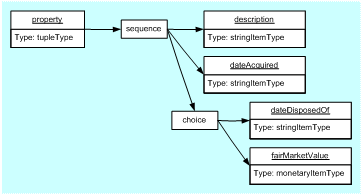
The content models for tuples can be defined using only XML Schema. Content models for tuples are not defined or modified by any of the XBRL linkbases.
4.10 Equality predicates relevant to detecting duplicate items and tuples
There are several different senses of “equal” that are relevant to detection of duplicates in XBRL instances: Identical, Structure equal (s-equal), Parent equal (p-equal), Value equal (v-equal), [XPATH]-equal (x-equal), Context equal (c-equal) and Unit equal (u-equal). These different equality predicates are polymorphic and formally defined in a recursive fashion. They are all symmetric predicates, i.e. the result of X (predicate) Y = the result of Y (predicate) X.
Table 4. Equality predicate definitions.
|
Argument Types |
Predicates |
Definition |
|
node |
identical |
Exactly the same XML node. |
|
sequence |
s‑equal, v‑equal, c‑equal, u‑equal |
Every node in one sequence is {s-equal, v‑equal, c‑equal, u‑equal} to the node in the same position in the other sequence. |
|
set |
identical, s‑equal, v‑equal, c‑equal, u‑equal |
Set X is {identical, s-equal, v-equal, c-equal, u-equal} to set Y if:
every node in set X can be paired with a node in set Y to which it is {identical, s-equal, v-equal, c-equal, u-equal} and the two sets have the same number of members. |
|
any XML object |
x-equal |
An XML object A is x-equal to an XML object B if the [XPATH] expression A = B returns the value true (see http://www.w3.org/TR/xpath.html#booleans) |
|
text |
s‑equal |
The two text strings are x-equal |
|
attribute |
s‑equal |
The two attributes have local names and namespaces that are s-equal and have values that are x-equal |
|
Element (except those handled separately in this list) |
s‑equal |
Not identical, and their element local names and namespaces are both s‑equal, and the set of their attributes are s‑equal, and the sequence of text and sub-element contents are s‑equal. |
|
entity |
s‑equal |
identifier elements are s‑equal, and segment elements are s‑equal (with any missing segment treated as s‑equal to an empty segment element). |
|
startDate |
s-equal |
The implied date/time is equal, according to the rules set out in Section 4.7.2 |
|
endDate |
s-equal |
The implied date/time is equal, according to the rules set out in Section 4.7.2 |
|
instant |
s-equal |
The implied date/time is equal, according to the rules set out in Section 4.7.2 |
|
period |
s‑equal |
One of the following conditions applies: 1. both elements have a child forever element, or 2. their child instant elements are s‑equal, or 3. their child startDate elements are s‑equal and their child endDate elements are s‑equal |
|
unit |
s-equal |
The child divide or set of measure elements are s-equal. |
|
divide |
s-equal |
The unitNumerator and unitDenominator elements are both s-equal |
|
unitNumerator |
s-equal |
The sets of child measure elements are s-equal |
|
unitDenominator |
s-equal |
The sets of child measure elements are s-equal |
|
measure |
s-equal |
The namespace prefix in the content of the two measure elements resolves to the same namespace and the local names in the content of the two measure elements are s-equal. |
|
context |
s‑equal |
period elements are s-equal, and entity elements are s-equal, and scenario elements are s‑equal. |
|
item |
s‑equal |
they are c-equal, and they are u-equal, and precision attributes are s‑equal, and decimals attributes are s‑equal, and the text of their contents is s‑equal after converting any values of numeric items to a decimal representation. |
|
tuple |
s‑equal |
The sets of (item and tuple) children are s‑equal. |
|
usedOn |
s-equal |
The namespace prefix in the content of the two usedOn elements resolves to the same namespace and the local names in the content of the two usedOn elements are s-equal. |
|
item |
p‑equal |
Nodes are children of the identical parent. |
|
tuple |
p‑equal |
Nodes are children of the identical parent. |
|
item |
c‑equal |
their contextRef attributes identify contexts that are identical or s‑equal |
|
Any pair of numeric items |
u-equal |
numeric items X and Y are u-equal if and only if all the following conditions apply: i. the set of descendant unitNumerator elements of UX is s-equal to the set of descendant unitNumerator elements of UY, and ii. the set of descendant unitDenominator elements of UX is s-equal to the set of descendant unitDenominator elements of UY, and iii. the set of child measure elements of of UX is s-equal to the set of child measure elements of UY, where UX is the unit element referenced by the unitRef attribute of X and UY is the unit element referenced by the unitRef attribute of Y
NOTE: if UX is identical to UY then the above tests will always return the result true
|
|
Any pair of non-numeric items |
u-equal |
true |
|
One numeric item and one non-numeric item |
u-equal |
false |
|
numeric items not of type fractionItemType or a type derived from fractionItemType by restriction |
v‑equal |
A and B are v-equal if and only if all the following conditions apply: i. A and B are c-equal and u-equal ii. the numeric values AN and BN are x-equal where AN is obtained by rounding the content of A to N significant figures and BN is obtained by rounding the content of B to N significant figures where N is the lower of: a. the specified or inferred precision for A and b. the specified or inferred precision for B
|
|
numeric items of type fractionItemType or a type derived from fractionItemType by restriction |
v‑equal |
A and B are v-equal if and only if all the following conditions apply: i. A and B are c-equal and u-equal ii. AN is x-equal to BN and AD is x-equal to BD where: a. AN is the numerator and AD is the denominator of the normal form (defined below) of A and b. BN is the numerator and BD is the denominator of the normal form of B.
For any item F of type fractionItemType or a type derived from fractionItemType by restriction, the normal form has numerator FN and denominator FD such that FN and FD are integers and have no integer common factor and there exists a number H such that multiplying FN by H gives the numerator of F and multiplying FD by H gives the denominator of F.
|
|
numeric items, one of which is of type fractionItemType or a type derived from fractionItemType by restriction and the other of which is not |
v‑equal |
v-equal is always false for such combinations of numeric items |
|
non-numeric item |
v‑equal |
A and B are v-equal if and only if all the following conditions apply i. A and B are c-equal ii. [XPATH] normalize-space(AC) = normalize-space(BC) where AC is the content of A and BC is the content of B.
|
|
duplicate |
Item X and item Y are duplicates if and only if all the following conditions apply:
i. X is not identical to Y, and ii. the element local name of X is s-equal to the element local name of Y, and iii. X and Y are defined in the same namespace, and iv. X is p-equal to Y, and v. X is c-equal to Y , and vi. X is u-equal to Y.
|
|
|
duplicate |
Tuple X and tuple Y are duplicates if and only if all the following conditions apply:
i. X is not identical to Y, and ii. the element local name of X is s-equal to the element local name of Y, and iii. X and Y are defined in the same namespace and iv. X is p-equal to Y, and v. every node A in the set of child tuples of X can be paired with one node B in the set of child tuples of Y such that A and B satisfy all the requirements for being duplicate tuples except for being p-equal, and vi. X has the same number of child tuples as Y, and vii. every node A in the set of child items of X can be paired with one node B in the set of child items of Y such that A is v-equal to B, and A and B satisfy all the requirements for being duplicate items except for being p-equal, and viii. X has the same number of child items as Y
|
The following extended example illustrates positive and negative examples of each of the above predicates
Example 25. Duplicate items, tuples and contexts
|
element |
An XBRL instance containing two contexts that are s-equal and doubly nested tuples. Several of the elements are named in the left column. |
|
a analysis b customer b name b gross b returns
c customer c name c gross
d customer
d returns
e customer f name g name
h totalGross
np3
u3 Xnnp3X |
<xbrl xmlns="http://www.xbrl.org/2003/instance" xmlns:s="http://mycompany.com/xbrl/taxonomy" xmlns:xbrli="http://www.xbrl.org/2003/instance" xmlns:xsi="http://www.w3.org/2001/XMLSchema-instance">
<s:analysis> <s:customer> <s:name contextRef="np3">Acme</s:name> <s:gross unitRef="u3" contextRef="np3" precision="4">3001</s:gross>
<s:returns unitRef="u3" contextRef="np3" <s:net unitRef="u3" contextRef="np3" precision="4">2900</s:net> </s:customer> <s:customer> <s:name contextRef="Xnnp3X">Acme</s:name> <s:gross unitRef="u3" contextRef="np3" precision="3">3000</s:gross> <s:returns
unitRef="u3" contextRef="np3" <s:net unitRef="u3" contextRef="np3" precision="4">2900</s:net> </s:customer> <s:customer> <s:name contextRef="np3">Acme</s:name> <s:gross unitRef="u3" contextRef="np3" precision="4">3000</s:gross> <s:returns unitRef="u3" contextRef="np3" precision="3">500</s:returns> <s:net unitRef="u3" contextRef="np3" precision="4">2500</s:net> </s:customer> <s:customer> <s:name contextRef="np3">Bree</s:name> <s:name contextRef="Xnnp3X">Bree</s:name> <s:gross unitRef="u3" contextRef="np3" precision="4">3000</s:gross>
<s:returns unitRef="u3" contextRef="np3" <s:net unitRef="u3" contextRef="np3" precision="4">2800</s:net> </s:customer> <s:totalGross
unitRef="u3" contextRef="np3" </s:analysis>
<!-- One Redundant Context Xnnp3X = period,2003 --> <context id="np3"> <entity> <identifier scheme="http://www.nasdaq.com">SAMP</identifier> </entity> <period> <startDate>2003-01-01</startDate> <endDate>2003-12-31</endDate> </period> </context> <unit id="u3"><measure>ISO4217:USD</measure></unit> <context id="Xnnp3X"> <entity> <identifier scheme="http://www.nasdaq.com">SAMP</identifier> </entity> <period> <startDate>2003-01-01</startDate> <endDate>2003-12-31</endDate> </period> </context> </xbrl> |
|
Note that, notwithstanding the lack of a calculation linkbase in this example, the total of 12000 in “h totalGross” is the most precise value that can be derived from sum of the values of gross for the 4 customers (3001+3000+3000+3000=12001 but the most precise value can be correct to only 3 significant figures because c gross has precision="3" and is hence 12000) |
|
Example 26. Predicates for detecting duplicates
|
Node 1 |
Node 2 |
Type |
Predicate |
True |
Reason |
|
np3 |
Xnnp3X |
context |
Identical |
no |
different nodes |
|
np3 |
Xnnp3X |
context |
s‑equal |
yes |
entity and period are s-equal |
|
|
|
|
|
|
|
|
f name |
g name |
item |
s‑equal |
yes |
different context ids np3 and Xnnp3X which are nevertheless s-equal |
|
f name |
g name |
item |
p-equal |
yes |
same parent element |
|
f name |
g name |
item |
c-equal |
yes |
equal contexts np3 and Xnnp3X |
|
f name |
g name |
item |
v-equal |
yes |
equal content “Bree” |
|
f name |
g name |
item |
duplicates |
yes |
p‑equal and c‑equal |
|
|
|
|
|
|
|
|
b name |
c name |
item |
s‑equal |
yes |
different context ids np3 and Xnnp3X which are nevertheless s-equal |
|
b name |
c name |
item |
p-equal |
no |
they are in different customer tuples |
|
b name |
c name |
item |
c-equal |
yes |
equal contexts np3 and Xnnp3X |
|
b name |
c name |
item |
v-equal |
yes |
they both have content “Acme” |
|
b name |
c name |
item |
duplicates |
no |
not p-equal, so v‑equal doesn’t matter |
|
|
|
|
|
|
|
|
b gross |
c gross |
item |
s‑equal |
no |
|
|
b gross |
c gross |
item |
p-equal |
no |
different parents |
|
b gross |
c gross |
item |
c-equal |
yes |
they both have context np3 and unit u3 |
|
b gross |
c gross |
item |
v-equal |
yes |
“3001” with precision 3 equals “3000” |
|
b gross |
c gross |
item |
duplicates |
no |
not p-equal, so v‑equal doesn’t matter |
|
|
|
|
|
|
|
|
b customer |
c customer |
tuple |
s‑equal |
no |
different context ids np3 and Xnnp3X |
|
b customer |
c customer |
tuple |
p-equal |
yes |
same parent “a analysis” |
|
b customer |
c customer |
tuple |
c-equal |
n/a |
c‑equal doesn’t apply to tuples |
|
b customer |
c customer |
tuple |
v-equal |
n/a |
v‑equal doesn’t apply to tuples |
|
b customer |
c customer |
tuple |
duplicates |
yes |
p‑equal, and child items name, gross, returns and net are all v‑equal |
|
|
|
|
|
|
|
|
b returns |
d returns |
item |
s‑equal |
no |
different values |
|
b returns |
d returns |
item |
p-equal |
no |
parents are b customer and d customer |
|
b returns |
d returns |
item |
c-equal |
yes |
both have context np3 and unit u3 |
|
b returns |
d returns |
item |
v-equal |
no |
b value is 100, d value is 500 |
|
b returns |
d returns |
item |
duplicates |
no |
not p‑equal, so v‑equal doesn’t matter |
|
|
|
|
|
|
|
|
b customer |
d customer |
tuple |
s‑equal |
no |
different values of returns and net |
|
b customer |
d customer |
tuple |
p-equal |
yes |
same parent “a analysis” |
|
b customer |
d customer |
tuple |
c-equal |
n/a |
c‑equal doesn’t apply to tuples |
|
b customer |
d customer |
tuple |
v-equal |
n/a |
v‑equal doesn’t apply to tuples |
|
b customer |
d customer |
tuple |
duplicates |
no |
p-equal, and child items b name and b gross are v‑equal to d name and d gross, and child items b returns and b net are not v‑equal to b returns and b net. |
The equality predicates in the definition of duplicate items are ones of equal location, not equal content. In addition, it should be noted that attributes other than contextRef, unitRef, precision and decimals MUST be ignored for the purposes of this comparison (a consequence of the definition of s-equality for items). For example, additional id attributes do not distinguish otherwise equal items. Whether items appear within a tuple or not also impacts on whether they are duplicates, because the definition of duplicate items also carries the proviso that they have the same parent (i.e. are p-equal).
When determining whether two numeric items are v-equal (a predicate that is used in the definition of various other equality type predicates) it is necessary to take into consideration the values of precision for the two numeric items. If precision has not been specified for either of the two numeric items it is necessary to infer a value for it according to the rules in Section 4.6.6.
The XBRL definition of duplicate items and tuples encompasses many, but not all, inconsistent and redundant data items in an XBRL instance. Tuples that are not duplicates according to the XBRL definition might still have semantic inconsistencies. In the example above, customer elements “c” and “d” appear to contain data about the same customer, in the same context, but have inconsistent data; XBRL does not detect these as duplicate tuples even though to a human reader an element such as name indicates a “unique key” that is sufficient to determine that these two tuples are, in effect, c-equal (same context, different content).
4.11 Footnotes
While tuples deal with certain regularly-structured associations between elements that might appear in an XBRL instance, many documents include irregularly structured associations between facts. For instance, several facts may all be linked to the sentence “Including the effects of the merger with Example.com.” To express these irregular linkages, XBRL uses the footnoteLink element to describe these irregularly structured associations between facts in an XBRL instance.
4.11.1 The footnoteLink element
The footnoteLink element is an extended link. Its generic syntax is documented in Section 3.5.3. It contains locators, resources and arcs that describe irregular relationships between facts in an XBRL instance.
The XML Schema constraints on the footnoteLink element are shown below.
|
<schema targetNamespace="http://www.xbrl.org/2003/linkbase" xmlns="http://www.w3.org/2001/XMLSchema" xmlns:link="http://www.xbrl.org/2003/linkbase" xmlns:xl="http://www.xbrl.org/2003/XLink" xmlns:xlink="http://www.w3.org/1999/xlink" elementFormDefault="qualified">
<element name="footnoteLink" substitutionGroup="xl:extended"> <annotation> <documentation> footnote extended link element definition </documentation> </annotation> <complexType> <complexContent> <restriction base="xl:extendedType"> <choice minOccurs="0" maxOccurs="unbounded"> <element ref="xl:title"/> <element ref="link:documentation"/> <element ref="link:loc"/> <element ref="link:footnoteArc"/> <element ref="link:footnote"/> </choice> <anyAttribute namespace="http://www.w3.org/XML/1998/namespace" processContents="lax" /> </restriction> </complexContent> </complexType> </element>
</schema> |
Example 27. A footnote in an XBRL instance
|
<?xml version="1.0"?> <xbrl xmlns="http://www.xbrl.org/2003/instance" xmlns:xsi="http://www.w3.org/2001/XMLSchema-instance" xmlns:fr="http://www.xbrl-fr.org/xbrl/2003-02-29" xmlns:link="http://www.xbrl.org/2003/linkbase" xmlns:xlink="http://www.w3.org/1999/xlink" xmlns:ISO4217="http://www.xbrl.org2003/2003/iso4217" xsi:schemaLocation="http://www.xbrl-fr.org/xbrl/2003-02-29 fr.xsd">
<fr:propertyPlantEquipmentGross precision="4" unitRef="u1" contextRef="c1">1200</fr:propertyPlantEquipmentGross> <fr:assetsTotal id="f1" precision="4" unitRef="u1" contextRef="c1">2600</fr:assetsTotal> <fr:equityTotal id="f3" precision="4" unitRef="u1" contextRef="c1">1100</fr:equityTotal> <fr:liabilitiesTotal id="f2" precision="4" unitRef="u1" contextRef="c1">2600</fr:liabilitiesTotal>
<link:footnoteLink xlink:type="extended" xlink:title="1" <link:footnote xlink:type="resource" xlink:label="footnote1" xlink:role="http://www.xbrl.org/2003/role/footnote" xml:lang="en">Including the effects of the merger.</link:footnote> <link:footnote xlink:type="resource" xlink:label="footnote1" xlink:role="http://www.xbrl.org/2003/role/footnote" xml:lang="fr">Y compris les effets de la fusion.</link:footnote> <link:loc xlink:type="locator" xlink:label="fact1" xlink:href="#f1"/> <link:loc xlink:type="locator" xlink:label="fact1" xlink:href="#f2"/> <link:loc xlink:type="locator" xlink:label="fact1" xlink:href="#f3"/> <link:footnoteArc xlink:type="arc" xlink:from="fact1" xlink:to="footnote1" xlink:title="view explanatory footnote" xlink:arcrole="http://www.xbrl.org/2003/arcrole/fact-footnote"/> </link:footnoteLink> <context id="c1"> <entity> <identifier scheme="http://www.un.org/">Example plc</identifier> </entity> <period> <instant>2001-08-16</instant> </period> <scenario name="Actual values"> <fr:scenarioType>actual</fr:scenarioType> </scenario> </context> <unit id="u1"><measure>ISO4217:EUR</measure></unit> </xbrl> |
|
Meaning: The one footnoteArc connects three facts to two footnotes. The two footnotes are in different languages. The xlink:title attribute has been used on the footnoteArc element to document the nature of the resource being made accessible from the facts. |
4.11.1.1 Locators in footnoteLink elements
footnoteLink elements MUST NOT contain locators that are not loc elements. loc elements are documented in detail in Section 3.5.3.7. The loc element, when used in a footnoteLink, MUST only point to items or tuples in the same XBRL instance that contains the loc element itself.
4.11.1.2 The footnote element
The footnote element is the only resource allowed in footnoteLink elements. Generic resources are documented in detail in Section 3.5.3.8. The content of footnote resources is restricted relative to generic resources. Specifically, footnote resources MAY have mixed content containing a simple string, or a fragment of XHTML or a mixture of both.
One standard role is defined for footnote elements. Its value is:
http://www.xbrl.org/2003/role/footnote
The XML Schema constraints on the footnote element are shown below.
|
<schema targetNamespace="http://www.xbrl.org/2003/linkbase" xmlns="http://www.w3.org/2001/XMLSchema" xmlns:link="http://www.xbrl.org/2003/linkbase" xmlns:xl="http://www.xbrl.org/2003/XLink" xmlns:xlink="http://www.w3.org/1999/xlink" elementFormDefault="qualified">
<element name="footnote" substitutionGroup="xl:resource"> <annotation> <documentation> Definition of the reference resource element </documentation> </annotation> <complexType mixed="true"> <complexContent mixed="true"> <extension base="xl:resourceType"> <sequence> <any namespace="http://www.w3.org/1999/xhtml" processContents="skip" minOccurs="0" maxOccurs="unbounded"/> </sequence> <anyAttribute namespace="http://www.w3.org/XML/1998/namespace" processContents="lax" /> </extension> </complexContent> </complexType> </element> </schema> |
4.11.1.2.1 The xml:lang attribute on footnote elements
All footnote resources MUST have an xml:lang attribute identifying the language used for the content of the footnote. The value of the xml:lang attribute MUST conform to [XML] rules. (See http://www.w3.org/TR/2000/REC-xml-20001006#sec-lang-tag for details).
4.11.1.3 The footnoteArc element
The footnoteArc element has the same syntax as generic extended link arcs. See Section 3.5.3.9 for details.
The XML Schema constraints on the footnoteArc element are shown below.
|
<schema targetNamespace="http://www.xbrl.org/2003/linkbase" xmlns="http://www.w3.org/2001/XMLSchema" xmlns:link="http://www.xbrl.org/2003/linkbase" xmlns:xl="http://www.xbrl.org/2003/XLink" xmlns:xlink="http://www.w3.org/1999/xlink" elementFormDefault="qualified">
<element name="footnoteArc" type="xl:arcType" substitutionGroup="xl:arc"> <annotation> <documentation> Concrete arc for use in footnote extended links. </documentation> </annotation> </element>
</schema> |
4.11.1.3.1 xlink:arcrole attributes on footnoteArc elements
The value of the xlink:arcrole attribute MUST be a URI that indicates the meaning of the arc.
One standard arc role value has been defined for arc role values on footnoteArc elements. Its value is:
http://www.xbrl.org/2003/arcrole/fact-footnote
This arc role value is for use on a footnoteArc from item or tuple locators to footnote resources and it indicates that the footnote conveys human-readable information about the fact or facts.
4.11.1.3.2 xlink:title attribute on footnoteArc elements (optional)
The xlink:title attribute MAY be used to convey information about the relationship between facts and related footnotes to users navigating between those facts and footnotes. The content of the xlink:title attribute MUST be a string. The xlink:title attribute content MAY be made visible to users of [XLINK]-enabled applications.
If the xlink:title attribute is insufficient for this purpose (for example, if the information needs to be provided in several languages), then titles, as defined in Section 3.5.3.9.6, MAY be used.
5 XBRL Taxonomies
Section 3.1 provides an overview of XBRL taxonomies.
A taxonomy is defined as an XML Schema [SCHEMA‑1] and the set of directly referenced extended links (via the linkbaseRef element; see Section 5.1.2) and any extended links that are nested within the XML Schema. The XML Schemas in taxonomies are referred to, in this specification, as “taxonomy schemas”.
5.1 Taxonomy schemas
A taxonomy MUST include a taxonomy schema. A taxonomy schema MUST be a valid instance of an XML Schema.
If extended links are included in a taxonomy, the taxonomy schema MUST contain linkbaseRef elements that point to their linkbases (See Section 5.1.2) or the extended links MUST be nested in linkbases contained in the taxonomy schema itself.
The XBRL instance schema defines the abstract elements item and tuple. As a consequence of this and of [SCHEMA‑1] (in particular http://www.w3.org/TR/xmlschema-1/#src-resolve) it is necessary for taxonomy schemas to import the XBRL instance schema xbrl-instance-2003-12-31.xsd if they define concepts (elements in the item or tuple substitution groups). However, taxonomy schemas do not need to import the XBRL instance schema (for example, if their only purpose is to define syntax for segments and scenarios in contexts).
Taxonomy schemas SHOULD specify a target namespace. If a target namespace attribute is so specified, its value MUST NOT be empty
It will be necessary to include namespace declarations for several other schemas when creating taxonomy schemas, such as the namespace for XML Schema itself.
Example 28. A skeletal taxonomy schema showing linkbase references
|
<schema targetNamespace="http://www.mycompany.com/taxonomy/2003-10-19" xmlns="http://www.w3.org/2001/XMLSchema" xmlns:xhtml="http://www.w3.org/1999/xhtml" xmlns:xbrli="http://www.xbrl.org/2003/instance" xmlns:link="http://www.xbrl.org/2003/linkbase" xmlns:ci="http://www.mycompany.com/taxonomy/2003-10-19" xmlns:xlink="http://www.w3.org/1999/xlink"> <annotation> <appinfo> <link:linkbaseRef xlink:type="simple" xlink:href="linkbase_presentation.xml" xlink:role="http://www.xbrl.org/2003/role/presentationLinkbaseRef" xlink:arcrole="http://www.w3.org/1999/xlink/properties/linkbase"/> <link:linkbaseRef xlink:type="simple" xlink:href="linkbase_calculation.xml" xlink:role="http://www.xbrl.org/2003/role/calculationLinkbaseRef" xlink:arcrole="http://www.w3.org/1999/xlink/properties/linkbase"/> <link:linkbaseRef xlink:type="simple" xlink:href="linkbase_definition.xml" xlink:role="http://www.xbrl.org/2003/role/definitionLinkbaseRef" xlink:arcrole="http://www.w3.org/1999/xlink/properties/linkbase"/> <link:linkbaseRef xlink:type="simple" xlink:href="linkbase_label.xml" xlink:role="http://www.xbrl.org/2003/role/labelLinkbaseRef" xlink:arcrole="http://www.w3.org/1999/xlink/properties/linkbase"/> <link:linkbaseRef xlink:type="simple" xlink:href="linkbase_reference.xml" xlink:role="http://www.xbrl.org/2003/role/referenceLinkbaseRef" xlink:arcrole="http://www.w3.org/1999/xlink/properties/linkbase"/> </appinfo> </annotation> <import namespace="http://www.xbrl.org/2003/instance" schemaLocation="xbrl-instance.xsd"/> </schema> |
XBRL taxonomies MAY be constructed to refer to other taxonomies; this extensibility of taxonomies is a critical feature of XBRL. In order to realise the complete potential of the technology, taxonomies must be extensible to accommodate virtually any business entity’s unique reporting requirements while maintaining significant comparability across entities.
XBRL taxonomy schemas MAY import other taxonomy schemas and reference additional XBRL linkbases as appropriate to achieve this extensibility.
Taxonomy schemas MAY also define custom role values and custom arc role values for use in linkbases. See Section 5.1.2 and 5.1.4 for details.
5.1.1 Concept definitions
Concepts are defined in taxonomy schemas. Each concept defined in a taxonomy schema is uniquely identified by an element’s syntax definition in the taxonomy schema. To correspond to a concept definition, an XML Schema element definition has to specify the element’s name, a substitution group, and type. All element names MUST be unique within a given taxonomy schema. The element MUST be a member of the substitution group that has either the XBRL item element or the XBRL tuple element as its head. The element MAY also include any of the other XML Schema attributes that can be used on an element’s syntax definition, including abstract and nillable.
An element defining the syntax for a concept SHOULD also have an id attribute. Providing an id attribute simplifies the content of the xlink:href attribute on linkbase loc elements (See Section 3.5.1.2). Note that some XML Schema validators require uniqueness of all id attribute values in a taxonomy schema and in all XML schemas that it imports or includes, directly or indirectly. To increase robustness to such interpretations of the XML Schema specification [SCHEMA-2], care SHOULD be taken to limit the extent to which id attributes values are likely to clash with id attribute values in related schemas. In the example below, this has been done by prefixing the element name with an additional string, “ci_”.
Example 29. Typical element definitions in a taxonomy schema
|
<schema xmlns="http://www.w3.org/2001/XMLSchema" xmlns:xbrli="http://www.xbrl.org/2003/instance"> <element id="ci_preferredDividends" name="preferredDividends" xbrli:periodType="duration" type="xbrli:monetaryItemType" substitutionGroup="xbrli:item" nillable="true"/> <element id="ci_stockBasedCompensationPolicy" name="stockBasedCompensationPolicy" xbrli:periodType="duration" type="xbrli:stringItemType" substitutionGroup="xbrli:item" nillable="true"/> </schema> |
|
Meaning: Two concepts have been defined, one associated with the preferredDividends element and the other associated with the stockBasedCompensationPolicy element. Both concepts can be represented by nil-value items in XBRL instances. The preferredDividends concept is required to appear in XBRL instances as a numeric item with a duration period in its context and the stockBasedCompensationPolicy concept is to appear in XBRL instances as a non-numeric item with an instant period in its context. |
XBRL also defines two attributes, periodType and balance, that MAY be used on the element syntax definitions.
5.1.1.1 The periodType attribute
Some elements are associated with concepts that are measurable at an instant in time while others measure change over a period of time.
The XML Schema constraints on the periodType attribute are shown below.
|
<schema targetNamespace="http://www.xbrl.org/2003/instance" xmlns="http://www.w3.org/2001/XMLSchema" xmlns:xbrli="http://www.xbrl.org/2003/instance" xmlns:link="http://www.xbrl.org/2003/linkbase" elementFormDefault="qualified">
<attribute name="periodType"> <annotation> <documentation> The periodType attribute (restricting the period for XBRL items) </documentation> </annotation> <simpleType> <restriction base="token"> <enumeration value="instant" /> <enumeration value="duration" /> </restriction> </simpleType> </attribute>
</schema> |
The periodType attribute MUST be used on elements in the substitution group for the item element. A value of instant for the periodType attribute indicates that the element, when used in an XBRL instance, MUST always be associated with a context in which the period is an instant. A value of duration indicates that the element, when used in an XBRL instance, MUST always be associated with a context in which the period is a duration, expressed using the startDate and endDate elements or expressed using the forever element.
Example 30. Instant and duration concept definitions
|
<schema xmlns="http://www.w3.org/2001/XMLSchema" xmlns:xbrli="http://www.xbrl.org/2003/instance"> <element id="a1" name="changeInRetainedEarnings" xbrli:periodType="duration" type="xbrli:monetaryItemType" substitutionGroup="xbrli:item"/> <element id="a2" name="fixedAssets" xbrli:balance="debit" xbrli:periodType="instant" type="xbrli:monetaryItemType" substitutionGroup="xbrli:item"/> </schema> |
5.1.1.2 The balance attribute (optional)
An optional balance attribute MAY be added to the definition of an element if its type is monetaryItemType or derived from monetaryItemType. The balance attribute MUST NOT be used on items that do not have type equal to the monetaryItemType or to a type that is derived from monetaryItemType.
If the idea of debit/credit balance is appropriate to the element, it MAY be indicated using this attribute.
The XML Schema constraints on the balance attribute are shown below.
|
<schema targetNamespace="http://www.xbrl.org/2003/instance" xmlns="http://www.w3.org/2001/XMLSchema" xmlns:xbrli="http://www.xbrl.org/2003/instance" xmlns:link="http://www.xbrl.org/2003/linkbase" elementFormDefault="qualified">
<attribute name="balance"> <annotation> <documentation> The balance attribute (imposes calculation relationship restrictions) </documentation> </annotation> <simpleType> <restriction base="token"> <enumeration value="debit" /> <enumeration value="credit" /> </restriction> </simpleType> </attribute>
</schema> |
Example 31. Using the balance element to indicate normal debit and credit balances
|
<schema xmlns="http://www.w3.org/2001/XMLSchema" xmlns:xbrli="http://www.xbrl.org/2003/instance"> <element id="netIncome" name="netIncome" xbrli:balance="credit" xbrli:periodType="duration" type="xbrli:monetaryItemType" substitutionGroup="xbrli:item"/> <element id="fixedAssets" name="fixedAssets" xbrli:balance="debit" xbrli:periodType="instant" type="xbrli:monetaryItemType" substitutionGroup="xbrli:item"/> </schema> |
The balance attribute is important to applications that consume numbers related to accounting concepts such as asset, liability, equity, revenue and expense. The balance attribute (debit/credit) provides a definitive declaration of how values in XBRL instances are to be authored and interpreted when the debit/credit designation is provided.
Table 5. Correct signage in an XBRL instance
|
Taxonomy element |
Account balance |
Sign of XBRL instance element value |
|
balance="credit" |
Credit |
Positive or zero |
|
balance="credit" |
Debit |
Negative or zero |
|
balance="debit" |
Debit |
Positive or zero |
|
balance="debit" |
Credit |
Negative or zero |
The numeric representation of a debit or credit item will normally (that is, more often than not) be positive in an XBRL instance.
Example 32. A concept appearing with positive and negative values in an XBRL instance
|
<xbrl xmlns:my="http://my.namespace.com"> <my:netIncome precision="3" unitRef="u1" contextRef="c1">500</my:netIncome> <my:netIncome precision="3" unitRef="u1" contextRef="c2">-200</my:netIncome> </xbrl> |
|
Meaning: A profit of 500 and a loss of 200 in different contexts. |
In addition, the assignment of balance attributes constrains the legal weights in calculationArc elements.
Table 6. Constraints among the balance attribute and calculation arc weights
|
balance attribute of "from" item |
balance attribute of "to" item |
illegal values of the weight attribute on calculationArc |
|
debit |
debit |
Negative (< 0) |
|
debit |
credit |
Positive (> 0) |
|
credit |
debit |
Positive (> 0) |
|
credit |
credit |
Negative (< 0) |
5.1.1.3 Item data types
All item types MUST be one of the types listed below or derived from one of them by restriction. This set of XBRL provided base types covers the appropriate subset of XML Schema built-in types (both primitive and derived) [SCHEMA-2] as well as 4 types that have been identified as having particular relevance to the domain space addressed by XBRL (monetaryItemType, sharesItemType, pureItemType and fractionItemType) and hence explicitly defined in the XBRL namespace. All these types have simple content except for fractionItemType. Therefore, an item type in a taxonomy can never have complex content unless it is derived by restriction from fractionItemType.
The [SCHEMA‑1] mechanism that enables the explicit assertion of the type of an element in an instance document (http://www.w3.org/TR/xmlschema-1/index.html#xsi_type) MUST NOT be applied to any item or tuple in an XBRL instance. The type of items and tuples MUST be specified in the appropriate taxonomy schema instead.
|
XBRL Item Type |
Base type |
unitRef attribute |
|
decimalItemType |
decimal |
yes |
|
floatItemType |
float |
yes |
|
doubleItemType |
double |
yes |
|
The following numeric types are all based on the XML Schema built-in types that are derived by restriction from decimal. |
||
|
integerItemType |
integer |
yes |
|
nonPositiveIntegerItemType |
nonPositiveInteger |
yes |
|
negativeIntegerItemType |
negativeInteger |
yes |
|
longItemType |
long |
yes |
|
intItemType |
int |
yes |
|
shortItemType |
short |
yes |
|
byteItemType |
byte |
yes |
|
nonNegativeIntegerItemType |
nonNegativeInteger |
yes |
|
unsignedLongItemType |
unsignedLong |
yes |
|
unsignedIntItemType |
unsignedInt |
yes |
|
unsignedShortItemType |
unsignedShort |
yes |
|
unsignedByteItemType |
unsignedByte |
yes |
|
positiveIntegerItemType |
positiveInteger |
yes |
|
The following numeric types are all types that have been identified as having particular relevance to the domain space addressed by XBRL and are hence included in addition to the built-in types from XML Schema. |
||
|
monetaryItemType |
xbrli:monetary |
yes |
|
sharesItemType |
xbrli:shares |
yes |
|
pureItemType |
xbrli:pure |
yes |
|
fractionItemType |
complex type with the numerator being a decimal and the denominator being a non-zero, decimal (xbrli:nonZeroDecimal) |
yes |
|
The following non-numeric types are all based on XML Schema built-in types that are not derived from either decimal or string. |
||
|
stringItemType |
string |
no |
|
booleanItemType |
Boolean |
no |
|
hexBinaryItemType |
hexBinary |
no |
|
base64BinaryItemType |
base64Binary |
no |
|
anyURIItemType |
anyURI |
no |
|
QNameItemType |
QName |
no |
|
durationItemType |
duration |
no |
|
dateTimeItemType |
dateTime |
no |
|
timeItemType |
time |
no |
|
dateItemType |
date |
no |
|
gYearMonthItemType |
gYearMonth |
no |
|
gYearItemType |
gYear |
no |
|
gMonthDayItemType |
gMonthDay |
no |
|
gDayItemType |
gDay |
no |
|
gMonthItemType |
gMonth |
no |
|
The following non-numeric types are all based on the XML Schema built-in types that are derived by restriction (and/or list) from string. |
||
|
normalizedStringItemType |
normalizedString |
no |
|
tokenItemType |
token |
no |
|
languageItemType |
language |
no |
|
NameItemType |
Name |
no |
|
NCNameItemType |
NCName |
no |
Some of these types, especially some of those that XML Schema has defined for backward compatibility with Document Type Definitions (“DTDs”), may never be needed for any XBRL application, but all are provided by XBRL for completeness and compatibility with XML Schema.
Example 33. Deriving an enumerated item type
|
<schema targetNamespace="http://www.someCompany.com/taxonomy" xmlns:my="http://www.someCompany.com/taxonomy" xmlns:xbrli="http://www.xbrl.org/2003/instance" xmlns="http://www.w3.org/2001/XMLSchema" elementFormDefault="qualified">
<complexType name="stateProvinceItemType"> <simpleContent> <restriction base="xbrli:tokenItemType"> <enumeration value="MI"/> <enumeration value="ON"/> </restriction> </simpleContent> </complexType>
<element name="stateProvince" id="my_stateProvince" xbrli:periodType="instant" substitutionGroup="xbrli:item" type="my:stateProvinceItemType"/> </schema> |
|
Meaning: Deriving new item types by restriction from the XBRL provided item types is the only allowed method for XBRL taxonomy schemas. Earlier, in Example 18, the stateProvinceType was defined and used to define a sub-element of segment. Here, instead we define an XBRL concept appearing in the company’s own taxonomy; note that the previously defined simple type is not used. |
5.1.1.3.1 The monetary, shares and pure data types
The XBRL instance schema defines the monetary data type, which specialises the XML Schema decimal type. All numeric elements in XBRL Taxonomies that represent monetary values MUST use the monetaryItemType data type or one derived from it. The shares data type represents share-based values and the pure data type represents growth rates, percentages, and other measures where an implicit numerator and denominator are expressed in the same units. See Section 5.1.1.3 for definitions of the item types that use these special data types.
The XML Schema definitions of these data types are shown below.
|
<schema targetNamespace="http://www.xbrl.org/2003/instance" xmlns="http://www.w3.org/2001/XMLSchema" xmlns:xbrli="http://www.xbrl.org/2003/instance" xmlns:link="http://www.xbrl.org/2003/linkbase" elementFormDefault="qualified">
<annotation> <documentation> Define the simple types used as a base for for item types </documentation> </annotation>
<simpleType name="monetary"> <annotation> <documentation> the monetary type serves as the datatype for those financial concepts in a taxonomy which denote units in a currency. Instance items with this type must have a unit of measure from the ISO 4217 namespace of currencies. </documentation> </annotation> <restriction base="decimal" /> </simpleType>
<simpleType name="shares"> <annotation> <documentation> This datatype serves as the datatype for share based financial concepts. </documentation> </annotation> <restriction base="decimal" /> </simpleType>
<simpleType name="pure"> <annotation> <documentation> This datatype serves as the type for dimensionless numbers such as percentage change, growth rates, and other ratios where the numerator and denominator have the same units. </documentation> </annotation> <restriction base="decimal" /> </simpleType>
</schema> |
5.1.1.3.2 The fractionItemType data type
The values of some facts that are to be reported may be known exactly but it may not be possible to represent them exactly using any of the built-in data types provided for in XML Schema. Examples are fractional values whose decimal representation contains recurring digits such as 1/3 (whose decimal representation is 0.333333…). To enable XBRL instances to report these exact values, a complex type, fractionItemType, is provided. All values of fractionItemType are exact. The precision and decimals attributes MUST not occur on items with the fractionItemType.
The XML Schema constraints on the fractionItemType are shown below.
|
<schema targetNamespace="http://www.xbrl.org/2003/instance" xmlns="http://www.w3.org/2001/XMLSchema" xmlns:xbrli="http://www.xbrl.org/2003/instance" xmlns:link="http://www.xbrl.org/2003/linkbase" elementFormDefault="qualified">
<element name="numerator" type="decimal" /> <element name="denominator" type="xbrli:nonZeroDecimal" /> <complexType name="fractionItemType" final="extension"> <sequence> <element ref="xbrli:numerator"/> <element ref="xbrli:denominator"/> </sequence> <attribute name="contextRef" type="IDREF" use="required" /> <attribute name="unitRef" type="IDREF" use="required" /> <attribute name="id" type="ID" use="optional" /> <anyAttribute namespace="##other" processContents="lax" /> </complexType>
</schema> |
Example 34. Representing fractions
|
Fractional value |
Representation |
|
1/3 |
<myTaxonomy:oneThird id="oneThird" unitRef="u1" contextRef="numC1"> <numerator>1</numerator> <denominator>3</denominator> </myTaxonomy:oneThird> |
The numerator element MUST contain numeric values. The denominator element MUST contain a numeric value that is non-zero and finite.
5.1.2 The linkbaseRef element
The linkbaseRef element MAY occur at the XPath [XPATH] path "schema/annotation/appinfo/*" in a taxonomy schema. In a taxonomy schema, the linkbaseRef element identifies a linkbase that MUST always participate in a DTS if that taxonomy schema participates in the DTS.
The syntax of the linkbaseRef element in taxonomy schemas is identical to the syntax of the linkbaseRef element in XBRL instances. For more details, see Section 4.2.5.
5.1.3 Defining custom role types – the roleType element
The roleType element contains a custom role type definition. The roleType element describes the custom role type by defining the roleURI of the role type, declaring the elements that the role type may be used on, and providing a human-readable definition of the role type.
Role types define custom values for the xlink:role attribute on the [XLINK] extended link and resource elements. The roleType element MUST be located at the [XPATH] path “schema/annotation/appinfo”. The role values that are defined by this specification (as standard role attribute values) MUST NOT be redefined using the roleType element.
There MUST NOT be more than one roleType element with the same roleURI attribute value within a taxonomy schema. Within a DTS, there MAY be more than one roleType element with the same roleURI attribute value. However, all roleType elements with the same roleURI attribute value MUST be s-equal.
The value of any xlink:role attribute MUST be an absolute URI. For the definitionLink, calculationLink, presentationLink, labelLink, referenceLink, footnoteLink, label, reference, and footnote elements, the value of the xlink:role attribute MUST be a standard role value defined in this specification or a custom role value defined by a roleType element. The value of the roleURI attribute identifies the xlink:role attribute value that is being defined. The values of the usedOn sub-elements identify which elements are allowed to use the custom role type. Since roleType elements are pointed to via a roleRef element in linkbases that use the custom role type, the roleType element MAY have an id attribute.
Example 35. Defining a custom role type
|
Example: The role type definition of a role: "http://www.mycomp.com/role/endnote" to indicate those footnotes in an XBRL instance that ought to be presented only at the end of a document. |
|
<schema targetNamespace="http://www.mycomp.com/mytaxonomy" xmlns:link="http://www.xbrl.org/2003/linkbase" xmlns="http://www.w3.org/2001/XMLSchema" elementFormDefault="qualified"> <annotation> <appinfo> <link:roleType roleURI="http://www.mycompany.com/role/endnote" id=”endnote”> <link:definition> A footnote that should be displayed only at the end of a document </link:definition> <link:usedOn>link:footnote</link:usedOn> </link:roleType> </appinfo> </annotation> </schema> |
|
This roleType element defines a role that could be used as follows: |
|
<link:roleRef xlink:type="simple" xlink:href="mycomproles.xsd#endnote" roleURI="http://www.mycomp.com/role/endnote"/>
…
<link:footnote xlink:role="http://www.mycomp.com/role/endnote" xlink:type="resource" xlink:label="endnote1"> Excluding the effects of the merger and contingent liabilities. </link:footnote> |
|
The xlink:role value is resolved back to the roleType element by finding the roleRef element with a roleURI attribute value that matches the xlink:role value. The xlink:href attribute on the roleRef element points directly (via the fragment identifier) to the roleType element with the id attribute equal to “endnote” in the mycomproles.xsd taxonomy schema. The roleType element has a matching roleURI attribute value. |
The XML Schema constraints on the roleType element and its sub-elements are set out below.
|
<schema targetNamespace="http://www.xbrl.org/2003/linkbase" xmlns="http://www.w3.org/2001/XMLSchema" xmlns:link="http://www.xbrl.org/2003/linkbase" xmlns:xl="http://www.xbrl.org/2003/XLink" xmlns:xlink="http://www.w3.org/1999/xlink" elementFormDefault="qualified">
<element name="definition" type="string"> <annotation> <documentation> The element to use for human-readable definition of custom roles and arc roles. </documentation> </annotation> </element>
<element name="usedOn" type="QName"> <annotation> <documentation> Definitionof the usedOn element - used to identify what elements may use a taxonomy defined role or arc role value. </documentation> </annotation> </element>
<element name="roleType"> <annotation> <documentation> The roleType element definition - used to define custom role values in XBRL extended links. </documentation> </annotation> <complexType> <sequence> <element ref="link:definition" minOccurs="0"/> <element ref="link:usedOn" maxOccurs="unbounded"/> </sequence> <attribute name="roleURI" type="xlink:nonEmptyURI" use="required"/> <attribute name="id" type="ID"/> </complexType> </element>
</schema> |
5.1.3.1 The roleURI attribute
The roleURI attribute MUST occur and MUST contain the role value being defined. When the custom role type is used, the xlink:role attribute value matches the value of the roleURI.
5.1.3.2 The id attribute on roleType elements (optional)
The roleType element MAY have an id attribute. The value of the id attribute MUST conform to the [XML] rules for attributes with the ID type (http://www.w3.org/TR/REC-xml#NT-TokenizedType). Providing an id attribute simplifies the content of the xlink:href attribute on roleRef elements.
5.1.3.3 The definition element in roleType elements (optional)
The roleType element MAY contain a definition element. The content of a definition element MUST be a string giving meaning to the role type.
5.1.3.4 The usedOn element in roleType elements
The roleType element MAY contain one or more usedOn elements. The usedOn element identifies which elements MAY use the role type being defined. Elements that use the defined role type MUST be identified with a usedOn element in the roleType element. Within a roleType element there MUST NOT be s-equal usedOn elements.
5.1.4 Defining custom arc role types – the arcroleType element
The arcroleType element contains a custom arc role definition. The arcroleType element describes the custom arc role type by declaring the arc role value, declaring the elements that the arc role type may be used on, declaring the type of cycles that are allowed for a network of relationships using the arc role type, and providing a human-readable definition of the meaning of the arc role type.
The arcroleType element MUST be located at the [XPATH] path “schema/annotation/appinfo”. The arc role values defined by this specification (as standard arc role values) MUST NOT be redefined using the arcroleType element.
There MUST NOT be more than one arcroleType element with the same arcroleURI attribute value within a taxonomy schema. Within a DTS, there MAY be more than one arcroleType element with the same arcroleURI attribute value. However, all arcroleType elements with the same arcroleURI attribute value MUST be s-equal.
The value of any xlink:arcrole attribute MUST be a URI. For the definitionArc, calculationArc, presentationArc, labelArc, referenceArc and footnoteArc elements the value of the xlink:arcrole attribute MUST be either a standard arc role value defined by this specification or a custom arc role value defined by an arcroleType element.
The value of the arcroleURI identifies the xlink:arcrole attribute value that is being defined. The values of the usedOn sub-elements identify which arcs may use this arc role type. Because arcroleType elements are pointed to via an arcroleRef element in linkbases that use the custom arc role value, the arcroleType element MAY have an id attribute.
Example 36. Defining a custom arc role value
|
Example: The definition of an arc role value: "http://www.mycomp.com/arcrole/average-item" that connects items in the calculation linkbase <schema targetNamespace="http://www.mycomp.com/mytaxonomy" xmlns:link="http://www.xbrl.org/2003/linkbase" xmlns="http://www.w3.org/2001/XMLSchema" elementFormDefault="qualified"> <annotation> <appinfo> <link:arcroleType arcroleURI="http://www.mycomp.com/arcrole/average-item" id="average-item" cyclesAllowed="none"> <usedOn>link:calculationArc</usedOn> </link:arcroleType> </appinfo> </annotation> </schema> |
|
<link:arcroleRef xlink:type="simple" xlink:href="mycomparcroles.xsd#average-item" arcroleURI="http://www.mycomp.com/arcrole/average-item"/>
…
<link:calculationArc xlink:arcrole="http://www.mycomp.com/arcrole/average-item" xlink:type="arc" xlink:from="salesAverage" xlink:to="salesDetail" link:weight="1"/>
|
|
The xlink:arcrole value is resolved back to the arcroleType element by finding the arcroleRef element with an arcroleURI attribute value that matches the xlink:arcrole value. The xlink:href attribute on the arcroleRef element points directly (via the fragment identifier) to the arcroleType element with the id attribute equal to “average-item” in the mycomparcroles.xsd taxonomy schema. The arcroleType element has a matching arcroleURI attribute value. |
The XML Schema constraints on the arcroleType element and its sub-elements are set out below.
|
<schema targetNamespace="http://www.xbrl.org/2003/linkbase" xmlns="http://www.w3.org/2001/XMLSchema" xmlns:link="http://www.xbrl.org/2003/linkbase" xmlns:xl="http://www.xbrl.org/2003/XLink" xmlns:xlink="http://www.w3.org/1999/xlink" elementFormDefault="qualified">
<element name="definition" type="string"> <annotation> <documentation> The element to use for human-readable definition of custom roles and arc roles. </documentation> </annotation> </element>
<element name="usedOn" type="QName"> <annotation> <documentation> Definition of the usedOn element - used to identify what elements may use a taxonomy defined role or arc role value. </documentation> </annotation> </element>
<element name="arcroleType"> <annotation> <documentation> The arcroleType element definition - used to define custom arc role values in XBRL extended links. </documentation> </annotation> <complexType> <sequence> <element ref="link:definition" minOccurs="0"/> <element ref="link:usedOn" maxOccurs="unbounded"/> </sequence> <attribute name="arcroleURI" type="xlink:nonEmptyURI" use="required"/> <attribute name="id" type="ID"/> <attribute name="cyclesAllowed" use="required"> <simpleType> <restriction base="NMTOKEN"> <enumeration value="any"/> <enumeration value="undirected"/> <enumeration value="none"/> </restriction> </simpleType> </attribute> </complexType> </element>
</schema> |
5.1.4.1 The arcroleURI attribute
The arcroleURI attribute MUST occur and MUST contain the arc role value being defined. When the defined arc role type is used, the xlink:arcrole attribute value matches the value of the arcroleURI.
5.1.4.2 The id attribute on arcroleType elements (optional)
The arcroleType element MAY have an id attribute. The value of the id attribute MUST conform to the [XML] rules for attributes with the ID type (http://www.w3.org/TR/REC-xml#NT-TokenizedType). Providing an id attribute simplifies the content of the xlink:href attribute on arcroleRef elements.
5.1.4.3 The cyclesAllowed attribute
The arcroleType element MUST have a cyclesAllowed attribute that identifies the type of cycles that are allowed in a network of relationships as defined in Section 3.5.3.9.7.3. Fully conformant XBRL processors MUST detect and signal networks of relationships with custom arc role types that violate the cycle restrictions documented with this attribute.
The cyclesAllowed attribute MUST have one of the following values:
|
Value |
Notes |
|
any |
A network that allows any cycles does not limit the kinds of relationships that can be expressed. |
|
undirected |
A network that allows undirected cycles MAY have any number of directed paths between any two nodes in the network, but MUST NOT allow a node to have a path back to itself. A path is a non‑empty set of arcs between nodes. |
|
none |
A network that allows no cycles MUST have at most one path between any two nodes. |
5.1.4.4 The definition element on arcroleType elements (optional)
The arcroleType element MAY contain a definition element. The definition element MUST contain a string giving human-readable meaning to the arc role type.
5.1.4.5 The usedOn element on arcroleType elements
The arcroleType element MAY contain one or more usedOn elements. The usedOn element identifies which elements MAY use the arc role type being defined. Elements that use the defined arc role type MUST be identified with a usedOn element in the arcroleType element. Within an arcroleType element there MUST NOT be s-equal usedOn elements.
5.1.5 Prohibit <redefine>
The [SCHEMA‑1] <redefine> construct MUST NOT appear in any taxonomy schema. Use of <redefine> could cause ambiguity in respect of the target of links in linkbases that reference locators and so it is prohibited.
5.2 Taxonomy linkbases
The extended links in a taxonomy provide additional information about concepts by expressing relationships between concepts (inter-concept relationships) or associating concepts with documentation about their meaning. The extended links in a taxonomy are grouped into linkbases, as defined in Section 3.5.1.5. Taxonomies currently use five different types of extended link: definition, calculation, presentation, label and reference. The first three types of extended link express inter-concept relationships, while the last two express relationships between concepts and their documentation.
An example of an inter-concept relationship is a calculation linkbase that expresses a relationship between “cash” and “current assets” where “cash” sums up to “current assets”. An example of a relationship between a concept and additional documentation is a label linkbase that expresses a relationship between the concept “cash” and a human-readable label in English, such as “Cash” and additional labels for cash in other languages. Also, the label linkbase may contain additional labels for different purposes, such as a label of “Opening Cash Balance”, “Closing Cash Balance” and “Total Cash”. Although the concept is always referred to as “cash” the labels provide multiple ways of tagging the concept for display purposes.
The linkbases MAY exist in a separate document from the taxonomy schema, although they MAY alternatively be embedded in the taxonomy schema at the XPath [XPATH] path "schema/annotation/appinfo/*". When a linkbase in a taxonomy is not embedded in the taxonomy schema document, the taxonomy schema MUST contain a linkbaseRef to point to the document containing the linkbase.
There are five kinds of extended links used in XBRL taxonomies.
v. Relation links (calculation, definition, and presentation) manage the relations between taxonomy elements.
vi. Label links manage the text associated with taxonomy elements in various languages.
vii. Reference links manage the references to authoritative literature (either online or paper).
Each of these extended links MUST be held in an [XLINK] document container. The [XLINK] document container MUST be a linkbase element located either:
1. at the path "schema/annotation/appinfo/*" in the taxonomy schema; or
2. at the root element of a separate document.
In the presentation, calculation, and definition extended links in a DTS, arcs organise XBRL concepts into networks of relationships that associate each concept with other concepts. In label and reference extended links, arcs represent networks of relationships between concepts and their documentation (labels and references). See Section 3.5.3.9.7.3 for details about networks of relationships.
Each network of inter-concept relationships in a DTS MAY contain root concepts. A root concept is an XBRL concept that, for a given network of relationships, is not an XML fragment on the “to” side of any relationship in the network. It is possible for a concept to be a root concept in one network of relationships but not in another network of relationships. Note that this implies that any disconnected concept, i.e. one that is neither on the “to” side nor the “from” side of any relationship in any network, is a root concept.
The presentation, definition, and calculation extended links are not required in order to specify the formatting of a report derived from a collection of XBRL instances. However, XBRL instance consuming applications are free to use the semantic information provided in a DTS to format such reports as they deem appropriate.
Taxonomy authors may or may not find it useful to keep the networks of presentation, calculation and definition relationships in some kind of correspondence.
Inter-concept relationships and relationships between concepts and resources that document them MAY be overridden or prohibited (See Section 3.5.3.9.7 for details). As an example of prohibition, consider the situation of a third party desiring to create a new “sub-total” concept intervening between “children” concepts that already have summation-item arcs to the “total” concept (See Section 5.2.5.2 for details about summation-item arcs and calculation relationships in extended links). The creator of the sub-total concept will add arcs from the sub-total concept to the children concepts and from the total concept to the sub-total concept. There would then be two paths from the children concepts to the total concept, one using the new arcs through the sub-total concept, and the other using the original arcs direct from the summation concept. In the case of calculation links, this could result in the double counting of values. The creator of the sub-total concept SHOULD create prohibiting arcs to prevent this, effectively removing the arcs going directly from the total concept to the children concepts from the network of relationships in the calculation.
Example 37. Using relationship prohibition to insert a new sub-total into a calculation network
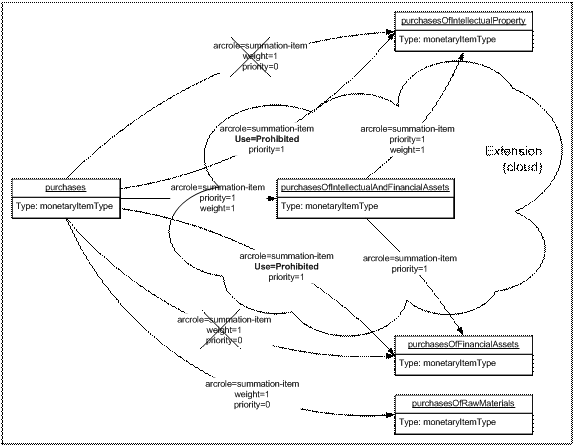
One or more relationships in a network of relationships can form a cycle (that is, there may be a path in the network from an XML fragment back to that same XML fragment without involving any one relationship more than once). Depending on the semantics of the relationships in a network, different types of cycles may be semantically coherent, or they may represent a semantic inconsistency that processing applications MAY choose to detect.
Fully conformant XBRL processors MUST detect cycles that constitute semantic inconsistencies. Semantically inconsistent cycles are identified for each network that is given semantic meaning in this specification.
Example 38. Types of cycles
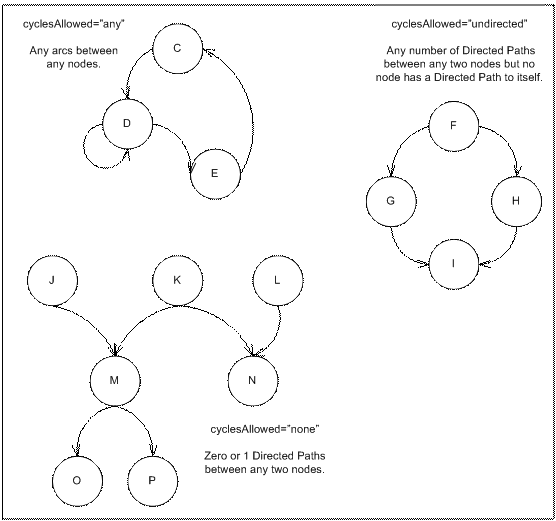
To illustrate networks of relationships between concepts, consider the following concepts that might be defined in a taxonomy (note that the label would not be part of the element; labels are just shown to provide clarity):
Example 39. Elements of a financial reporting taxonomy
|
Label |
Element Name |
Balance |
Substitution Group |
|
Income Statement |
incomeStatement |
|
|
|
… other taxonomy elements |
(various) |
(various) |
(various) |
|
Net Income Before Tax |
netIncomeBeforeTax |
credit |
item |
|
Taxes |
taxes |
debit |
item |
|
Net Income After Tax |
netIncomeAfterTax |
credit |
item |
|
Extraordinary Items |
extraordinaryItems |
debit |
item |
|
Net Income |
netIncome |
credit |
item |
|
Performance Measures |
performanceMeasures |
|
item |
Suppose that the mathematical relations that exist between the concepts expressed as elements within the taxonomy as documented by some source are as follows:
1. netIncomeAfterTax = netIncomeBeforeTax – taxes
2. netIncome = netIncomeAfterTax – extraordinaryItems
The calculation linkbase might then contain calculation extended links to facilitate computation of netIncome, netIncomeBeforeTax, netIncomeAfterTax, per the formulae above and expressed in a tree hierarchy in an application.
Example 40. Hierarchy in a calculation linkbase
|
|
Example: Calculation hierarchy in which each item contributes to a summation.
Arcs are annotated with the numeric weight in parentheses. The weight indicates the weight attribute value of the calculation link expressing how the element contributes to the calculation/summation. |
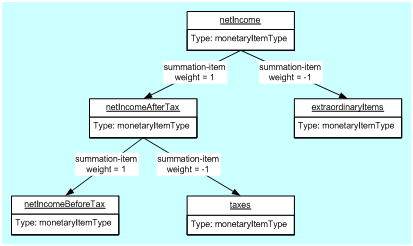
The definition linkbase might also contain definition extended links that relate concepts to other concepts. In the case below, performanceMeasures is an element defined in the taxonomy and the types of performance measures are: netIncome, netIncomeBeforeTax, and netIncomeAfterTax. The xlink:arcrole of the link, an absolute URI such as http://www.xbrl.org/2003/arcrole/general-special, explains the type of definition relationship of the relation. See Section 3.5.3.9.4 for details.
Example 41. Hierarchy of general-special arcs in a definition linkbase
|
|
Example: Definition hierarchy in which various concepts are defined to be “Performance Measures.”
Arcs are annotated with their “order” attribute used for presenting the hierarchy. |
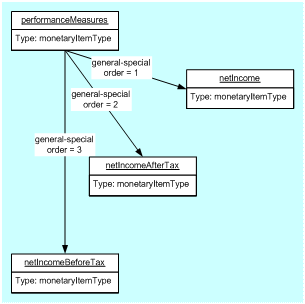
Presentation links are used to arrange taxonomy elements into a hierarchy and specific ordering. In general, different uses will require different sets of presentation links. There is one set of users – taxonomy developers and domain experts working with a taxonomy – whose presentation needs remain relevant throughout the entire lifecycle of a taxonomy. In some sense this view is “context free” as opposed to the presentation of instance data that is “context dependent.” When taxonomies are published they cannot contain all possible presentations but they MAY contain at least one “developer’s eye” view, which is “context free” in the sense that it does not need to take XBRL instance contexts into account. The presentation linkbase in this example could contain presentation links to organise concepts to look like line items in a financial statement. Another presentation linkbase could contain links to organise a subset of these same concepts into a data collection form.
Example 42. Hierarchy in a presentation linkbase
|
|
Example: Presentation hierarchy that mimics the order in which line items might appear on an income statement.
This view might be used in applications to present taxonomies to users of the application. The arcs are annotated with their “order” attribute. |
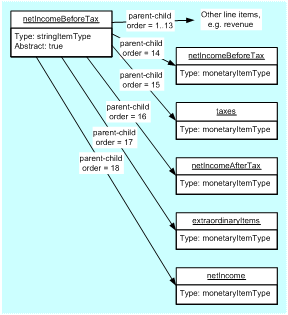
In these examples, the three linkbases are trees, but they need not be strict trees at all. This is particularly true for the calculation linkbase. There are several ways to calculate movements in Equity, for example: one might net the issuing and retirement of common stock, net the issuing and retirement of preferred stock, and add those two – or one might add up all the issuance of stock whether common or preferred, and net it against the retirement of common and preferred. Although the calculations are hierarchical (that is, there are no loops), they do not form a tree.
5.2.1 The linkbase element
The linkbase element is fully documented in Section 3.5.2.
5.2.2 The labelLink element
The labelLink element is an extended link. Its generic syntax is documented in Section 3.5.3. It is intended to contain relationships between concepts and textual documentation and labels for those concepts.
The XML Schema constraints on the labelLink element are shown below.
|
<schema targetNamespace="http://www.xbrl.org/2003/linkbase" xmlns="http://www.w3.org/2001/XMLSchema" xmlns:link="http://www.xbrl.org/2003/linkbase" xmlns:xl="http://www.xbrl.org/2003/XLink" xmlns:xlink="http://www.w3.org/1999/xlink" elementFormDefault="qualified">
<element name="labelLink" substitutionGroup="xl:extended"> <annotation> <documentation> label extended link element definition </documentation> </annotation> <complexType> <complexContent> <restriction base="xl:extendedType"> <choice minOccurs="0" maxOccurs="unbounded"> <element ref="xl:title"/> <element ref="link:documentation"/> <element ref="link:loc"/> <element ref="link:labelArc"/> <element ref="link:label"/> </choice> <anyAttribute namespace="http://www.w3.org/XML/1998/namespace" processContents="lax" /> </restriction> </complexContent> </complexType> </element>
</schema> |
5.2.2.1 Locators in labelLink elements
labelLink elements MUST NOT contain locators that are not loc elements. loc elements are documented in detail in Section 3.5.3.7. The loc element, when used in a labelLink, MUST only point to concepts in taxonomy schemas or to label resources as defined in 5.2.2.2.
5.2.2.2 The label element
Although each taxonomy defines a single set of elements representing a set of business reporting concepts, the human-readable XBRL documentation for those concepts, including labels (strings used as human-readable names for each concept) and other explanatory documentation, is contained in a resource element in the label linkbase. The resource uses the xml:lang attribute to specify the language used (via the XML standard lang attribute) and an optional classification of the purpose of the documentation (via a role attribute).
This ability to provide documentation in a variety of different languages enables XBRL concepts to be more easily reported in a multilingual environment.
Documentation of XBRL concepts MUST be contained in label elements in labelLink extended links. The label element is an [XLINK] resource. Its generic syntax is documented in Section 3.5.3.8. The label element MUST have the standard xml:lang attribute, and it MUST appear inside a labelLink element. This content of the label element is mixed, allowing a simple string, a fragment of XHTML or a combination of both.
XBRL processors are NOT REQUIRED to detect or display concept documentation that appears anywhere other than in a label element.
The XML Schema constraints on the label element are shown below.
|
<schema targetNamespace="http://www.xbrl.org/2003/linkbase" xmlns="http://www.w3.org/2001/XMLSchema" xmlns:link="http://www.xbrl.org/2003/linkbase" xmlns:xl="http://www.xbrl.org/2003/XLink" xmlns:xlink="http://www.w3.org/1999/xlink" elementFormDefault="qualified">
<element name="label" substitutionGroup="xl:resource"> <annotation> <documentation> Definition of the label resource element. </documentation> </annotation> <complexType mixed="true"> <complexContent mixed="true"> <extension base="xl:resourceType"> <sequence> <any namespace="http://www.w3.org/1999/xhtml" processContents="skip" minOccurs="0" maxOccurs="unbounded"/> </sequence> <anyAttribute namespace="http://www.w3.org/XML/1998/namespace" processContents="lax" /> </extension> </complexContent> </complexType> </element>
</schema> |
Example 43. Label resource examples
|
<label xlink:type="resource" xlink:role="http://www.xbrl.org/2003/role/label" xlink:label="ci_currentAssets_en" xml:lang="en">Current Assets</label> |
|
<label xlink:type="resource" xlink:role="http://www.xbrl.org/2003/role/label" xmlns:xhtml="http://www.w3.org/1999/xhtml" xlink:label="ci_netIncome_en" xml:lang="en"><xhtml:b>Net Income</xhtml:b> (Loss)</label> |
5.2.2.2.1 The xml:lang attribute on label elements
All label resources MUST have an xml:lang attribute identifying the language used for the content of the label. The value of the xml:lang attribute MUST conform to [XML] rules. (See http://www.w3.org/TR/2000/REC-xml-20001006#sec-lang-tag for details).
5.2.2.2.2 The xlink:role attribute on label elements (optional)
Label resources MAY contain an xlink:role attribute, which SHOULD distinguish between label resources by the nature of the XBRL concept documentation that they provide. Table 8 specifies all standard xlink:role attribute values and their meanings for label resources.
Table 8. Standard label role attribute values.
|
label resource xlink:role attribute value |
Meaning |
|
(Omitted role attribute) |
Standard label for a concept. |
|
http://www.xbrl.org/2003/role/label |
Standard label for a concept. |
|
http://www.xbrl.org/2003/role/terseLabel |
Short label for a concept, often omitting text that should be inferable when the concept is reported in the context of other related concepts. |
|
http://www.xbrl.org/2003/role/verboseLabel |
Extended label for a concept, making sure not to omit text that is required to enable the label to be understood on a stand alone basis. |
|
http://www.xbrl.org/2003/role/positiveLabel http://www.xbrl.org/2003/role/positiveTerseLabel http://www.xbrl.org/2003/role/positiveVerboseLabel
http://www.xbrl.org/2003/role/negativeLabel http://www.xbrl.org/2003/role/negativeTerseLabel http://www.xbrl.org/2003/role/negativeVerboseLabel
http://www.xbrl.org/2003/role/zeroLabel http://www.xbrl.org/2003/role/zeroTerseLabel http://www.xbrl.org/2003/role/zeroVerboseLabel
|
Label for a concept, when the value being presented is positive (negative, zero). For example, the standard and standard positive labels might be “profit after tax” and the standard negative labels “loss after tax”, the terse label and terse positive labels might both be “profit”, while the negative terse label might be “loss”. |
|
http://www.xbrl.org/2003/role/totalLabel |
The label for a concept for use in presenting values associated with the concept when it is being reported as the total of a set of other values. |
|
http://www.xbrl.org/2003/role/periodStartLabel http://www.xbrl.org/2003/role/periodEndLabel |
The label for a concept with periodType="instant" for use in presenting values associated with the concept when it is being reported as a start (end) of period value. |
|
http://www.xbrl.org/2003/role/documentation |
Documentation of a concept, providing an explanation of its meaning and its appropriate usage and any other documentation deemed necessary. |
|
http://www.xbrl.org/2003/role/definitionGuidance |
A precise definition of a concept, providing an explanation of its meaning and its appropriate usage. |
|
http://www.xbrl.org/2003/role/disclosureGuidance |
An explanation of the disclosure requirements relating to the concept. Indicates whether the disclosure is · mandatory (i.e. prescribed by authoritative literature); · recommended (i.e. encouraged by authoritative literature; · common practice (i.e. not prescribed by authoritative literature, but disclosure is common); · structural completeness (i.e., included to complete the structure of the taxonomy). |
|
http://www.xbrl.org/2003/role/presentationGuidance |
An explanation of the rules guiding presentation (placement and/or labelling) of this concept in the context of other concepts in one or more specific types of business reports. For example, “Net Surplus should be disclosed on the face of the Profit and Loss statement”. |
|
http://www.xbrl.org/2003/role/measurementGuidance |
An explanation of the method(s) required to be used when measuring values associated with this concept in business reports. |
|
http://www.xbrl.org/2003/role/commentaryGuidance |
Any other general commentary on the concept that assists in determining definition, disclosure, measurement, presentation or usage. |
|
http://www.xbrl.org/2003/role/exampleGuidance |
An example of the type of information intended to be captured by the concept. |
Example 44. Arc between a concept and one of its labels
|
<label xlink:type="resource" xlink:label="A" xlink:role="http://www.xbrl.org/2003/role/label" xml:lang="en">Current Assets</label> <loc xlink:type="locator" xlink:href="us_bs_v2.xsd#currentAssets" xlink:label="B"/> <labelArc xlink:type="arc" xlink:from="B" xlink:to="A" xlink:arcrole="http://www.xbrl.org/2003/arcrole/concept-label"/> |
|
Meaning: The label resource contains the text of the label and the arc element associates the concept with the label. |
5.2.2.3 The labelArc element
The labelArc element is an [XLINK] arc. Its generic syntax is defined in Section 3.5.3.9. In labelLink elements, it connects concepts with label resources.
The XML Schema constraints on the labelArc element are shown below.
|
<schema targetNamespace="http://www.xbrl.org/2003/linkbase" xmlns="http://www.w3.org/2001/XMLSchema" xmlns:link="http://www.xbrl.org/2003/linkbase" xmlns:xl="http://www.xbrl.org/2003/XLink" xmlns:xlink="http://www.w3.org/1999/xlink" elementFormDefault="qualified">
<element name="labelArc" type="xl:arcType" substitutionGroup="xl:arc"> <annotation> <documentation> Concrete arc for use in label extended links. </documentation> </annotation> </element>
</schema> |
One standard arc role value is defined for labelArc elements. Its value is:
http://www.xbrl.org/2003/arcrole/concept-label
This arc role value is for use on a labelArc from a concept locator (loc element) to a label element and it indicates that the label conveys human-readable information about the concept.
labelArc elements cannot describe cyclic relationships between concepts because they only relate concepts to label resources, not other concepts. For this reason, no restrictions on cyclic labelArc networks are prescribed.
The label elements that participate in a relationship described by a labelArc element MUST be [XLINK] local resources except when the use attribute on the labelArc is “prohibited”, in which case the label elements MAY be [XLINK] local resources and/or [XLINK] remote resources.
5.2.3 The referenceLink element
The referenceLink element is an extended link. Its generic syntax is documented in Section 3.5.3. It is intended to contain relationships between concepts and references to authoritative statements in the published business, financial and accounting literature that give meaning to the concepts.
The XML Schema constraints on the referenceLink element are shown below.
|
<schema targetNamespace="http://www.xbrl.org/2003/linkbase" xmlns="http://www.w3.org/2001/XMLSchema" xmlns:link="http://www.xbrl.org/2003/linkbase" xmlns:xl="http://www.xbrl.org/2003/XLink" xmlns:xlink="http://www.w3.org/1999/xlink" elementFormDefault="qualified">
<element name="referenceLink" substitutionGroup="xl:extended"> <annotation> <documentation> reference extended link element definition </documentation> </annotation> <complexType> <complexContent> <restriction base="xl:extendedType"> <choice minOccurs="0" maxOccurs="unbounded"> <element ref="xl:title"/> <element ref="link:documentation"/> <element ref="link:loc"/> <element ref="link:referenceArc"/> <element ref="link:reference"/> </choice> <anyAttribute namespace="http://www.w3.org/XML/1998/namespace" processContents="lax" /> </restriction> </complexContent> </complexType> </element>
</schema> |
Example 45. Sample values of xlink:role for several referenceLink elements
|
http://www.my.org/role/balanceSheet http://www.my.org/role/incomeStatement http://www.my.org/role/statementOfComprehensiveIncome http://www.my.org/role/statementOfStockholdersEquity http://www.my.org/role/cashFlows |
|
Meaning: The taxonomy has given a “role” to each referenceLink extended link to partition the extended links in an accounting-related taxonomy based on which part of a financial statement they relate to. |
5.2.3.1 Locators in referenceLink elements
referenceLink elements MUST NOT contain locators that are not loc elements. loc elements are documented in detail in Section 3.5.3.7. The loc element, when used in a referenceLink, MUST only point to concepts in taxonomy schemas or to reference resources as defined in 5.2.3.2.
5.2.3.2 The reference element
The reference element enables XBRL taxonomies to ground the definitions of concepts in authoritative statements in published business, financial and accounting literature. The reference element SHOULD only provide information necessary to find the reference materials that are relevant to understanding appropriate usage of the concept being defined. They MUST NOT contain the content of those reference materials themselves. Where textual documentation is required to complete the definition of an XBRL context, this MUST be contained in XBRL label elements as documented in Section 5.2.2.2.
The reference element is an [XLINK] resource. Its generic syntax is documented in Section 3.5.3.8. The reference element MUST appear inside a referenceLink element.
The XML Schema constraints on the reference element are shown below.
|
<schema targetNamespace="http://www.xbrl.org/2003/linkbase" xmlns="http://www.w3.org/2001/XMLSchema" xmlns:link="http://www.xbrl.org/2003/linkbase" xmlns:xl="http://www.xbrl.org/2003/XLink" xmlns:xlink="http://www.w3.org/1999/xlink" elementFormDefault="qualified">
<element name="part" type="string" abstract="true"> <annotation> <documentation> Definition of the reference part element - for use in reference resources. </documentation> </annotation> </element>
<element name="reference" substitutionGroup="xl:resource"> <annotation> <documentation> Definition of the reference resource element. </documentation> </annotation> <complexType mixed="true"> <complexContent mixed="true"> <extension base="xl:resourceType"> <sequence> <element ref="link:part" minOccurs="0" maxOccurs="unbounded"/> </sequence> </extension> </complexContent> </complexType> </element>
</schema> |
Reference elements are composed of parts. Since the division of references into parts varies in every jurisdiction, part is an abstract element defined in this specification. Taxonomies MAY define elements that substitute for part, allowing them to be included inside reference elements.
Example 46. Arc between a concept and supporting references
|
<linkbase xmlns="http://www.xbrl.org/2003/linkbase" xmlns:ref="http://www.xbrl.org/2003/ref" xmlns:link="http://www.xbrl.org/2003/linkbase" xmlns:xlink="http://www.w3.org/1999/xlink" xmlns:xsi="http://www.w3.org/2001/XMLSchema-instance">
<referenceLink xlink:type="extended" <!-- locator for element --> <loc xlink:type="locator" xlink:href="samp001.xsd#s_customerSales" xlink:label="s_customerSales"/> <!-- arcs --> <referenceArc xlink:type="arc" xlink:from="s_customerName" xlink:to="s_customerName_REF" xlink:arcrole="http://www.xbrl.org/2003/arcrole/concept-reference"/> <!-- references all with the same xlink:label --> <reference xlink:type="resource" xlink:label="s_salesBycustomer_REF" xlink:role="http://www.xbrl.org/2003/role/definitionRef"> <ref:name>Handbook of Business Reporting</ref:name> <ref:pages>5</ref:pages> </reference> <reference xlink:type="resource" xlink:label="s_salesBycustomer_REF" xlink:role="http://www.xbrl.org/2003/role/measurementRef"> <ref:name>Handbook of Business Reporting</ref:name> <ref:pages>45-50</ref:pages> </reference> </referenceLink> </linkbase> |
|
Meaning: The reference elements contain two literature citations, with different xlink:role attributes to distinguish them. The arc relates the concept at to both references. The elements name and pages are defined as members of the part substitution group in the taxonomy referred to by the ref: namespace prefix, as shown below: |
|
<schema targetNamespace="http://www.xbrl.org/2003/ref" xmlns:ref="http://www.xbrl.org/2003/ref" xmlns:xlink="http://www.w3.org/1999/xlink" xmlns:link="http://www.xbrl.org/2003/linkbase" xmlns="http://www.w3.org/2001/XMLSchema" elementFormDefault="qualified"> <import namespace="http://www.xbrl.org/2003/linkbase" schemaLocation="xbrl-linkbase.xsd"/> <element name="name" type="string" substitutionGroup="link:part"/> <element name="number" type="string" substitutionGroup="link:part"/> <element name="paragraph" type="string" substitutionGroup="link:part"/> <element name="subparagraph" type="string" substitutionGroup="link:part"/> <element name="clause" type="string" substitutionGroup="link:part"/> <element name="pages" type="string" substitutionGroup="link:part"/> </schema> |
Example 47. Reference resource
|
<reference xlink:type="resource" xlink:label="ci_propertyPlantAndEquipmentNet_APB"> <ci:name>ABP</ci:name> <ci:page>42</ci:page> </reference> |
5.2.3.2.1 The xlink:role attribute on reference elements (optional)
Reference elements MAY contain an optional xlink:role attribute, which MUST distinguish between reference elements by the nature of the XBRL concept documentation that they make external reference to. Table 9 specifies the standard xlink:role attribute values and their meanings for reference resources. These parallel the standard xlink:role attribute values for label resources.
Table 9. Reference role attribute values.
|
reference resource xlink:role attribute value |
Meaning |
|
(Omitted role attribute) |
Standard reference for a concept |
|
http://www.xbrl.org/2003/role/reference |
Standard reference for a concept |
|
http://www.xbrl.org/2003/role/definitionRef |
Reference to documentation that details a precise definition of the concept. |
|
http://www.xbrl.org/2003/role/disclosureRef http://www.xbrl.org/2003/role/mandatoryDisclosureRef http://www.xbrl.org/2003/role/recommendedDisclosureRef |
Reference to documentation that details an explanation of the disclosure requirements relating to the concept. Specified categories include: · mandatory · recommended |
|
http://www.xbrl.org/2003/role/unspecifiedDisclosureRef
|
Reference to documentation that details an explanation of the disclosure requirements relating to the concept. Unspecified categories include, but are not limited to: · common practice · structural completeness The latter categories do not reference documentation but are indicated in the link role to indicate why the concept has been included in the taxonomy. |
|
http://www.xbrl.org/2003/role/presentationRef |
Reference to documentation which details an explanation of the presentation, placement or labelling of this concept in the context of other concepts in one or more specific types of business reports |
|
http://www.xbrl.org/2003/role/measurementRef |
Reference concerning the method(s) required to be used when measuring values associated with this concept in business reports |
|
http://www.xbrl.org/2003/role/commentaryRef |
Any other general commentary on the concept that assists in determining appropriate usage |
|
http://www.xbrl.org/2003/role/exampleRef |
Reference to documentation that illustrates by example the application of the concept that assists in determining appropriate usage. |
5.2.3.3 The referenceArc element
The referenceArc element is an [XLINK] arc. Its generic syntax is defined in Section 3.5.3.9. In referenceLink elements, it connects concepts with reference resources.
The XML Schema constraints on the referenceArc element are shown below.
|
<schema targetNamespace="http://www.xbrl.org/2003/linkbase" xmlns="http://www.w3.org/2001/XMLSchema" xmlns:link="http://www.xbrl.org/2003/linkbase" xmlns:xl="http://www.xbrl.org/2003/XLink" xmlns:xlink="http://www.w3.org/1999/xlink" elementFormDefault="qualified">
<element name="referenceArc" type="xl:arcType" substitutionGroup="xl:arc"> <annotation> <documentation> Concrete arc for use in reference extended links. </documentation> </annotation> </element>
</schema> |
One standard arc role value is defined for referenceArc elements. Its value is:
http://www.xbrl.org/2003/arcrole/concept-reference
This arc role value is for use on a referenceArc from a concept locator (loc element) to a reference resource and it indicates that the reference is to materials documenting the meaning of the concept.
referenceArc elements cannot describe cyclic relationships between concepts because they represent relationships only between concepts and reference resources, not between concepts and other concepts. For this reason, no restrictions on cyclic referenceArc networks are prescribed.
The reference elements that participate in a relationship described by a referenceArc element MUST be [XLINK] local resources except when the use attribute on the referenceArc is “prohibited”, in which case the reference elements MAY be [XLINK] local resources and/or [XLINK] remote resources.
5.2.4 The presentationLink element
The presentationLink element is an extended link. Its generic syntax is documented in Section 3.5.3. It is intended to describe presentational relationships between concepts in taxonomies. The presentationLink element MUST NOT contain [XLINK] resources.
The XML Schema constraints on the presentationLink element are shown below.
|
<schema targetNamespace="http://www.xbrl.org/2003/linkbase" xmlns="http://www.w3.org/2001/XMLSchema" xmlns:link="http://www.xbrl.org/2003/linkbase" xmlns:xl="http://www.xbrl.org/2003/XLink" xmlns:xlink="http://www.w3.org/1999/xlink" elementFormDefault="qualified">
<element name="presentationLink" substitutionGroup="xl:extended"> <annotation> <documentation> presentation extended link element definition. </documentation> </annotation> <complexType> <complexContent> <restriction base="xl:extendedType"> <choice minOccurs="0" maxOccurs="unbounded"> <element ref="xl:title"/> <element ref="link:documentation"/> <element ref="link:loc"/> <element ref="link:presentationArc"/> </choice> <anyAttribute namespace="http://www.w3.org/XML/1998/namespace" processContents="lax" /> </restriction> </complexContent> </complexType> </element>
</schema> |
5.2.4.1 Locators in presentationLink elements
presentationLink elements MUST NOT contain locators that are not loc elements. loc elements are documented in detail in Section 3.5.3.7. The loc element, when used in a presentationLink, MUST only point to concepts in taxonomy schemas.
5.2.4.2 The presentationArc element
The presentationArc element is an [XLINK] arc. Its generic syntax is defined in Section 3.5.3.9. The presentationArc element defines how concepts relate to one another for presentation.
The XML Schema constraints on the syntax for presentationArc elements are shown below.
|
<schema targetNamespace="http://www.xbrl.org/2003/linkbase" xmlns="http://www.w3.org/2001/XMLSchema" xmlns:link="http://www.xbrl.org/2003/linkbase" xmlns:xl="http://www.xbrl.org/2003/XLink" xmlns:xlink="http://www.w3.org/1999/xlink" elementFormDefault="qualified">
<element name="presentationArc" substitutionGroup="xl:arc"> <complexType> <annotation> <documentation> Extension of the extended link arc type for presentation arcs. Adds a preferredLabel attribute that documents the role attribute value of preferred labels (as they occur in label extended links). </documentation> </annotation> <complexContent> <extension base="xl:arcType"> <attribute name="preferredLabel" use="optional"> <simpleType> <restriction base="anyURI"> <minLength value="1"/> </restriction> </simpleType> </attribute> </extension> </complexContent> </complexType> </element> </schema> |
Example 48. A presentation arc
|
<presentationArc xlink:type="arc" xlink:from="ci_currentAssets" xlink:to="ci_prepaidExpenses" xlink:arcrole="http://www.xbrl.org/2003/arcrole/parent-child" order="4"/> |
|
Meaning: Current assets must be presented as the parent of prepaid expenses. The prepaid expense element appears after any children of current assets whose order is less than 4, and appears before any children of current assets whose order is more than 4. |
A taxonomy MAY define abstract elements (Table 1) and create presentation relationships to and/or from them, to allow taxonomy presentation applications to present groups of concepts, even when those concepts are not related in any other way such as by calculation associations. Abstract elements SHOULD be in the substitution group for the abstract XBRL item element (See Section 4.6).
Example 49. An abstract concept definition
|
<element name="balanceSheet" id="ci_balanceSheet" type="xbrli:stringItemType" substitutionGroup="xbrli:item" abstract="true" xbrli:periodType="instant"/> |
|
Meaning: The balanceSheet element exists in the taxonomy only to organise other elements; it MUST NOT appear in an XBRL instance. It has the arbitrary type attribute of xbrli:stringItemType to satisfy the requirements of section 4.6 and the arbitrary periodType attribute xbrli:periodType="instant" to satisfy the requirements of section 5.1.1.1. These arbitrary attributes add no semantic information. |
One standard arc role value is defined for presentationArc elements. Its value is:
http://www.xbrl.org/2003/arcrole/parent-child
Such arcs are referred to as “parent-child” arcs. Parent-child arcs represent relationships between parent concepts and child concepts and indicate that, in a hierarchical view of XBRL information, it is appropriate to show the child concept as a child of the parent concept. Parent-child arcs MUST represent relationships only between concepts (which, by definition, are in the tuple or item substitution groups).
Because a network of parent-child arcs represents a hierarchy of concepts, it makes no sense for such a network to document that a concept is its own descendant. For this reason, directed cycles are not allowed in networks of parent-child relationships. Fully conformant XBRL processors MUST detect and signal directed cycles in networks of parent-child relationships.
5.2.4.2.1 The preferredLabel attribute (optional)
The preferredLabel attribute is a URI that MAY be supplied on a parent-child arc to indicate the most appropriate kind of label to use when presenting the arc’s child concept. If supplied, the value of the preferredLabel attribute MUST be equal to an xlink:role attribute value on a label resource (in a labelLink extended link) that is the target of a concept-label arc from the presentationArc element’s child concept.
XBRL processors MAY use the value of the preferredLabel attribute to choose between different labels that have been associated with the one concept. This can be particularly useful when a given concept is used in a variety of ways within a DTS. For example, cash can be used in the balance sheet and as the starting and ending balances in a cash flow statement. Each appearance of the concept in a set of presentation links MAY use this feature to indicate a different preferred label.
The xlink:role attribute value on the label extended link containing the preferred label and the xlink:role attribute value on the presentation extended link containing the presentationArc element do not have to be equal.
5.2.5 The calculationLink element
The calculationLink element is an extended link. Its generic syntax is documented in Section 3.5.3. It describes additive calculation relationships between concepts in taxonomies. The calculationLink element MUST NOT contain [XLINK] resources.
The XML Schema constraints on the calculationLink element are shown below.
|
<schema targetNamespace="http://www.xbrl.org/2003/linkbase" xmlns="http://www.w3.org/2001/XMLSchema" xmlns:link="http://www.xbrl.org/2003/linkbase" xmlns:xl="http://www.xbrl.org/2003/XLink" xmlns:xlink="http://www.w3.org/1999/xlink" elementFormDefault="qualified">
<element name="calculationLink" substitutionGroup="xl:extended"> <annotation> <documentation> calculation extended link element definition </documentation> </annotation> <complexType> <complexContent> <restriction base="xl:extendedType"> <choice minOccurs="0" maxOccurs="unbounded"> <element ref="xl:title"/> <element ref="link:documentation"/> <element ref="link:loc"/> <element ref="link:calculationArc"/> </choice> <anyAttribute namespace="http://www.w3.org/XML/1998/namespace" processContents="lax" /> </restriction> </complexContent> </complexType> </element>
</schema> |
5.2.5.1 Locators in calculationLink elements
calculationLink elements MUST NOT contain locators that are not loc elements. loc elements are documented in detail in Section 3.5.3.7. The loc element, when used in a calculationLink, MUST only point to concepts in taxonomy schemas.
5.2.5.2 The calculationArc element
The calculationArc element is an [XLINK] arc. Its generic syntax is defined in Section 3.5.3.9. The calculationArc element defines how concepts relate to one another for calculation purposes.
The XML Schema constraints on the syntax for calculationArc elements are shown below.
|
<schema targetNamespace="http://www.xbrl.org/2003/linkbase" xmlns="http://www.w3.org/2001/XMLSchema" xmlns:link="http://www.xbrl.org/2003/linkbase" xmlns:xl="http://www.xbrl.org/2003/XLink" xmlns:xlink="http://www.w3.org/1999/xlink" elementFormDefault="qualified">
<element name="calculationArc" substitutionGroup="xl:arc"> <complexType> <annotation> <documentation> Extension of the extended link arc type for calculation arcs. Adds a weight attribute to track weights on contributions to summations. </documentation> </annotation> <complexContent> <extension base="xl:arcType"> <attribute name="weight" type="decimal" use="required"/> </extension> </complexContent> </complexType> </element>
</schema> |
One standard arc role value is defined for calculationArc elements. Its value is:
http://www.xbrl.org/2003/arcrole/summation-item
Such arcs are referred to as “summation-item” arcs. Summation-item arcs MUST represent relationships only between concepts that are in the item substitution group and whose type is numeric (see section 5.1.1.3). They represent aggregation relationships between concepts. Each of these relationships is between one concept, referred to as the summation concept, and another concept, referred to as the contributing concept.
A complete summation-item arc set for a given summation concept is defined in the context of the DTS supporting an XBRL instance. It is the set of all summation-item arcs, defined in calculationLink extended links with the same xlink:role attribute value that associate contributing concepts to the given summation concept. A summation item is an occurrence of a summation concept in an XBRL instance.
For a given extended link role R and summation item S, another item I is a contributing item if all of the following conditions are satisfied:
1. I is an occurrence of a contributing concept for S in R.
2. I is c-equal and u-equal to S.
3. I is a descendant of the parent of S (i.e. I is a sibling of S or a descendant of one of the siblings of S).
4. I is not nil-valued (i.e. it does not have an xsi:nil attribute with value true).
A calculation binds for a summation item S if and only if:
1. S has at least one contributing item.
2. S is not a duplicate item (as defined in section 4.10), and
3. None of the contributing items are duplicates.
4. S is not nil-valued (i.e. it does not have an xsi:nil attribute with value true).
NOTE: Calculation checks work exclusively on the information that is explicitly provided in the instance; items and values that can be inferred through essence-alias relationships are not considered. Several items (all corresponding to the one concept) can bind to a summation item if they are not duplicates because they are not p-equal. This is relevant in the context of calculation scoping through tuples (See Section 5.2.5.2.2) and means that detection of duplicates is not a sufficient test for double counting problems in XBRL instances.
The total of a binding calculation is defined to be the sum of the rounded values of the contributing numeric items in the binding, each multiplied by the value of the weight attribute on the item's associated calculationArc. This multiplication takes place after any necessary rounding is performed. The rounded value of a numeric item is the result of rounding the value of the numeric item to its precision or inferred precision (see Section 4.6.6 and 4.6.7). A binding calculation is defined to be consistent if the rounded value of the summation item is equal to the total rounded to the precision or inferred precision of the summation item.
An XBRL instance is consistent with the semantics of the calculation linkbases in its supporting DTS if all binding calculations for the XBRL instance are consistent.
Fully conformant XBRL processors MUST detect and signal inconsistencies, as defined above, between an XBRL instance and the summation-item arcs of calculation linkbases in its supporting DTS.
Example 50. Calculations involving decimals and precision
|
Suppose that the numeric item a is a summation for numeric items b and c (with weight 1.0) and there exists a context with id 'c1' and unit with id 'u1' in the instance so that the summation binds. To perform the calculation, first round 984.8 to precision 3 to give 985 and then round 582.334973 to the inferred precision 4 to give 582.3 resulting in a total of 1567.3. The total is then equal to the summation item after rounding to precision 2 (the precision of the summation item a) at 1600, so that this calculation is consistent. |
|
<a contextRef="c1" unitRef="u1" precision="2">1559</a> <b contextRef="c1" unitRef="u1" precision="3">984.8</b> <c contextRef="c1" unitRef="u1" decimals="1">582.334973</c> |
|
This calculation is not consistent since the total at precision 2 is, again, 1600 but the summation item to precision 2 has value 1500. |
|
<a contextRef="c1" unitRef="u1" precision="2">1527</a> <b contextRef="c1" unitRef="u1" precision="3">984.8</b> <c contextRef="c1" unitRef="u1" decimals="1">582.334973</c> |
Example 51. Syntax of a calculationArc
|
<calculationArc xlink:type="arc" xlink:arcrole="http://www.xbrl.org/2003/arcrole/summation-item" xlink:from="currentAssets" xlink:to="prepaidExpenses" weight="1.0" order="1"/> |
A DTS might include a single concept viewed from different perspectives or as having several different dimensions. In the example below, the cash concept can be broken down by branch location, by account type, and by availability.
Example 52. Cash, equivalent to cash as totalled by branch location and account type
|
Cash n Cash by Branch Location n Cash in Domestic Branches n Cash in Foreign Branches n Cash by Account Type n Cash in Interest Bearing Accounts n Cash in Non-interest Bearing Accounts n Cash by Availability n Cash on Hand n Cash as Balances Due |
Cash in domestic branches and cash in foreign branches adds to cash. Cash in interest bearing accounts and cash in non-interest bearing accounts also adds to cash. Cash on hand and cash as balances due also adds to cash. To ensure that the calculation relationships between all of these disaggregate cash concepts and the cash concept itself do not cause double or triple counting, the three pairs of summation-item arcs SHOULD be grouped into extended links with different extended link role values.
Thus, the summation-item arcs from cash to cash in domestic branches and to cash in foreign branches could be defined in extended links with the extended link role value:
http://www.mytaxonomy.com/calcLinks/cashByBranchLocation
Likewise, the summation-item arcs from cash to cash in interest bearing accounts and cash in non-interest bearing accounts could be defined in extended links with the extended link role value:
http://www.mytaxonomy.com/calcLinks/cashByAccountType
Finally, the summation-item arcs from cash to cash on hand and cash as balances due could be defined in extended links with the extended link role value:
http://www.mytaxonomy.com/calcLinks/cashByAvailability
The different extended link role values avoid double or triple counting in this example by ensuring that the pairs of summation-item arcs are not all processed together.
5.2.5.2.1 The weight attribute
The weight attribute MUST appear on calculationArc elements. The weight attribute MUST have a non-zero decimal value. For summation-item arcs, the weight attribute indicates the multiplier to be applied to an item value when accumulating numeric values from item elements to summation elements. A value of “1.0” means that 1.0 times the numeric value of the item is applied to the parent item. A weight of “-1.0” means that 1.0 times the numeric value is subtracted from the summation item.
5.2.5.2.2 Calculation scoping
A summation-item calculationArc applies when the taxonomy concepts that are located by the “from” and “to” attributes of a summation-item calculation arc identify c-equal and u-equal items (i.e. they are within equivalent contexts and units in an XBRL instance). However, calculations also take into account tuple structure in the XBRL instance. The “from” item MUST be a child of the least common ancestor of both the “from” and “to” items for the calculation relationships to bind. A consequence of this scoping is that items inside duplicate tuples cannot participate together in calculations.
Example 53. XBRL instance fragment with nested tuples
|
There are three calculation arcs in the calculationLink: from (summation) net to (item) gross, weight = 1.0 from (summation) net to (item) returns, weight = -1.0 from (summation) totalGross to (item) gross, weight = 1.0 The following is a fragment of an XBRL instance. Note that all numeric items share a single context c1. |
|
<analysis> <customer> <name contextRef="c1">Acme</name> <gross precision="4" unitRef="u1" contextRef="c1">3000</gross> <returns precision="3" unitRef="u1" contextRef="c1">100</returns> <net precision="4" unitRef="u1" contextRef="c1">2900</net> </customer> <customer> <name contextRef="c1">Bree</name> <gross precision="4" unitRef="u1" contextRef="c1">2000</gross> <returns precision="3" unitRef="u1" contextRef="c1">200</returns> <net precision="4" unitRef="u1" contextRef="c1">1800</net> </customer> <totalGross precision="4" unitRef="u1" contextRef="c1">5000</totalGross> </analysis> |
|
calculation item ("to") path |
calculation summation ("from") path |
Match? |
Reason |
|
analysis/customer[1]/gross |
analysis/customer[1]/net |
Yes. |
They are siblings. |
|
analysis/customer[2]/gross |
analysis/customer[2]/net |
Yes. |
They are siblings. |
|
analysis/customer[1]/returns |
analysis/customer[1]/net |
Yes. |
They are siblings. |
|
analysis/customer[2]/gross |
analysis/customer[2]/net |
Yes. |
They are siblings. |
|
analysis/customer[1]/gross |
analysis/customer[2]/net |
No. |
The “to” summation is not a sibling or uncle of the item. |
|
analysis/customer[2]/gross |
analysis/customer[1]/net |
No. |
The “to” summation is not a sibling or uncle of the item. |
|
analysis/customer[1]/gross |
analysis/totalGross |
Yes. |
totalGross is an uncle of the item under ancestor analysis. |
|
analysis/customer[2]/gross |
analysis/totalGross |
Yes. |
totalGross is an uncle of the item under ancestor analysis. |
5.2.6 The definitionLink element
The definitionLink element is an extended link. Its generic syntax is documented in Section 3.5.3. It is intended to contain a variety of miscellaneous relationships between concepts in taxonomies. The definitionLink element MUST NOT contain [XLINK] resources.
The XML Schema constraints on the definitionLink element are shown below.
|
<schema targetNamespace="http://www.xbrl.org/2003/linkbase" xmlns="http://www.w3.org/2001/XMLSchema" xmlns:link="http://www.xbrl.org/2003/linkbase" xmlns:xl="http://www.xbrl.org/2003/XLink" xmlns:xlink="http://www.w3.org/1999/xlink" elementFormDefault="qualified">
<element name="definitionLink" substitutionGroup="xl:extended"> <annotation> <documentation> definition extended link element definition </documentation> </annotation> <complexType> <complexContent> <restriction base="xl:extendedType"> <choice minOccurs="0" maxOccurs="unbounded"> <element ref="xl:title"/> <element ref="link:documentation"/> <element ref="link:loc"/> <element ref="link:definitionArc"/> </choice> <anyAttribute namespace="http://www.w3.org/XML/1998/namespace" processContents="lax" /> </restriction> </complexContent> </complexType> </element>
</schema> |
5.2.6.1 Locators in definitionLink elements
definitionLink elements MUST NOT contain locators that are not loc elements. loc elements are documented in detail in Section 3.5.3.7. The loc element, when used in a definitionLink, MUST only point to concepts in taxonomy schemas.
5.2.6.2 The definitionArc element
The definitionArc element is an [XLINK] arc. Its generic syntax is defined in Section 3.5.3.9. The definitionArc elements define various kinds of relationships between concepts.
The XML Schema constraints on the syntax for definitionArc elements are shown below.
|
<schema targetNamespace="http://www.xbrl.org/2003/linkbase" xmlns="http://www.w3.org/2001/XMLSchema" xmlns:link="http://www.xbrl.org/2003/linkbase" xmlns:xl="http://www.xbrl.org/2003/XLink" xmlns:xlink="http://www.w3.org/1999/xlink" elementFormDefault="qualified">
<element name="definitionArc" type="xl:arcType" substitutionGroup="xl:arc"> <annotation> <documentation> Concrete arc for use in definition extended links. </documentation> </annotation> </element>
</schema> |
Four standard arc role values are defined for definitionArc elements.
5.2.6.2.1 "general-special" arcs
The first standard arc role value for definitionArc elements is:
http://www.xbrl.org/2003/arcrole/general-special
Such arcs are referred to as "general-special" arcs. definitionArc elements with this arc role value MUST represent relationships only between concepts that are in the item substitution group.
General-special arcs connect from a generalisation concept locator to a specialisation concept locator. A generalisation item is an occurrence of a generalisation concept in an XBRL instance. A specialisation item is an occurrence of a specialisation concept in an XBRL instance. A valid value for a specialisation item is a valid value of its generalisation item (if both items are c-equal and u-equal). However, a valid value for a generalisation item is not necessarily a valid value for its specialisation item, even if they are c-equal and u-equal.
Only undirected cycles are allowed in networks of general-special arcs. Fully conformant XBRL processors MUST detect and signal directed cycles in networks of general-special arcs.
Example 54. A general-special arc
|
<definitionArc xlink:type="arc" xlink:from="postalCode" xlink:to="zipCode" xlink:arcrole="http://www.xbrl.org/2003/arcrole/general-special" order="1"/> |
|
Meaning: postalCode is a generalisation of zipCode. The order attribute indicates that when this link is displayed to a user, it appears after links with order less than 1, and before links with order greater than 1. |
5.2.6.2.2 "essence-alias" arcs
The second standard arc role value for definitionArc elements is:
http://www.xbrl.org/2003/arcrole/essence-alias
Such arcs are referred to as "essence-alias" arcs. definitionArc elements with this arc role value MUST represent relationships only between concepts that are in the item substitution group.
This arc role value is for use on a definitionArc from an essence concept locator to an alias concept locator.
Only undirected cycles are allowed in networks of essence-alias arcs. Fully conformant XBRL processors MUST detect any directed cycles in networks of essence-alias arcs.
It is often the case that particular concepts have been defined more than once in a single taxonomy or in a set of taxonomies. It is appropriate, in such cases, for taxonomy authors to have a single “canonical best element” or “essence” for one of the concepts and to associate it with the other “alias” concepts using the essence-alias definition arc to indicate to XBRL validating processors and other XBRL instance consuming applications that the items MUST be consistent as defined below.
An essence-alias arc denotes a relationship between two concepts, from the essence (basic, primary) concept, to the other alias (alternative name) concept.
For definitions of “alias concept” “alias item” “essence concept” and “essence item” refer to Table 1. For any set of essence‑alias arcs that have the same essence concept the term “alias concept set” means the set of alias concepts associated with the set of arcs and the term “alias item set” means a corresponding set of items in an s-equal context in an XBRL instance. The following conditions apply to definition arcs that are not prohibited (See Section 3.5.3.9.5 for details on prohibited arcs) in any extension taxonomy having this arc role, to the alias concepts and essence concepts of such arcs, and to their corresponding alias items and essence items.
1. An alias concept MAY be the essence concept of any number of other alias concepts.
2. Both the alias concept and essence concept of an arc MUST have the same item type and the same value for the periodType attribute. Also, if the balance attribute is present on both the alias concept and essence concept of an arc, it MUST have the same value for both concepts. There is no similar requirement if the balance attribute is absent from either or both of the concepts
3. If an alias item and an essence item in an XBRL instance that are c-equal and p-equal are not v-equal or are not u-equal in those respective s-equal contexts, then the two items are not consistent with the semantics of the definition links in the DTS supporting the XBRL instance. This requirement only applies if both items do not have nil values. Only fully conformant XBRL processors MUST detect such inconsistencies.
4. For any non-numeric essence concept E, for which there is no corresponding essence item EI having parent P for an XBRL instance context C, an XBRL processor MAY infer the existence of such an item EI having a value that is v-equal to the values of all of the (non nil valued) members of the alias item set S corresponding to all essence-alias arcs with E as their essence concept having parent P if S is not the empty set. If all (non nil valued) members of S are not v-equal, then the XBRL instance is not consistent with the definition link semantics expressed in its DTS and fully conformant XBRL processors MUST detect and signal such inconsistencies. If an application applies this rule and any member M of S does not have a value supplied or has a nil value, but is an essence item in some set of essence-alias arcs, this rule MUST be applied recursively to infer the value of M before inferring the value of E.
Example 55. Inference of values for non-numeric items with concepts connected by essence-alias arcs
|
In an XBRL instance there is a context c1. The concepts D and E are string item types connected by an essence-alias definitionArc, with E being the essence concept and D being the alias concept. E has the value "Bert" in context c1 while D has the value “Ernie” in context c1. These values are inconsistent with the definitionArc semantics that have been expressed. |
5. For any numeric essence concept E, for which there is no corresponding essence item EI having parent P for an XBRL instance context C, an XBRL processor MAY infer the existence of such an item EI having a value that is v-equal to the values of all of the members of the (non nil valued) alias item set S corresponding to all essence-alias arcs with E as their essence concept having parent P if S is not the empty set, at the greatest values of precision and decimals for which this is possible (see 4.6.3 above). If all (non nil valued) members of S are not v-equal, then the XBRL instance is not consistent with the definition link semantics expressed in its DTS and fully conformant XBRL processors MUST detect such inconsistencies. If an application applies this rule and any member M of S does not have a value supplied or has a nil value, but is an essence item in some set of essence-alias arcs, this rule MUST be applied recursively to infer the value of M before inferring the value of E.
XBRL processors are not required to infer the values of alias items from the values of essence items and this specification provides no rules for so doing.
Example 56. Inference of values for numeric items with concepts connected by essence-alias arcs
|
Case 1
The concepts A, B and C are connected by essence-alias arcs, with A being the essence and B and C being aliases. In an XBRL instance, B has the value 110 with precision=2 and C has the value 99 with precision=2. A, B and C are c-equal.
The values of B and C are inconsistent at their specified precision of 2. As a result, no inference can be made for A.
Case 2
The concepts A, B and C are connected by essence-alias arcs, with A being the essence and B and C being aliases. In an XBRL instance, B has the value 110 with precision=1 and C has the value 99 with precision=1. A, B and C are c-equal.
Rounding B to precision=1 gives the result 100 Rounding C to precision=1 gives the result 100 Since these two values are the same, a value of 100 at precision=1 can be inferred for A. |
5.2.6.2.3 "similar-tuples" arcs
The third standard arc role value for definitionArc elements is:
http://www.xbrl.org/2003/arcrole/similar-tuples
Such arcs are referred to as "similar-tuples" arcs. definitionArc elements with this arc role value MUST represent relationships only between concepts that are in the tuple substitution group.
The similar-tuples arcs represent relationships between tuple concepts that have equivalent definitions (as provided in the labels and references for those tuples) even when they have different XML content models.
For example, this kind of relationship would be appropriate to use between two different tuple concepts that are both designed to describe mailing addresses.
The semantics of similar-tuples arcs are symmetric. It does not matter which tuple the arc goes from and which tuple the arc goes to.
Any cycles can be semantically sensible in networks of definitionArc elements with the http://www.xbrl.org/2003/arcrole/similar-tuples arc role value because the relationship between concepts being described by these relationships is symmetric.
5.2.6.2.4 "requires-element" arcs
The fourth standard arc role value for definitionArc elements is:
http://www.xbrl.org/2003/arcrole/requires-element
Such arcs are referred to as "requires-element" arcs. definitionArc elements with this arc role value MUST represent relationships only between concepts (which, by definition, are in the tuple or item substitution groups).
If an instance of the concept at the source of the arc occurs in an XBRL instance then an instance of the arc’s target concept MUST also occur in the XBRL instance. No requirements are placed on c-equality or u-equality of these concept instances when testing this requirement. Likewise, this requirement does not impose requirements on relative locations of the concept instances in tuples. Fully conformant XBRL processors MUST detect and signal instances in which this relationship is violated.
For example, the data that is normally entered into a paper form could be represented electronically using XBRL instances. To represent the “required field” idea, the taxonomy author can create a definitionArc with the http://www.xbrl.org/2003/arcrole/requires-element arc role value. This arc would link the concepts representing the required fields and an element representing the concept of the form itself.
Cycles are allowed in networks of requires-element arcs.
6 References
|
Paul Grosso, Eve Maler, Jonathan Marsh, and Norman Walsh, editors |
|
|
|
XPointer element() Scheme |
|
|
|
|
|
|
|
IEEE |
|
|
|
IEEE Standard for Binary Floating Point Arithmetic |
|
|
http://standards.ieee.org/reading/ieee/std_public/description/busarch/754-1985_desc.html |
|
|
|
|
International Standards Organisation. |
|
|
|
ISO 4217 Currency codes, ISO 639 Language codes, ISO 3166 Country codes, ISO 8601 international standard numeric date and time representations. |
|
|
|
|
|
|
|
World Wide Web Consortium |
|
|
|
Namespaces in XML |
|
|
|
|
|
|
|
Scott Bradner |
|
|
|
RFC2119 |
|
|
|
|
|
|
|
World Wide Web Consortium. |
|
|
|
XML Schema Part 0: Primer. |
|
|
|
|
|
|
|
World Wide Web Consortium. |
|
|
|
XML Schema Part 1: Structures. |
|
|
|
|
|
|
|
World Wide Web Consortium. |
|
|
|
XML Schema Part 2: Datatypes. |
|
|
|
|
|
|
|
International Standards Organisation |
|
|
|
Information Processing – Text and office systems – Standard Generalized Markup Language (SGML) |
|
|
http://www.iso.ch/iso/en/CatalogueDetailPage.CatalogueDetail?CSNUMBER=16387 |
|
|
|
|
Tim Berners-Lee, Roy Fielding, and Larry Masinter |
|
|
|
RFC 2396: Uniform Resource Identifiers. Internet Engineering Task Force, 1995. |
|
|
http://www.ietf.org/rfc/rfc2396.txt subsequently amended at http://www.ietf.org/rfc/rfc2732.txt |
|
|
|
|
David vun Kannon and Luther Hampton, editors |
|
|
|
Extensible Business Reporting Language (XBRL) 2.0 and 2.0a Specification. |
|
|
|
|
|
|
|
Murray Altheim et al. |
|
|
|
Modularization of HTML |
|
|
|
|
|
|
|
Tim Bray, Jean Paoli, C.M. Sperberg-McQueen |
|
|
|
Extensible Markup Language (XML) 1.0 (Second Edition). |
|
|
|
|
|
|
|
Jonathan Marsh |
|
|
|
XML Base. |
|
|
|
|
|
|
|
Steve DeRose, Eve Maler, David Orchard |
|
|
|
XML Linking Language (XLink) Version 1.0. |
|
|
|
|
|
|
|
James Clark and Steve DeRose |
|
|
|
XML Path Language (XPath) 1.0 Specification |
|
|
|
|
|
|
|
Paul Grosso, Eve Maler, Jonathan Marsh, and Norman Walsh, editors |
|
|
|
XML Pointer Language (XPointer Framework) V1.0. |
|
|
A. Schemas
The following are the versions of the XML schemas provided as part of this specification. These are all normative. Non-normative versions (which should be identical to these except for appropriate comments indicating their non-normative status) are also provided as separate files for convenience of users of the specification.
NOTE: (non-normative) Following the schema maintenance policy of XBRL International, it is the intent (but is not guaranteed) that the location of non-normative versions of these schemas on the web will be as follows:
1) While any schema is the most current RECOMMENDED version and until it is superseded by any additional errata corrections a non-normative version will reside on the web in the directory http://www.xbrl.org/2003/
2) A non-normative version of each schema as corrected by this update to the RECOMMENDATION will be archived in perpetuity on the web in the directory http://www.xbrl.org/2003/2005-04-25
In order to allow validation of linkbase documents, the XBRL linkbase namespace (http://www.xbrl.org/2003/linkbase) MUST be used with the schema that implements the [XLINK] specification. This schema defines the namespace http://www.w3.org/1999/xlink is not an official document of the W3C. It is the intention of XBRL International to integrate with the official schemas for [XLINK] should they become available.
xbrl-instance-2003-12-31.xsd (normative)
<?xml version="1.0" ?>
<!-- (c) XBRL International. See www.xbrl.org/legal -->
<schema targetNamespace="http://www.xbrl.org/2003/instance"
xmlns="http://www.w3.org/2001/XMLSchema"
xmlns:xbrli="http://www.xbrl.org/2003/instance"
xmlns:link="http://www.xbrl.org/2003/linkbase"
elementFormDefault="qualified">
<annotation>
<documentation>
Taxonomy schema for XBRL. This schema defines syntax relating to
XBRL instances.
</documentation>
</annotation>
<import namespace="http://www.xbrl.org/2003/linkbase"
schemaLocation="xbrl-linkbase-2003-12-31.xsd" />
<annotation>
<documentation>
Define the attributes to be used on XBRL concept definitions
</documentation>
</annotation>
<attribute name="periodType">
<annotation>
<documentation>
The periodType attribute (restricting the period for XBRL items)
</documentation>
</annotation>
<simpleType>
<restriction base="token">
<enumeration value="instant" />
<enumeration value="duration" />
</restriction>
</simpleType>
</attribute>
<attribute name="balance">
<annotation>
<documentation>
The balance attribute (imposes calculation relationship restrictions)
</documentation>
</annotation>
<simpleType>
<restriction base="token">
<enumeration value="debit" />
<enumeration value="credit" />
</restriction>
</simpleType>
</attribute>
<annotation>
<documentation>
Define the simple types used as a base for for item types
</documentation>
</annotation>
<simpleType name="monetary">
<annotation>
<documentation>
the monetary type serves as the datatype for those financial
concepts in a taxonomy which denote units in a currency.
Instance items with this type must have a unit of measure
from the ISO 4217 namespace of currencies.
</documentation>
</annotation>
<restriction base="decimal" />
</simpleType>
<simpleType name="shares">
<annotation>
<documentation>
This datatype serves as the datatype for share based
financial concepts.
</documentation>
</annotation>
<restriction base="decimal" />
</simpleType>
<simpleType name="pure">
<annotation>
<documentation>
This datatype serves as the type for dimensionless numbers
such as percentage change, growth rates, and other ratios
where the numerator and denominator have the same units.
</documentation>
</annotation>
<restriction base="decimal" />
</simpleType>
<simpleType name="nonZeroDecimal">
<annotation>
<documentation>
As the name implies this is a decimal value that can not take
the value 0 - it is used as the type for the denominator of a
fractionItemType.
</documentation>
</annotation>
<union>
<simpleType>
<restriction base="decimal">
<minExclusive value="0" />
</restriction>
</simpleType>
<simpleType>
<restriction base="decimal">
<maxExclusive value="0" />
</restriction>
</simpleType>
</union>
</simpleType>
<simpleType name="precisionType">
<annotation>
<documentation>
This type is used to specify the value of the
precision attribute on numeric items. It consists
of the union of nonNegativeInteger and "INF" (used
to signify infinite precision or "exact value").
</documentation>
</annotation>
<union memberTypes="nonNegativeInteger">
<simpleType>
<restriction base="string">
<enumeration value="INF" />
</restriction>
</simpleType>
</union>
</simpleType>
<simpleType name="decimalsType">
<annotation>
<documentation>
This type is used to specify the value of the decimals attribute
on numeric items. It consists of the union of integer and "INF"
(used to signify that a number is expressed to an infinite number
of decimal places or "exact value").
</documentation>
</annotation>
<union memberTypes="integer ">
<simpleType>
<restriction base="string">
<enumeration value="INF" />
</restriction>
</simpleType>
</union>
</simpleType>
<attributeGroup name="numericItemAttrs">
<annotation>
<documentation>
Group of attributes for numeric items
</documentation>
</annotation>
<attribute name="contextRef" type="IDREF" use="required" />
<attribute name="unitRef" type="IDREF" use="required" />
<attribute name="precision" type="xbrli:precisionType" use="optional" />
<attribute name="decimals" type="xbrli:decimalsType" use="optional" />
<attribute name="id" type="ID" use="optional" />
</attributeGroup>
<attributeGroup name="nonNumericItemAttrs">
<annotation>
<documentation>
Group of attributes for non-numeric items
</documentation>
</annotation>
<attribute name="contextRef" type="IDREF" use="required" />
<attribute name="id" type="ID" use="optional" />
</attributeGroup>
<annotation>
<documentation>
General numeric item types - for use on concept element definitions
The following 3 numeric types are all based on the built-in
data types of XML Schema.
</documentation>
</annotation>
<complexType name="decimalItemType" final="extension">
<simpleContent>
<extension base="decimal">
<attributeGroup ref="xbrli:numericItemAttrs" />
<anyAttribute namespace="##other" processContents="lax" />
</extension>
</simpleContent>
</complexType>
<complexType name="floatItemType" final="extension">
<simpleContent>
<extension base="float">
<attributeGroup ref="xbrli:numericItemAttrs" />
<anyAttribute namespace="##other" processContents="lax" />
</extension>
</simpleContent>
</complexType>
<complexType name="doubleItemType" final="extension">
<simpleContent>
<extension base="double">
<attributeGroup ref="xbrli:numericItemAttrs" />
<anyAttribute namespace="##other" processContents="lax" />
</extension>
</simpleContent>
</complexType>
<annotation>
<documentation>
XBRL domain numeric item types - for use on concept element definitions
The following 4 numeric types are all types that have been identified as
having particular relevance to the domain space addressed by XBRL and are
hence included in addition to the built-in types from XML Schema.
</documentation>
</annotation>
<complexType name="monetaryItemType" final="extension">
<simpleContent>
<extension base="xbrli:monetary">
<attributeGroup ref="xbrli:numericItemAttrs" />
<anyAttribute namespace="##other" processContents="lax" />
</extension>
</simpleContent>
</complexType>
<complexType name="sharesItemType" final="extension">
<simpleContent>
<extension base="xbrli:shares">
<attributeGroup ref="xbrli:numericItemAttrs" />
<anyAttribute namespace="##other" processContents="lax" />
</extension>
</simpleContent>
</complexType>
<complexType name="pureItemType" final="extension">
<simpleContent>
<extension base="xbrli:pure">
<attributeGroup ref="xbrli:numericItemAttrs" />
<anyAttribute namespace="##other" processContents="lax" />
</extension>
</simpleContent>
</complexType>
<element name="numerator" type="decimal" />
<element name="denominator" type="xbrli:nonZeroDecimal" />
<complexType name="fractionItemType" final="extension">
<sequence>
<element ref="xbrli:numerator" />
<element ref="xbrli:denominator" />
</sequence>
<attribute name="contextRef" type="IDREF" use="required" />
<attribute name="unitRef" type="IDREF" use="required" />
<attribute name="id" type="ID" use="optional" />
<anyAttribute namespace="##other" processContents="lax" />
</complexType>
<annotation>
<documentation>
The following 13 numeric types are all based on the XML Schema
built-in types that are derived by restriction from decimal.
</documentation>
</annotation>
<complexType name="integerItemType" final="extension">
<simpleContent>
<extension base="integer">
<attributeGroup ref="xbrli:numericItemAttrs" />
<anyAttribute namespace="##other" processContents="lax" />
</extension>
</simpleContent>
</complexType>
<complexType name="nonPositiveIntegerItemType" final="extension">
<simpleContent>
<extension base="nonPositiveInteger">
<attributeGroup ref="xbrli:numericItemAttrs" />
<anyAttribute namespace="##other" processContents="lax" />
</extension>
</simpleContent>
</complexType>
<complexType name="negativeIntegerItemType" final="extension">
<simpleContent>
<extension base="negativeInteger">
<attributeGroup ref="xbrli:numericItemAttrs" />
<anyAttribute namespace="##other" processContents="lax" />
</extension>
</simpleContent>
</complexType>
<complexType name="longItemType" final="extension">
<simpleContent>
<extension base="long">
<attributeGroup ref="xbrli:numericItemAttrs" />
<anyAttribute namespace="##other" processContents="lax" />
</extension>
</simpleContent>
</complexType>
<complexType name="intItemType" final="extension">
<simpleContent>
<extension base="int">
<attributeGroup ref="xbrli:numericItemAttrs" />
<anyAttribute namespace="##other" processContents="lax" />
</extension>
</simpleContent>
</complexType>
<complexType name="shortItemType" final="extension">
<simpleContent>
<extension base="short">
<attributeGroup ref="xbrli:numericItemAttrs" />
<anyAttribute namespace="##other" processContents="lax" />
</extension>
</simpleContent>
</complexType>
<complexType name="byteItemType" final="extension">
<simpleContent>
<extension base="byte">
<attributeGroup ref="xbrli:numericItemAttrs" />
<anyAttribute namespace="##other" processContents="lax" />
</extension>
</simpleContent>
</complexType>
<complexType name="nonNegativeIntegerItemType" final="extension">
<simpleContent>
<extension base="nonNegativeInteger">
<attributeGroup ref="xbrli:numericItemAttrs" />
<anyAttribute namespace="##other" processContents="lax" />
</extension>
</simpleContent>
</complexType>
<complexType name="unsignedLongItemType" final="extension">
<simpleContent>
<extension base="unsignedLong">
<attributeGroup ref="xbrli:numericItemAttrs" />
<anyAttribute namespace="##other" processContents="lax" />
</extension>
</simpleContent>
</complexType>
<complexType name="unsignedIntItemType" final="extension">
<simpleContent>
<extension base="unsignedInt">
<attributeGroup ref="xbrli:numericItemAttrs" />
<anyAttribute namespace="##other" processContents="lax" />
</extension>
</simpleContent>
</complexType>
<complexType name="unsignedShortItemType" final="extension">
<simpleContent>
<extension base="unsignedShort">
<attributeGroup ref="xbrli:numericItemAttrs" />
<anyAttribute namespace="##other" processContents="lax" />
</extension>
</simpleContent>
</complexType>
<complexType name="unsignedByteItemType" final="extension">
<simpleContent>
<extension base="unsignedByte">
<attributeGroup ref="xbrli:numericItemAttrs" />
<anyAttribute namespace="##other" processContents="lax" />
</extension>
</simpleContent>
</complexType>
<complexType name="positiveIntegerItemType" final="extension">
<simpleContent>
<extension base="positiveInteger">
<attributeGroup ref="xbrli:numericItemAttrs" />
<anyAttribute namespace="##other" processContents="lax"/>
</extension>
</simpleContent>
</complexType>
<annotation>
<documentation>
The following 17 non-numeric types are all based on the primitive built-in
data types of XML Schema.
</documentation>
</annotation>
<complexType name="stringItemType" final="extension">
<simpleContent>
<extension base="string">
<attributeGroup ref="xbrli:nonNumericItemAttrs" />
<anyAttribute namespace="##other" processContents="lax" />
</extension>
</simpleContent>
</complexType>
<complexType name="booleanItemType" final="extension">
<simpleContent>
<extension base="boolean">
<attributeGroup ref="xbrli:nonNumericItemAttrs" />
<anyAttribute namespace="##other" processContents="lax" />
</extension>
</simpleContent>
</complexType>
<complexType name="hexBinaryItemType" final="extension">
<simpleContent>
<extension base="hexBinary">
<attributeGroup ref="xbrli:nonNumericItemAttrs" />
<anyAttribute namespace="##other" processContents="lax" />
</extension>
</simpleContent>
</complexType>
<complexType name="base64BinaryItemType" final="extension">
<simpleContent>
<extension base="base64Binary">
<attributeGroup ref="xbrli:nonNumericItemAttrs" />
<anyAttribute namespace="##other" processContents="lax" />
</extension>
</simpleContent>
</complexType>
<complexType name="anyURIItemType" final="extension">
<simpleContent>
<extension base="anyURI">
<attributeGroup ref="xbrli:nonNumericItemAttrs" />
<anyAttribute namespace="##other" processContents="lax" />
</extension>
</simpleContent>
</complexType>
<complexType name="QNameItemType" final="extension">
<simpleContent>
<extension base="QName">
<attributeGroup ref="xbrli:nonNumericItemAttrs" />
<anyAttribute namespace="##other" processContents="lax" />
</extension>
</simpleContent>
</complexType>
<complexType name="durationItemType" final="extension">
<simpleContent>
<extension base="duration">
<attributeGroup ref="xbrli:nonNumericItemAttrs" />
<anyAttribute namespace="##other" processContents="lax" />
</extension>
</simpleContent>
</complexType>
<complexType name="dateTimeItemType" final="extension">
<simpleContent>
<extension base="xbrli:dateUnion">
<attributeGroup ref="xbrli:nonNumericItemAttrs" />
<anyAttribute namespace="##other" processContents="lax" />
</extension>
</simpleContent>
</complexType>
<complexType name="timeItemType" final="extension">
<simpleContent>
<extension base="time">
<attributeGroup ref="xbrli:nonNumericItemAttrs" />
<anyAttribute namespace="##other" processContents="lax" />
</extension>
</simpleContent>
</complexType>
<complexType name="dateItemType" final="extension">
<simpleContent>
<extension base="date">
<attributeGroup ref="xbrli:nonNumericItemAttrs" />
<anyAttribute namespace="##other" processContents="lax" />
</extension>
</simpleContent>
</complexType>
<complexType name="gYearMonthItemType" final="extension">
<simpleContent>
<extension base="gYearMonth">
<attributeGroup ref="xbrli:nonNumericItemAttrs" />
<anyAttribute namespace="##other" processContents="lax" />
</extension>
</simpleContent>
</complexType>
<complexType name="gYearItemType" final="extension">
<simpleContent>
<extension base="gYear">
<attributeGroup ref="xbrli:nonNumericItemAttrs" />
<anyAttribute namespace="##other" processContents="lax" />
</extension>
</simpleContent>
</complexType>
<complexType name="gMonthDayItemType" final="extension">
<simpleContent>
<extension base="gMonthDay">
<attributeGroup ref="xbrli:nonNumericItemAttrs" />
<anyAttribute namespace="##other" processContents="lax" />
</extension>
</simpleContent>
</complexType>
<complexType name="gDayItemType" final="extension">
<simpleContent>
<extension base="gDay">
<attributeGroup ref="xbrli:nonNumericItemAttrs" />
<anyAttribute namespace="##other" processContents="lax" />
</extension>
</simpleContent>
</complexType>
<complexType name="gMonthItemType" final="extension">
<simpleContent>
<extension base="gMonth">
<attributeGroup ref="xbrli:nonNumericItemAttrs" />
<anyAttribute namespace="##other" processContents="lax" />
</extension>
</simpleContent>
</complexType>
<annotation>
<documentation>
The following 5 non-numeric types are all based on the XML Schema
built-in types that are derived by restriction and/or list from string.
</documentation>
</annotation>
<complexType name="normalizedStringItemType" final="extension">
<simpleContent>
<extension base="normalizedString">
<attributeGroup ref="xbrli:nonNumericItemAttrs" />
<anyAttribute namespace="##other" processContents="lax"/>
</extension>
</simpleContent>
</complexType>
<complexType name="tokenItemType" final="extension">
<simpleContent>
<extension base="token">
<attributeGroup ref="xbrli:nonNumericItemAttrs" />
<anyAttribute namespace="##other" processContents="lax"/>
</extension>
</simpleContent>
</complexType>
<complexType name="languageItemType" final="extension">
<simpleContent>
<extension base="language">
<attributeGroup ref="xbrli:nonNumericItemAttrs" />
<anyAttribute namespace="##other" processContents="lax"/>
</extension>
</simpleContent>
</complexType>
<complexType name="NameItemType" final="extension">
<simpleContent>
<extension base="Name">
<attributeGroup ref="xbrli:nonNumericItemAttrs" />
<anyAttribute namespace="##other" processContents="lax"/>
</extension>
</simpleContent>
</complexType>
<complexType name="NCNameItemType" final="extension">
<simpleContent>
<extension base="NCName">
<attributeGroup ref="xbrli:nonNumericItemAttrs" />
<anyAttribute namespace="##other" processContents="lax"/>
</extension>
</simpleContent>
</complexType>
<annotation>
<documentation>
XML Schema components contributing to the context element
</documentation>
</annotation>
<element name="segment">
<complexType>
<sequence>
<any namespace="##other" processContents="lax"
minOccurs="1" maxOccurs="unbounded" />
</sequence>
</complexType>
</element>
<complexType name="contextEntityType">
<annotation>
<documentation>
The type for the entity element, used to describe the reporting entity.
Note that the scheme attribute is required and cannot be empty.
</documentation>
</annotation>
<sequence>
<element name="identifier">
<complexType>
<simpleContent>
<extension base="token">
<attribute name="scheme" use="required">
<simpleType>
<restriction base="anyURI">
<minLength value="1" />
</restriction>
</simpleType>
</attribute>
</extension>
</simpleContent>
</complexType>
</element>
<element ref="xbrli:segment" minOccurs="0" />
</sequence>
</complexType>
<simpleType name="dateUnion">
<annotation>
<documentation>
The union of the date and dateTime simple types.
</documentation>
</annotation>
<union memberTypes="date dateTime " />
</simpleType>
<complexType name="contextPeriodType">
<annotation>
<documentation>
The type for the period element, used to describe the reporting date info.
</documentation>
</annotation>
<choice>
<sequence>
<element name="startDate" type="xbrli:dateUnion" />
<element name="endDate" type="xbrli:dateUnion" />
</sequence>
<element name="instant" type="xbrli:dateUnion" />
<element name="forever">
<complexType />
</element>
</choice>
</complexType>
<complexType name="contextScenarioType">
<annotation>
<documentation>
Used for the scenario under which fact have been reported.
</documentation>
</annotation>
<sequence>
<any namespace="##other" processContents="lax"
minOccurs="1" maxOccurs="unbounded" />
</sequence>
</complexType>
<element name="context">
<annotation>
<documentation>
Used for an island of context to which facts can be related.
</documentation>
</annotation>
<complexType>
<sequence>
<element name="entity" type="xbrli:contextEntityType" />
<element name="period" type="xbrli:contextPeriodType" />
<element name="scenario" type="xbrli:contextScenarioType" minOccurs="0" />
</sequence>
<attribute name="id" type="ID" use="required" />
</complexType>
</element>
<annotation>
<documentation>
XML Schema components contributing to the unit element
</documentation>
</annotation>
<element name="measure" type="QName" />
<complexType name="measuresType">
<annotation>
<documentation>
A collection of sibling measure elements
</documentation>
</annotation>
<sequence>
<element ref="xbrli:measure" minOccurs="1" maxOccurs="unbounded" />
</sequence>
</complexType>
<element name="divide">
<annotation>
<documentation>
Element used to represent division in units
</documentation>
</annotation>
<complexType>
<sequence>
<element name="unitNumerator" type="xbrli:measuresType" />
<element name="unitDenominator" type="xbrli:measuresType" />
</sequence>
</complexType>
</element>
<element name="unit">
<annotation>
<documentation>
Element used to represent units information about numeric items
</documentation>
</annotation>
<complexType>
<choice>
<element ref="xbrli:measure" minOccurs="1" maxOccurs="unbounded" />
<element ref="xbrli:divide" />
</choice>
<attribute name="id" type="ID" use="required" />
</complexType>
</element>
<annotation>
<documentation>
Elements to use for facts in instances
</documentation>
</annotation>
<element name="item" type="anyType" abstract="true">
<annotation>
<documentation>
Abstract item element used as head of item substitution group
</documentation>
</annotation>
</element>
<element name="tuple" type="anyType" abstract="true">
<annotation>
<documentation>
Abstract tuple element used as head of tuple substitution group
</documentation>
</annotation>
</element>
<element name="xbrl">
<annotation>
<documentation>
XBRL instance root element.
</documentation>
</annotation>
<complexType>
<sequence>
<element ref="link:schemaRef" minOccurs="1" maxOccurs="unbounded" />
<element ref="link:linkbaseRef" minOccurs="0" maxOccurs="unbounded" />
<element ref="link:roleRef" minOccurs="0" maxOccurs="unbounded" />
<element ref="link:arcroleRef" minOccurs="0" maxOccurs="unbounded" />
<choice minOccurs="0" maxOccurs="unbounded">
<element ref="xbrli:item"/>
<element ref="xbrli:tuple"/>
<element ref="xbrli:context"/>
<element ref="xbrli:unit"/>
<element ref="link:footnoteLink"/>
</choice>
</sequence>
<attribute name="id" type="ID" use="optional" />
<anyAttribute namespace="http://www.w3.org/XML/1998/namespace" processContents="lax" />
</complexType>
</element>
</schema>
xbrl-linkbase-2003-12-31.xsd (normative)
<?xml version="1.0"?>
<!-- (c) XBRL International. See www.xbrl.org/legal -->
<schema targetNamespace="http://www.xbrl.org/2003/linkbase"
xmlns="http://www.w3.org/2001/XMLSchema"
xmlns:link="http://www.xbrl.org/2003/linkbase"
xmlns:xl="http://www.xbrl.org/2003/XLink"
xmlns:xlink="http://www.w3.org/1999/xlink"
elementFormDefault="qualified">
<annotation>
<documentation>
XBRL simple and extended link schema constructs
</documentation>
</annotation>
<import namespace="http://www.xbrl.org/2003/XLink"
schemaLocation="xl-2003-12-31.xsd"/>
<import namespace="http://www.w3.org/1999/xlink"
schemaLocation="xlink-2003-12-31.xsd"/>
<element name="documentation"
type="xl:documentationType"
substitutionGroup="xl:documentation">
<annotation>
<documentation>
Concrete element to use for documentation of
extended links and linkbases.
</documentation>
</annotation>
</element>
<element name="loc" type="xl:locatorType" substitutionGroup="xl:locator">
<annotation>
<documentation>
Concrete locator element. The loc element is the
XLink locator element for all extended links in XBRL.
</documentation>
</annotation>
</element>
<element name="labelArc" type="xl:arcType" substitutionGroup="xl:arc">
<annotation>
<documentation>
Concrete arc for use in label extended links.
</documentation>
</annotation>
</element>
<element name="referenceArc" type="xl:arcType" substitutionGroup="xl:arc">
<annotation>
<documentation>
Concrete arc for use in reference extended links.
</documentation>
</annotation>
</element>
<element name="definitionArc" type="xl:arcType" substitutionGroup="xl:arc">
<annotation>
<documentation>
Concrete arc for use in definition extended links.
</documentation>
</annotation>
</element>
<element name="presentationArc" substitutionGroup="xl:arc">
<complexType>
<annotation>
<documentation>
Extension of the extended link arc type for presentation arcs.
Adds a preferredLabel attribute that documents the role attribute
value of preferred labels (as they occur in label extended links).
</documentation>
</annotation>
<complexContent>
<extension base="xl:arcType">
<attribute name="preferredLabel" use="optional">
<simpleType>
<restriction base="anyURI">
<minLength value="1"/>
</restriction>
</simpleType>
</attribute>
</extension>
</complexContent>
</complexType>
</element>
<element name="calculationArc" substitutionGroup="xl:arc">
<complexType>
<annotation>
<documentation>
Extension of the extended link arc type for calculation arcs.
Adds a weight attribute to track weights on contributions to
summations.
</documentation>
</annotation>
<complexContent>
<extension base="xl:arcType">
<attribute name="weight" type="decimal" use="required"/>
</extension>
</complexContent>
</complexType>
</element>
<element name="footnoteArc" type="xl:arcType" substitutionGroup="xl:arc">
<annotation>
<documentation>
Concrete arc for use in footnote extended links.
</documentation>
</annotation>
</element>
<element name="label" substitutionGroup="xl:resource">
<annotation>
<documentation>
Definition of the label resource element.
</documentation>
</annotation>
<complexType mixed="true">
<complexContent mixed="true">
<extension base="xl:resourceType">
<sequence>
<any namespace="http://www.w3.org/1999/xhtml" processContents="skip" minOccurs="0" maxOccurs="unbounded"/>
</sequence>
<anyAttribute namespace="http://www.w3.org/XML/1998/namespace" processContents="lax"/>
</extension>
</complexContent>
</complexType>
</element>
<element name="part" type="string" abstract="true">
<annotation>
<documentation>
Definition of the reference part element - for use in reference resources.
</documentation>
</annotation>
</element>
<element name="reference" substitutionGroup="xl:resource">
<annotation>
<documentation>
Definition of the reference resource element.
</documentation>
</annotation>
<complexType mixed="true">
<complexContent mixed="true">
<extension base="xl:resourceType">
<sequence>
<element ref="link:part" minOccurs="0" maxOccurs="unbounded"/>
</sequence>
</extension>
</complexContent>
</complexType>
</element>
<element name="footnote" substitutionGroup="xl:resource">
<annotation>
<documentation>
Definition of the reference resource element
</documentation>
</annotation>
<complexType mixed="true">
<complexContent mixed="true">
<extension base="xl:resourceType">
<sequence>
<any namespace="http://www.w3.org/1999/xhtml" processContents="skip" minOccurs="0" maxOccurs="unbounded"/>
</sequence>
<anyAttribute namespace="http://www.w3.org/XML/1998/namespace" processContents="lax"/>
</extension>
</complexContent>
</complexType>
</element>
<element name="presentationLink" substitutionGroup="xl:extended">
<annotation>
<documentation>
presentation extended link element definition.
</documentation>
</annotation>
<complexType>
<complexContent>
<restriction base="xl:extendedType">
<choice minOccurs="0" maxOccurs="unbounded">
<element ref="xl:title"/>
<element ref="link:documentation"/>
<element ref="link:loc"/>
<element ref="link:presentationArc"/>
</choice>
<anyAttribute namespace="http://www.w3.org/XML/1998/namespace" processContents="lax" />
</restriction>
</complexContent>
</complexType>
</element>
<element name="definitionLink" substitutionGroup="xl:extended">
<annotation>
<documentation>
definition extended link element definition
</documentation>
</annotation>
<complexType>
<complexContent>
<restriction base="xl:extendedType">
<choice minOccurs="0" maxOccurs="unbounded">
<element ref="xl:title"/>
<element ref="link:documentation"/>
<element ref="link:loc"/>
<element ref="link:definitionArc"/>
</choice>
<anyAttribute namespace="http://www.w3.org/XML/1998/namespace" processContents="lax" />
</restriction>
</complexContent>
</complexType>
</element>
<element name="calculationLink" substitutionGroup="xl:extended">
<annotation>
<documentation>
calculation extended link element definition
</documentation>
</annotation>
<complexType>
<complexContent>
<restriction base="xl:extendedType">
<choice minOccurs="0" maxOccurs="unbounded">
<element ref="xl:title"/>
<element ref="link:documentation"/>
<element ref="link:loc"/>
<element ref="link:calculationArc"/>
</choice>
<anyAttribute namespace="http://www.w3.org/XML/1998/namespace" processContents="lax" />
</restriction>
</complexContent>
</complexType>
</element>
<element name="labelLink" substitutionGroup="xl:extended">
<annotation>
<documentation>
label extended link element definition
</documentation>
</annotation>
<complexType>
<complexContent>
<restriction base="xl:extendedType">
<choice minOccurs="0" maxOccurs="unbounded">
<element ref="xl:title"/>
<element ref="link:documentation"/>
<element ref="link:loc"/>
<element ref="link:labelArc"/>
<element ref="link:label"/>
</choice>
<anyAttribute namespace="http://www.w3.org/XML/1998/namespace" processContents="lax" />
</restriction>
</complexContent>
</complexType>
</element>
<element name="referenceLink" substitutionGroup="xl:extended">
<annotation>
<documentation>
reference extended link element definition
</documentation>
</annotation>
<complexType>
<complexContent>
<restriction base="xl:extendedType">
<choice minOccurs="0" maxOccurs="unbounded">
<element ref="xl:title"/>
<element ref="link:documentation"/>
<element ref="link:loc"/>
<element ref="link:referenceArc"/>
<element ref="link:reference"/>
</choice>
<anyAttribute namespace="http://www.w3.org/XML/1998/namespace" processContents="lax" />
</restriction>
</complexContent>
</complexType>
</element>
<element name="footnoteLink" substitutionGroup="xl:extended">
<annotation>
<documentation>
footnote extended link element definition
</documentation>
</annotation>
<complexType>
<complexContent>
<restriction base="xl:extendedType">
<choice minOccurs="0" maxOccurs="unbounded">
<element ref="xl:title"/>
<element ref="link:documentation"/>
<element ref="link:loc"/>
<element ref="link:footnoteArc"/>
<element ref="link:footnote"/>
</choice>
<anyAttribute namespace="http://www.w3.org/XML/1998/namespace" processContents="lax" />
</restriction>
</complexContent>
</complexType>
</element>
<element name="linkbase">
<annotation>
<documentation>
Definition of the linkbase element. Used to
contain a set of zero or more extended link elements.
</documentation>
</annotation>
<complexType>
<choice minOccurs="0" maxOccurs="unbounded">
<element ref="link:documentation"/>
<element ref="link:roleRef"/>
<element ref="link:arcroleRef"/>
<element ref="xl:extended"/>
</choice>
<attribute name="id" type="ID" use="optional"/>
<anyAttribute namespace="http://www.w3.org/XML/1998/namespace" processContents="lax"/>
</complexType>
</element>
<element name="linkbaseRef" substitutionGroup="xl:simple">
<annotation>
<documentation>
Definition of the linkbaseRef element - used
to link to XBRL taxonomy extended links from
taxonomy schema documents and from XBRL
instances.
</documentation>
</annotation>
<complexType>
<complexContent>
<restriction base="xl:simpleType">
<attribute ref="xlink:arcrole" use="required">
<annotation>
<documentation>
This attribute must have the value:
http://www.w3.org/1999/xlink/properties/linkbase
</documentation>
</annotation>
</attribute>
<anyAttribute namespace="http://www.w3.org/XML/1998/namespace" processContents="lax" />
</restriction>
</complexContent>
</complexType>
</element>
<element name="schemaRef" type="xl:simpleType" substitutionGroup="xl:simple">
<annotation>
<documentation>
Definition of the schemaRef element - used
to link to XBRL taxonomy schemas from
XBRL instances.
</documentation>
</annotation>
</element>
<element name="roleRef" substitutionGroup="xl:simple">
<annotation>
<documentation>
Definition of the roleRef element - used
to link to resolve xlink:role attribute values to
the roleType element declaration.
</documentation>
</annotation>
<complexType>
<complexContent>
<extension base="xl:simpleType">
<attribute name="roleURI" type="xlink:nonEmptyURI" use="required">
<annotation>
<documentation>
This attribute contains the role name.
</documentation>
</annotation>
</attribute>
</extension>
</complexContent>
</complexType>
</element>
<element name="arcroleRef" substitutionGroup="xl:simple">
<annotation>
<documentation>
Definition of the roleRef element - used
to link to resolve xlink:arcrole attribute values to
the arcroleType element declaration.
</documentation>
</annotation>
<complexType>
<complexContent>
<extension base="xl:simpleType">
<attribute name="arcroleURI" type="xlink:nonEmptyURI" use="required">
<annotation>
<documentation>
This attribute contains the arc role name.
</documentation>
</annotation>
</attribute>
</extension>
</complexContent>
</complexType>
</element>
<element name="definition" type="string">
<annotation>
<documentation>
The element to use for human-readable definition
of custom roles and arc roles.
</documentation>
</annotation>
</element>
<element name="usedOn" type="QName">
<annotation>
<documentation>
Definition of the usedOn element - used
to identify what elements may use a
taxonomy defined role or arc role value.
</documentation>
</annotation>
</element>
<element name="roleType">
<annotation>
<documentation>
The roleType element definition - used to define custom
role values in XBRL extended links.
</documentation>
</annotation>
<complexType>
<sequence>
<element ref="link:definition" minOccurs="0"/>
<element ref="link:usedOn" maxOccurs="unbounded"/>
</sequence>
<attribute name="roleURI" type="xlink:nonEmptyURI" use="required"/>
<attribute name="id" type="ID"/>
</complexType>
</element>
<element name="arcroleType">
<annotation>
<documentation>
The arcroleType element definition - used to define custom
arc role values in XBRL extended links.
</documentation>
</annotation>
<complexType>
<sequence>
<element ref="link:definition" minOccurs="0"/>
<element ref="link:usedOn" maxOccurs="unbounded"/>
</sequence>
<attribute name="arcroleURI" type="xlink:nonEmptyURI" use="required"/>
<attribute name="id" type="ID"/>
<attribute name="cyclesAllowed" use="required">
<simpleType>
<restriction base="NMTOKEN">
<enumeration value="any"/>
<enumeration value="undirected"/>
<enumeration value="none"/>
</restriction>
</simpleType>
</attribute>
</complexType>
</element>
</schema>
xlink-2003-12-31.xsd (normative)
<?xml version="1.0" encoding="UTF-8"?>
<!-- (c) XBRL International. See www.xbrl.org/legal -->
<schema targetNamespace="http://www.w3.org/1999/xlink"
xmlns:xlink="http://www.w3.org/1999/xlink"
xmlns="http://www.w3.org/2001/XMLSchema"
elementFormDefault="qualified"
attributeFormDefault="qualified">
<annotation>
<documentation>
XLink attribute specification
</documentation>
</annotation>
<simpleType name="nonEmptyURI">
<annotation>
<documentation>
A URI type with a minimum length of 1 character.
Used on role and arcrole and href elements.
</documentation>
</annotation>
<restriction base="anyURI">
<minLength value="1"/>
</restriction>
</simpleType>
<simpleType name="typeEnum">
<annotation>
<documentation>
Enumeration of values for the type attribute
</documentation>
</annotation>
<restriction base="string">
<enumeration value="simple"/>
<enumeration value="extended"/>
<enumeration value="locator"/>
<enumeration value="arc"/>
<enumeration value="resource"/>
<enumeration value="title"/>
</restriction>
</simpleType>
<attributeGroup name="simpleType">
<attribute name="type" use="required">
<simpleType>
<restriction base="token">
<enumeration value="simple"/>
</restriction>
</simpleType>
</attribute>
</attributeGroup>
<attributeGroup name="extendedType">
<attribute name="type" use="required">
<simpleType>
<restriction base="token">
<enumeration value="extended"/>
</restriction>
</simpleType>
</attribute>
</attributeGroup>
<attributeGroup name="locatorType">
<attribute name="type" use="required">
<simpleType>
<restriction base="token">
<enumeration value="locator"/>
</restriction>
</simpleType>
</attribute>
</attributeGroup>
<attributeGroup name="arcType">
<attribute name="type" use="required">
<simpleType>
<restriction base="token">
<enumeration value="arc"/>
</restriction>
</simpleType>
</attribute>
</attributeGroup>
<attributeGroup name="resourceType">
<attribute name="type" use="required">
<simpleType>
<restriction base="token">
<enumeration value="resource"/>
</restriction>
</simpleType>
</attribute>
</attributeGroup>
<attributeGroup name="titleType">
<attribute name="type" use="required">
<simpleType>
<restriction base="token">
<enumeration value="title"/>
</restriction>
</simpleType>
</attribute>
</attributeGroup>
<simpleType name="showEnum">
<annotation>
<documentation>
Enumeration of values for the show attribute
</documentation>
</annotation>
<restriction base="string">
<enumeration value="new"/>
<enumeration value="replace"/>
<enumeration value="embed"/>
<enumeration value="other"/>
<enumeration value="none"/>
</restriction>
</simpleType>
<simpleType name="actuateEnum">
<annotation>
<documentation>
Enumeration of values for the actuate attribute
</documentation>
</annotation>
<restriction base="string">
<enumeration value="onLoad"/>
<enumeration value="onRequest"/>
<enumeration value="other"/>
<enumeration value="none"/>
</restriction>
</simpleType>
<attribute name="type" type="xlink:typeEnum"/>
<attribute name="role" type="xlink:nonEmptyURI"/>
<attribute name="arcrole" type="xlink:nonEmptyURI"/>
<attribute name="title" type="string"/>
<attribute name="show" type="xlink:showEnum"/>
<attribute name="actuate" type="xlink:actuateEnum"/>
<attribute name="label" type="NCName"/>
<attribute name="from" type="NCName"/>
<attribute name="to" type="NCName"/>
<attribute name="href" type="anyURI"/>
</schema>
xl-2003-12-31.xsd (normative)
<?xml version="1.0" encoding="UTF-8"?>
<!-- (c) XBRL International. See www.xbrl.org/legal -->
<schema targetNamespace="http://www.xbrl.org/2003/XLink"
xmlns:xlink="http://www.w3.org/1999/xlink"
xmlns:xl="http://www.xbrl.org/2003/XLink"
xmlns="http://www.w3.org/2001/XMLSchema"
elementFormDefault="qualified"
attributeFormDefault="unqualified">
<import namespace="http://www.w3.org/1999/xlink" schemaLocation="xlink-2003-12-31.xsd"/>
<complexType name="documentationType">
<annotation>
<documentation>
Element type to use for documentation of
extended links and linkbases.
</documentation>
</annotation>
<simpleContent>
<extension base="string">
<anyAttribute namespace="##other" processContents="lax"/>
</extension>
</simpleContent>
</complexType>
<element name="documentation" type="xl:documentationType" abstract="true">
<annotation>
<documentation>
Abstract element to use for documentation of
extended links and linkbases.
</documentation>
</annotation>
</element>
<annotation>
<documentation>
XBRL simple and extended link schema constructs
</documentation>
</annotation>
<complexType name="titleType">
<annotation>
<documentation>
Type for the abstract title element -
used as a title element template.
</documentation>
</annotation>
<complexContent>
<restriction base="anyType">
<attributeGroup ref="xlink:titleType"/>
</restriction>
</complexContent>
</complexType>
<element name="title" type="xl:titleType" abstract="true">
<annotation>
<documentation>
Generic title element for use in extended link documentation.
Used on extended links, arcs, locators.
See http://www.w3.org/TR/xlink/#title-element for details.
</documentation>
</annotation>
</element>
<complexType name="locatorType">
<annotation>
<documentation>
Generic locator type.
</documentation>
</annotation>
<complexContent>
<restriction base="anyType">
<sequence>
<element ref="xl:title" minOccurs="0" maxOccurs="unbounded" />
</sequence>
<attributeGroup ref="xlink:locatorType"/>
<attribute ref="xlink:href" use="required" />
<attribute ref="xlink:label" use="required" />
<attribute ref="xlink:role" use="optional" />
<attribute ref="xlink:title" use="optional" />
</restriction>
</complexContent>
</complexType>
<element name="locator" type="xl:locatorType" abstract="true">
<annotation>
<documentation>
Abstract locator element to be used as head of locator substitution group
for all extended link locators in XBRL.
</documentation>
</annotation>
</element>
<simpleType name="useEnum">
<annotation>
<documentation>
Enumerated values for the use attribute on extended link arcs.
</documentation>
</annotation>
<restriction base="NMTOKEN">
<enumeration value="optional" />
<enumeration value="prohibited" />
</restriction>
</simpleType>
<complexType name="arcType">
<annotation>
<documentation>
basic extended link arc type - extended where necessary for specific arcs
Extends the generic arc type by adding use, priority and order attributes.
</documentation>
</annotation>
<complexContent>
<restriction base="anyType">
<sequence>
<element ref="xl:title" minOccurs="0" maxOccurs="unbounded" />
</sequence>
<attributeGroup ref="xlink:arcType"/>
<attribute ref="xlink:from" use="required" />
<attribute ref="xlink:to" use="required" />
<attribute ref="xlink:arcrole" use="required" />
<attribute ref="xlink:title" use="optional" />
<attribute ref="xlink:show" use="optional" />
<attribute ref="xlink:actuate" use="optional" />
<attribute name="order" type="decimal" use="optional" />
<attribute name="use" type="xl:useEnum" use="optional" />
<attribute name="priority" type="integer" use="optional" />
<anyAttribute namespace="##other" processContents="lax" />
</restriction>
</complexContent>
</complexType>
<element name="arc" type="xl:arcType" abstract="true">
<annotation>
<documentation>
Abstract element to use as head of arc element substitution group.
</documentation>
</annotation>
</element>
<complexType name="resourceType">
<annotation>
<documentation>
Generic type for the resource type element
</documentation>
</annotation>
<complexContent mixed="true">
<restriction base="anyType">
<attributeGroup ref="xlink:resourceType"/>
<attribute ref="xlink:label" use="required" />
<attribute ref="xlink:role" use="optional" />
<attribute ref="xlink:title" use="optional" />
<attribute name="id" type="ID" use="optional" />
</restriction>
</complexContent>
</complexType>
<element name="resource" type="xl:resourceType" abstract="true">
<annotation>
<documentation>
Abstract element to use as head of resource element substitution group.
</documentation>
</annotation>
</element>
<complexType name="extendedType">
<annotation>
<documentation>
Generic extended link type
</documentation>
</annotation>
<complexContent>
<restriction base="anyType">
<choice minOccurs="0" maxOccurs="unbounded">
<element ref="xl:title" />
<element ref="xl:documentation" />
<element ref="xl:locator" />
<element ref="xl:arc" />
<element ref="xl:resource" />
</choice>
<attributeGroup ref="xlink:extendedType"/>
<attribute ref="xlink:role" use="required" />
<attribute ref="xlink:title" use="optional" />
<attribute name="id" type="ID" use="optional" />
<anyAttribute namespace="http://www.w3.org/XML/1998/namespace" processContents="lax"/>
</restriction>
</complexContent>
</complexType>
<element name="extended" type="xl:extendedType" abstract="true">
<annotation>
<documentation>
Abstract extended link element at head of extended link substitution group.
</documentation>
</annotation>
</element>
<complexType name="simpleType">
<annotation>
<documentation>
Type for the simple links defined in XBRL
</documentation>
</annotation>
<complexContent>
<restriction base="anyType">
<attributeGroup ref="xlink:simpleType"/>
<attribute ref="xlink:href" use="required" />
<attribute ref="xlink:arcrole" use="optional" />
<attribute ref="xlink:role" use="optional" />
<attribute ref="xlink:title" use="optional" />
<attribute ref="xlink:show" use="optional" />
<attribute ref="xlink:actuate" use="optional" />
<anyAttribute namespace="http://www.w3.org/XML/1998/namespace" processContents="lax"/>
</restriction>
</complexContent>
</complexType>
<element name="simple" type="xl:simpleType" abstract="true">
<annotation>
<documentation>
The abstract element at the head of the simple link substitution group.
</documentation>
</annotation>
</element>
</schema>
B. Document history and acknowledgments (non-normative)
This specification could not have been written without the contribution of many people. The participants in the XBRL Specification Working Group, public commentators, and personal advisors have all played a significant role. The XBRL International Specification Group is chaired by Masatomo Goto, Fujitsu Laboratories of USA, and its vice chair is Hugh Wallis of Hyperion Solutions Corporation. The XBRL International Domain Working Group also produced and refined many issue drafts and final requirements documents that defined the scope and guided the priorities of this version of the specification. The XBRL International Domain working group is chaired by Mark Schnitzer of Morgan Stanley and vice chaired by John Turner of KPMG. In alphabetical order and in addition to those individuals already credited as editors, Peter Calvert of ICAEW, Eric E. Cohen of PricewaterhouseCoopers, Don Dwiggins, Justin Foley of Decisionsoft, Charles Hoffman of UBmatrix, Josef MacDonald of Ernst & Young, Manabu Mizutani of PCS, David Prather of IASCF, Campbell Pryde of KPMG, Noboyuki Sambuichi of Hitachi, Paul Warren of Decisionsoft and Eiichi Watanabe of TSR, all contributed to the authoring and refinement of requirements and reviewing of the specification. In addition to the above Mark Goodhand of Decisionsoft contributed to the authoring and refinement of subsequent errata corrections.
2005-03-30 [Wallis] Updated document to reflect Specification Working Group approval of errata correction 013 and 047. Incorporated publication date (2005-04-25) in document title, name and text regarding the location on the web of non-normative versions of the schemas (Appendix A).
2005-03-24 [Wallis] Updated document to reflect Specification Working Group approval of errata corrections 044-046. Incorporated errata corrections 013 and 047. Added recognition of contribution from Mark Goodhand of Decisionsoft.
2005-03-10 [Wallis] Updated document to reflect Specification Working Group approval of errata corrections 034-043. Incorporated errata correction 044-046.
2005-03-03 [Wallis] Incorporated errata corrections 034-043
2004-10-08 [Wallis] Updated document to reflect Specification Working Group approval of all errata corrections preparatory to publication.
2004-10-01 [Wallis] Incorporated final edits for erratum 027 and correction for erratum 033.
2004-09-30 [Wallis] Incorporated further changes to errata 027 and 031 corrections as well as correction for erratum 032.
2004-09-08 [Wallis] Incorporated additional minor wording modifications to erratum correction 027. Reflected Working Group approval of errata corrections 026 and 028-030.
2004-08-19 [Wallis] Incorporated errata corrections 028-030.
2004-08-12 [Wallis] Incorporated errata corrections 026-027.
2004-07-27 [Wallis] updated e-mail address and affiliation for editor Wallis. Reflected Specification Working Group approval of errata corrections 018-022 and 024-025.
2004-07-14 [Wallis] incorporated correction of errata 018-022 and 024-025 pending Specification Working Group approval, erratum 023 indicating approval already given.
2004-04-30 [Wallis] Updated list of errata to indicate approvals by the Specification Working Group. Updated status section to indicate approval by the ISC for publication. Added non-normative note to Appendix A regarding the schema maintenance policy for schema updates and their location on the web.
2004-04-23 [Wallis] Incorporated correction of errata 009-017 (excluding 013 which is still in preparation as of this date).
2004-02-26 [Wallis] Updated correction of erratum 004 to include anyAttribute in the declaration of additional elements. Incorporated corrections for errata 006, 007 and 008.
2004-02-12 [Wallis] Incorporated corrections for errata 004 and 005. Updated corrections for erratum 001.
2004-01-22 [Wallis] Incorporated corrections for errata 001, 002 and 003. Changed descriptive text on page 1 to reflect the status of the document as incorporating errata corrections. Added Appendix D to provide summary documentation of errata corrections.
Changes prior to 2003-12-31 were reflected in the original RECOMMENDATION of that date. All changes subsequent to that date are errata corrections or editorial.
2003-12-28 [Wallis] Corrected schema definition of arcroleType to include the id attribute as described in section 5.1.4. Changed the document status, title, headers and footers etc. to reflect the status of RECOMMENDATION.
2003-12-17 [Wallis] Enhanced Example 6 to include examples of each rule relating to relationship prohibition and overriding.
2003-12-17 [Engel] Added section 1.6 to document namespace prefix conventions used in the text. Various typographical and formatting corrections and improvements throughout. Further tidying up of language around the notion that arcs represent relationships for greater consistency. Edited “new arc roles” to read “custom arc roles” and “new role” to read “custom role” throughout, for consistency of terminology. Added section header for some non-numeric item types in table 7.
2003-12-15 [Wallis] Editorial corrections to definitions in section 1.4 – added defintion of “ancestor”. Replaced occurrences of “instance document” and “XBRL document” with the more precise “XBRL instance” throughout, where appropriate. Deleted “sets” from 3.5.3.9.7.4 when referring to XML fragments since it had previously been erroneously introduced as an editorial change. Corrected “MAY” to “MUST” in the second sentence of section 4.2 (schemaRef element). Replaced line drawings with graphics in Examples 24, 40, 41, 42. Updated text in subsections of 5.2 to clarify the notion that arcs represent relationships. Corrected broken hyperlinks and outdated references in sections 1.3 and 6. Removed references to schemas that are no longer part of the specification from Appendix A. Deleted Appendix D (Approval Process). Various minor grammatical and typographical corrections throughout the document.
2003-12-10 [Wallis] Corrected section formatting in 3.5.3.7.3. Corrected Example 51 to add xbrli:periodType attribute. Removed sentence from 3.5.3.9 that appeared to contradict the limitations on number of XML fragments that can be pointed to by xlink:hrefs resulting from the restrictions on allowable xpointer syntax detailed in 3.5.4. Changed document dates to 2003-12-11.
2003-12-09 [Wallis] Replaced remaining occurrences of “network(s) of arcs” with “network(s) of relationships”. Removed the redundant item type uriItemType and changed schema dates to 2003-12-31. Changed schema dates from 2003-10-22 to 2003-12-31. Editorial changes to use the word “represent” instead of “define” when referring to how arcs are used to “represent” relationships. Reworded section 3.5.3.9 to refer to locators in the singular rather than the plural. Reworded Example 5 (Correct use of arcs) to allow for the possibility of various alternative legal constructions. Removed unnecessary prohibition on relationships being equivalent to themselves in section 3.5.3.9.7.4 and further clarified the language elsewhere in this section. Added the standard role for footnote elements: "http://www.xbrl.org/2003/role/footnote". Added “identical” to the definition of set-wise equality in 4.10 to support the language in 3.5.3.9.7.4. Renamed section 4 to “XBRL Instances” and inserted the missing section heading 4.1 “The xbrl element.” Much of the above pursuant to comments from Paul Warren and Don Dwiggins.
2003-12-09 [Shuetrim] Modified sections on extended link arcs and taxonomy linkbases to revise treatment of networks of relationships and relationship prohibition and overriding. Replaced arc equivalence definition with relationship equivalence definition. Moved the documentation of relationship prohibition and overrides back to the section on extended link arcs and out of the section on taxonomy linkbases so that it also relates to footnoteLinks and any other kinds of linkbases that get developed as XBRL modules.
2003-12-07 [Engel] Modified sections 3.5.2.4, 3.5.2.4.5, 3.5.2.5, 3.5.2.5.5, 5.1.3, 5.1.4 to clarify issues around custom role attribute definitions on simple links and the scope of roleRef and arcroleRef elements. Modified sections 3.5.3.9, 3.5.3.9.5, 3.5.3.9.5.1 (relocated to section 5.2), 3.5.3.9.5.2 (renumbered 3.5.3.9.5.1 and part relocated to section 5.2), 3.5.3.5.9.3 (renumbered to 3.5.3.5.9.2), 5.2 to clarify language relating to arc prohibition and traversal (removing confusing or ambiguous references to the XLink notion of traversal) including a more rigorous definition of equivalence of arcs. Added examples of one-to-one, one-to-many and many-to-many arc relationships. Corrected example of the correct use of arcs with respect to the prohibition on duplicate arcs (Section 3.5.3.9). Clarified the behaviour of prohibiting arcs within networks.
2003-12-05 [Wallis] Separated out the text relating to allowable forms of xpointer syntax from section 3.5.1.2 into a new section 3.5.4 and referenced it from sections 3.5.1.2, 3.5.2.4.2, 3.5.2.5.2, 3.5.3.7.2, 4.2.2 and 4.3.2. Provided more formal definitions of duplicate tuples and duplicate items. Added definitions of u-equals for sets and sequences. Clarified that equality predicates are symmetric. Updated restrictions on the balance attribute at the ends of essence-alias arcs so that they are only relevant if present on both ends of the arc. Corrected a left-over reference to “any of these two arc roles” in respect of essence-alias arcs.
2003-12-04 [Wallis] Clarified the definition of u-equal (section 4.10) to ensure that the order of the measures in the unit element is not relevant.
2003-12-03 [Shuetrim] Clarified 3.5.1.2 as to allowable forms of xpointer syntax and updated examples. Added reference to XPointer element() Scheme specification in section 6.
2003-12-02 [Wallis] Added clarifying text to Example 1 relating to simple links connecting only on resource at each end. Corrected the description of the unit element in section 4.8. Corrected formatting in “Table 4. Equality predicate definitions”. Removed the redundant (and incorrect) arcrole from the schemaRef element in Example 5. Corrected example 31 (missing "contextRef="). Applied additional restrictions on alias and essence concepts to ensure consistency between them (section 5.2.6.2). Reworded the definitions of the various definitionArc arcs and added sub-headings to section 5.2.6.2 for easier locations of the various definitions.
2003-11-17 [Wallis] Corrected error in 4.11.1.3.1 in fact-footnote arcrole syntax.
2003-11-13 [Wallis] Updated definition of taxonomy schema in section 1.4 and moved it in the table to its correct alphabetical position. Inserted clarifying forward references to section 5.1.3 and 5.1.4 in section 3.5.2.4. and 3.5.2.5. Corrected example 3 to use requires-element instead of requires-target. Clarified use="prohibited" in section 3.5.3.9.5.2. Added non-normative note re consistency between schemaRef and schemaLocation in section 4.2. Clarified text in 4.8.2 re the pure type. Clarified the definition of u-equal in 4.10 where non-numeric items are involved. Changed titles of sections 5.1.3 and 5.1.4 to better indicate their purpose. Clarified wording relating to cycles in 5.1.4.3. Corrected typos in Example 49. Updated definition and rules relating to essence-alias definition arc to properly handle scoping in tuples. Minor typographical edits. Removed restriction on duplicate roleType and arcroleType definitions within a taxonomy schema.
2003-10-26 [Wallis] Corrected typos in examples 24 and 25 identified by Charles Hoffman and Yufei Wang
2003-10-20 [Wallis] Amended the definition of tuple to have type="anyType" in order to accommodate validators that could not accept a more restrictive definition. Made changes to section 4.9 in order to define the restrictions on tuple in text rather than in XML schema and amended examples accordingly. Amended xbrl-instance definition of the tuple element and removed the defintion of tupleType which is no longer needed. Corrected the definition of the reference element in the xbrl-linkbase schema to add mixed="true" so that it can be validly derived from xl:resource (an amendment that was missed in the 2003-10-14 edits). Changed all dates from 2003-10-15 to 2003-10-22 except in this history section.
2003-10-16 [Wallis] Corrected the schema fragment in 4.9 (Tuples) to conform to the schema definition of tupleType.
2003-10-15 [Shuetrim] Relaxed the XML Schema constraints on the attributes of the documentation element to bring the XML Schema constraints into line with the wording of the specification, as suggested by Paul Warren.
2003-10-15 [Wallis] Changed all dates from 2003-09-30 to 2003-10-15 except in this history section. Updated status section to reflect Candidate Recommendation 2 status. Updated Approval Process Appendix (D). Added clarification text regarding precision as it relates to calculations, from Justin Foley, and updated acknowledgements accordingly. Made minor formatting changes to various tables to address pagination and text wrapping issues.
2003-10-14 [Shuetrim] Removed the reference parts schema from the specification. Added mixed="true" to the complexContent element in the tupleType content model to cover the mixed content in footnote and label resources. Corrected typographic errors flagged by Bill Palmer and Paul Warren.
2003-10-03 [Shuetrim] Corrected formatting errors and an error in the standard arc role for footnotes as identified by Charlie Hoffman.
2003-10-03 [Shuetrim] Corrected errors in examples that omitted precision information and unitRef information, as identified by Bill Palmer.
2003-10-02 [Shuetrim] Tightened XML Schema constraints around the xml:lang and xml:base attributes to require attributes used where they are appropriate to have the correct namespace. Corrected errors in precision examples identified by Justin Foley. Inserted the tuple text changes provided by Paul Warren to reflect requirement that were previously only made explicit in XML Schema. Removed the obsolete reference to standard role types.
2003-09-27 [Shuetrim] Modified text to allow roleRef and arcroleRef elements inside the xbrl element. Modified the DTS discovery algorithm accordingly. Incorporated text on finding two definitions for the same custom role or arcrole, as supplied by Phillip Engel. Modified the definitions of numeric item v-equality to include a requirement of u-equality. Modified the definition of item duplicates to include a requirement of u-equality for numeric items. Added explanatory text to the preferredLabel attribute documentation, noting that there is no requirement for the label extended link and presentation extended link to have the same xlink:role attribute value.
2003-09-25 [Shuetrim] Added sections explaining the usage of the unitRef and contextRef attributes. Added ISO 8601 to the references to related literature section.
2003-09-24 [Shuetrim] Removed the dependence on the xml.xsd schema from the XBRL specification by eliminating the XML Schema validation of the xml namespace attributes used by XBRL (base and lang). Standardised the wording of section headings. Added xml:base sections for all of the specific simple link elements documented in the specification. Made editorial changes to the sections introduced by Phillip Engel on 2003-09-18. Fixed the error in the treatment of items with “shares” units, as noted by Paul Warren. Added Don Bruey’s example for appropriate usages of the xlink:href attribute.
2003-09-22 [Wallis] Updated specification wording to reflect status as a candidate recommendation. Reworded the details relating to the interpretation of endDate and instant values where no time component has been provided. Added a reference from the section on monetary, pure and shares items types back to the section that formally defines the constraints relating to usage of these item types.
2003-09-21 [Shuetrim] Corrected an error in example 4 indicating that the schemaRef element was defined in the xbrl-instance namespace instead of the xbrl-linkbase namespace. Corrected an error in the XML Schema for schemaRef elements that used the wrong namespace prefix for simpleType. Incorporated the suggested rewording of the algorithm for inference of precision from decimals provided by Hugh Wallis to handle a specific boundary case.
2003-09-19 [Shuetrim] Updated the schemas and schema fragments to 2003-09-30. Corrected an error in the target namespace for the schemaRef element in the specification examples as per the suggestion from Paul Warren.
2003-09-18 [Engel] Modified the handling of custom roles and arc roles to handle the separation of the identifying URI’s from the URL’s that locate the definitions of the custom roles and arc roles. Extended the DTS discovery algorithm to include discovery via roleRef and arcroleRef elements.
2003-09-17 [Shuetrim] Stated explicitly that documents used as a starting point for DTS discovery are also part of the DTS. Corrected the title for the section on the id attribute for linkbase elements. Ruled out traversal of any arc twice in the definition of cycles. Clarified the role of abstract elements in networks of concepts.
2003-09-10 [Shuetrim] Removed the requirement that the xbrl-instance-2003-09-30.xsd schema be part of a DTS. Made editorial changes to the drafting of the specification to eliminate redundant wording and to clarify terminology for alias-essence relationships. Inserted the XHTML label example provided by Don Bruey. Changed references to XLink so that they use the reference to the relevant bibliographic entry. Modified the specified xlink:role attribute on extended links to make them mandatory and to require them not to be empty. Eliminated the inferred xlink:role attribute value in the event that the attribute is missing or empty. Amended the definition of calculation binding to items in XBRL instances to leverage the definition of item duplicates and to ensure that the rules for calculation binding did not obstruct the binding of calculation arcs through tuple structures. Removed the requirement to use XML Schema to describe relationships between elements within tuples to facilitate binding in calculation relationships.
2003-09-05 [Shuetrim] Refined the definition of a network of arcs in a DTS to also take into account arcs that have been over-ridden rather than explicitly prohibited.
2003-09-04 [Shuetrim] Changed references to the XLink standard to references to the XLink specification as suggested by Don Bruey. Modified the introduction to taxonomy linkbases to clarify the role of linkbases in providing semantics for XBRL defined reporting concepts. Corrected the section heading error for locators in definitionLink elements noted by Campbell Pryde. Eliminated a redundant statement that xlink:arcrole attributes must be absolute URIs. Changed the value in example 5 to more clearly demonstrate the impact of the precision attribute. Clarified the explanation of decimals=-2 in example 8 by replacing the use of the ambiguous word, “prior”. Removed the reference to the now illegal empty scenario element in example 22.
2003-09-02 [Shuetrim] Reworded the specification relating to the handling of measure elements for pure numbers to clarify the required namespace and to clarify the treatment of percentage values. Added “placement” to the documentation of the http://www.xbrl.org/2003/role/presentationRef and eliminated the redundant http://www.xbrl.org/2003/role/placementRef reference role as recommended by Josef Macdonald. This change brings the reference treatment into line with the label treatment.
2003-08-28 [Shuetrim] Removed the requirement that c-equal items not be s-equal and removed the requirement that u-equal items not be s-equal, as recommend by Frank Lippold.
2003-08-21 [Shuetrim] Removed the detail on tuple content model restrictions in the section on changes in XBRL instances. Corrected the title for the section on documentation elements in linkbases. Eliminated the xbrl-role-2003-07-31.xsd schema from the specification. Removed the obsolete reference to the non-numeric contexts in the explanatory text for example 6. Removed the requirement that the requires-element relationship only bind when the related items are c-equal.
2003-08-21 [Shuetrim] Removed the any element from the set of allowed elements in tuple content model definitions. Added the attribute element to the set of allowed elements in tuple content model definitions. Added a requirement that tuple content models cannot include abstract elements.
2003-08-18 [Shuetrim] Added discovery of linkbases from other linkbase locators to the DTS discovery algorithm to cover situations where traversals to resources in linkbases are being prohibited in other linkbases.
2003-08-14 [Shuetrim] Corrected a section cross reference to the “Taxonomy Linkbases” section.
2003-08-13 [Shuetrim] Flagged the changes to the content of the unit element in the section on changes in XBRL instances.
2003-08-13 [Shuetrim] Added http:// to the beginning of the scheme URIs in example 13.
2003-08-12 [Shuetrim] Added a value to the identifier element in example 15.
2003-08-08 [Shuetrim] Changed the content model for the documentation element from complexContent to simpleContent on advice from Takuki Kamiya. Responded to editorial comments from Charlie Hoffman. Updated the section on changes to the specification to reflect the modifications to the content model for the unit element.
2003-08-06 [Shuetrim] Added documentation of the xml:base attribute on simple links and extended links. Fixed references to the numerator and denominator elements in the units element, changing them to references to the unitNumerator and unitDenominator that distinguish them from the elements used in fractionItemType items. Rewrote the treatment of unit equality definitions in the section on equality predicates to cover unitNumerator and unitDenominator elements and the divide element and the measure element.
2003-08-05 [Shuetrim] Removed the reference to inference of decimal places accuracy for numeric items in the section on inference of precision from decimals. Replaced reference to numerator and denominator elements in the divide element with unitNumerator and unitDenominator elements. Clarified the definition of s-equality for unit elements. Corrected the omission of xml:base attributes on simple and extended links. Imposed fixed values for xlink:type attributes. Changed the DTS requirement relating to the XBRL-instance schema to use a normative MUST rather than a must. Clarified example 36 regarding the references supporting the concepts in the general-special relationships.
2003-07-31 [Shuetrim] Made the usedOn attribute a QName and eliminated the enumeration restriction on it. Changed the schema dates to 2003-07-31 from 2003-07-28. Corrected the definition of arc equivalence to cover prohibition of arcs to resources. Introduced the requirement that a DTS must include a taxonomy schema that imports the XBRL-instance schema. Prohibited values of zero for the weight attribute on calculationArc elements. Eliminated the XHTML content in simple links.
2003-07-30 [Shuetrim] Introduced the section on XLink and XBRL. Reorganised the sections on extended links, linkbases and simple links to refer to the new section on XLink and XBRL. Reorganised the section on taxonomy extended links to bring together all materials for each type of extended link into the one sub-section. Reorganised the section on XBRL instances to bring together the various sections dealing with syntax in taxonomy schemas. Clarified the definition of arc equivalence to make the definition no longer contingent on extraneous attribute values. Added the requirement that the balance attribute only be used on items with a monetaryItemType or a type derived therefrom. Clarified the interpretation of tupleTypes being final with respect to extension. Changed the font to Verdana from Times New Roman. Modified restrictions on parent-child arcs to allow undirected cycles. Updated the xbrl-role.xsd schema to reflect the new syntax. Updated the schema appendix to reflect current syntax.
2003-07-29 [Shuetrim] Removed the items types: NOTATIONitemType, NMTOKENItemType, NMTOKENItemType, NMTOKENSItemType, IDItemType, IDREFItemType, IDREFSItemType, ENTITYItemType and ENTITIESItemType. Changed the content model for the xbrl element to require a schemaRef element and to require that the schemaRef elements occur first, followed by linkbaseRef elements, followed by the other possible children in any order. Also introduced the requirement that at least one schemaRef element occurs as a child of the xbrl element. Changed the name of the numerator and denominator child elements of the divide element to be called unitNumerator and unitDenominator to avoid a naming clash with the fractionItemType children. Added the documentation element to be used for documentation on linkbase elements and extended link elements. Added ID attributes to the linkbase and extended link elements. Changed the DTS discovery model to ensure linkbases contained in discovered schemas are also discovered. Clarified the treatment of linkbases that are nested within taxonomy schemas. Modified the definition of taxonomy schemas to allow XML Schemas that do not import the XBRL instance schema.
2003-07-28 [Shuetrim] Modified the schemas to tighten the XML Schema constraints on extended links and their content. Clarified the definition of arc equivalence to cover arcs from concepts to resources instead of just concepts to other concepts. Modified the calculationLink XML Schema content model to allow flexible ordering of children.
2003-07-23 [Shuetrim] Changed the instantaneous attribute to be called the periodType attribute. Added the schemaRef element. Rearranged the standard arc role value sections, merging them with the descriptions of each of the specific arc elements. Separated the unit element from the context element. Changed the numericContext and nonNumericContext to a single context element and modified the attributes on items to reference unit and context elements using contextRef and unitRef attributes.
2003-07-22. [Shuetrim] References to MIME type have been removed from the specification. Moved the section on the linkbase related schemas to the appendix listing the text of the various schema documents supporting this specification. Modified the syntax for the unit element to eliminate the multiply element. Added the section on levels of conformance of XBRL processors.
2003-07-20. [Shuetrim] Removed profile attributes. Removed the references to deprecated syntax, eliminating the syntax instead. Removed the aloc, absoluteContext and relativeContext elements from the calculationLink element, removing the capacity for expressing cross-context calculations using the calculationLink. Removed the references to an ability to associate concepts to remote labels Removed the CWA attribute. Changed all rules expressed in terms of processing errors or fatal errors into rules expressed in terms of MUST and MUST NOT style requirements.
2003-06-09. [Wallis] Numerous editorial changes, clarifications etc. Incorporated changes pursuant to the resolution of comments 025 (no change needed), 030 (no change required), 032, 034, 036, 037, 045, 055
2003-05-16. [Wallis] Incorporated changes pursuant to the resolution of comments 003, 004, 005, 006, 007, 008, 009, 010, 011, 013, 014, 015, 018, 019, 020, 021, 022, 026, 028
2003-04-29. [Wallis] Formatting, table headings (bolding and repeating on new pages), prevent table cells splitting across pages where appropriate, font, pagination, hyperlinking and typographical changes.
2003-04-23. [Hamscher] Edits to incorporate name of release as the name of specification, updated status to Public Working Draft. Updated list of editors, contributors and Acknowledgements. Corrected numerous typographical and style errors caught by Charles Hoffman, Campbell Pryde and Hugh Wallis.
2003-04-21. [Wallis] Finalised changes required to present to Domain Working Group as a candidate for submition to the ISC for approval as Public Working Draft. Incorporated minor corrections from Charles Hoffman. Added detailed text to define v-equal for numeric items of different types in a complete and unambiguous way. Various minor formatting and grammatical updates.
2003-04-20. [Hamscher] Changed the relative context specifiers to use the XML Schema duration type; provided tables detailing the matching rules for absolute contexts; removed proposed absolute and relative context filters; provided an example of an absolute context in use. Consolidated all roles and arc roles as fragments under the http://www.xbrl.org/2003/role namespace URI. Added footnote linkbase material in several places per suggestion of Phillip Engel.
2003-04-17. [Hamscher] Edited arc role material to incorporate distinction between directed and undirected arcs, adding attributes to the arc role definition material, along with changes to schema. Removed composition linkbase material, and rewrote the tuple related material, moving composition linkbase functionality relating to extensions into the definition linkbase, and defining the legal schema constructs appearing in restrictions of the tuple type. Clarified text relating to equality testing in the presence of the precision attribute. Added note clarifying that items may only refer to a context ID that is within the scope of the enclosing xbrl element. Added note clarifying that the general-special arc role has the same semantic intent as 2.0’s definition parent-child arc.
2003-04-14 [Hamscher] Updated material on arc roles and equality definitions. Updated schemas accordingly. Made the symmetry of arc roles more explicit and made explicit the requirement that arcs be symmetric. Added standard “zero” label roles. Added table captions and table of tables. Generalised c-equal to not require identical element names so as to use it in alias-essence definitions. Removed unused references. Changed the absoluteContext and relativeContext types to anyURI so as to allow for remote context definitions.
2003-04-08 [Hamscher] Typo, schema, and reference fixes in preparation for internal release.
2003-04-06 [Hamscher] Fixed example text based on suggestions of Rene van Egmond and Don Dwiggins of UBmatrix. Section 5.3 on derived types changed to mandate the derivation of item types by restriction from a provided item type. Corrected miscellaneous typos in examples and schemas detected by Charles Hoffman. Added more to Example 8. Began converting to use of upper case modals. Weakened directions for use of the balance attribute from “MUST” to “MAY” at direction of DWG. Incorporated comments from David vun Kannon and Geoff Shuetrim, adding the “/positive” label role, defining “linkbase namespace” and “instance namespace”, clarifying the role of XBRL validation, moving MIME type node to the end, possibly to be removed; changed the profile description to use a set of Boolean attributes while removing the nopointers profile, adding the pure type and item type, created the ISO4217 namespace and schema, rearranged description of order attribute, made fixes to the absolute and relative context examples. Removed conceptMatch attribute and generalised the arcRole definition mechanism to cover any arc role with concomitant changes to the schema. Replaced occurrences of must, shall and may with MUST and MAY. Added notes regarding the impact of combining schemas with different name spaces on phenomena such as arc overrides and arc role definitions. Rewrote sections relating to equivalence and duplications to provide precise definitions of various notions of equality. Changed the relativecontext and absoluteContext to normal elements instead of resources, and restricted the use of the relativeContext and absoluteContext attributes only within the calculationLink element. Added a calculation linkbase example using relative contexts. Updated the label and reference linkbase role tables to reflect most recent changes from Josef MacDonald. Updated schemas.
2003-03-30 [Hamscher] Added clarifications and other edits from Hugh Wallis, Eric E. Cohen, and others. Revised the four introductory linkbase examples using material provided by Charles Hoffman. Incorporated arcroleType material from Phillip Engel and propagated arcrole syntax changes throughout. Distinguished between XBRL validation and optional calculation linkbase validation. Changed baseProfile to profile as list of tokens and propagated changes throughout. Revised schemas. Fixed typos, replaced “instance document” and variations with “XBRL instance” throughout. Added example captions. Changed the use="required" statement to apply only to the part-whole arc role. Expanded the examples of duplicates and equivalence. Removed sections 6 and 7 (semantics) since this material is now integrated into sections 4 and 5.
2003-03-23 [Hamscher] Added acknowledgement of Domain working group members. Defined the numericItemAttrs attribute group, rootType complex type that disallows nested group elements, disallowed nested segment elements, and otherwise brought consistency to other Schema changes throughout the text. Cleaned up text relating to allowed item types. Defined equality for numeric items in the face of differing values of precision and decimals. Clarified that equality of items is not affected by adding “ID” attributes. Removed the optional unit sub-element in nonNumericContext and multiple segment sub-elements in the entity type. Moved the bulk of the tuple definition material to the linkbase section as a placeholder. Changed arcroles to remove linkprops path element. Added text about arc cycles. Shortened the footnote example. Used the newly DWG approved debit/credit material. Specified the two legal locations for linkbase elements. Added the linkbase element syntax. Provided an example of remote label content and moved this material to the label resource section. Tentatively restricted the linkbaseRef element to empty content. Included schema fragments for every defined element. Removed linkprops component from all defined role and arcrole values. Tentatively added three negative label roles pending DWG approval. Added a tentative table of reference resource roles. Added mention of XML Base in three places and note regarding absolute URI usage in two. Incorporated material from Geoff Shuetrim into the composition linkbase, which includes the tuple arc, sequence resource, and choice resource. Removed element-dimension from the calculation linkbase and incorporated text into the definition linkbase for the alias-essence relationship.
2003-03-11 [Hamscher] Began revisions to relativeContext and absoluteContext and miscellaneous fixes to schema material.
2003-03-11 [Shuetrim] Added a section proposing a variant on the calculation link processing model that is sensitive to calculation link role attribute values. Introduced a number of smaller edits and queries regarding the approach in relation to tuples and other areas of significant change since the previous draft.
2003-03-10 [Hamscher] Added relative contexts to the calculation linkbase and the relativeContext element and all its paraphernalia. Tentatively added absolute contexts. Redefined equivalence so as to ignore non-XBRL attributes and rely only on tuple elements. Added example of tuple scoping for calculation arcs. Removed the stock-flow and flow-stock arcroles. Added additional explanatory text to the abstract. Separated the explanation of linkbases from taxonomies and schemas. Added table of primitive and derived types and item types. Tightened up language around the href attribute of linkbaseRef. More formatting tweaks particularly to non-normative examples.
2003-03-07 [Hamscher] Changed the baseProfile attribute to a URI. Added “0.0” as a legal value for the weight attribute on calculationArc. Added additional material regarding schemaLocation. Added list of legal item types.
2003-03-06 [Hamscher] Changed stockFlow to instantaneous to generalise. Added example of Spanish and Portuguese labels to reinforce the point that schemas and linkbases can be mixed and matched by any given schema. Defined “identical” “equivalent” and in some cases, “matching,” and used these to rewrite context processing and duplicate items. Defined “inconsistency” of decimals and precision attributes. Changed xbrlPrecision to precisionType, etc. Added the baseProfile attribute and noted inline where it impacts the scope of XBRL syntax recognised. Moved the order attribute to appear on all arc elements. Yet more formatting changes, small fixes to examples and schema fragments but these still need to be finalised with published schemas.
2003-02-18 [Hamscher] Responded to comments from Hugh Wallis and Geoff Shuetrim, in most cases by editing the text as requested, and noted areas requiring further resolution. Tried to increase the consistency of formatting, in particular to indicate all normative material as unshaded even when appearing inside a table.
2003-02-08 [Wallis] Numerous editorial changes and comments added. Changed, deleted and added sections about precision and decimals. Added definitions section. Added a fractionItemType data type.
2003-01-27 [Hamscher] Added normative text relating to arcroles. Removed the reference-actual and actual-reference arcroles to conform with Linkbase clarity issues. Revised the section on arcrole to conform to linkbase clarity requirements insofar as they are currently defined. Described the definitionArc as a “specialisation / generalisation” arc. When used to define a tuple, the relationship is actually a part-whole relationship, as noted when defining the constraint that children of a tuple definition must not appear in XBRL instances except when wrapped by the parent. Added placeholders for numeric precision and decimal sections. Removed anySimpleType from the schema. Changed references to 2.1 to Tulip. Reformatted entire document based on more recent XBRL International documents. Changed example uses of <group> to <xbrl>.
2003-01-22 [vun Kannon] Added material clarifying the syntax and semantics of tuples.
2003-01-19 [Shuetrim] Added material relating to linkbase clarity, and all new roles for label resources.
2002-09-05 [vun Kannon] Released as internal working draft of 2.1 specification. Included stockFlow and balance attributes and XML Schema primitive data types.
2002-06-12 [vun Kannon] Began 2.1 changes. Eliminated reference to the group element. Added xbrl root element. Changed definition of duplicate items to allow duplicates in separate tuples. Added prohibition of duplicate tuples.
2002-01-09 [vun Kannon] Corrected the discussion of the datatype of item to refer to anySimpleType.
2001-12-13 [vun Kannon] Added additional explanatory text relating to concept equivalency. Eliminated references to “draft” status.
2001-11-21 [Hamscher] Added additional explanatory text relating to links and linkbases and their intended uses, reformatted examples and callouts for readability, applied “code” and “code block” styles as appropriate, corrected minor typos.
2001-11-15. [Matherne] Edited for consistency and readability. Added “example” and “suggested” label to several illustrations for clarity. In the example at section 4.4, changed the link pointing to a file on the web site. Change the page footer to XBRL Specification v2, 2001-11-14. Added text at “Status of This Document”.
2001-11-15. [vun Kannon] Added wording on MIME types, priority deadlock in overriding arcs.
2001-10-16 [vun Kannon/Wang] Edited for consistency and readability. Modified examples to make namespaces consistent. Incorporated commentary from discussion groups and added explanatory material.
2001-08-24 [Hampton] Edited for consistency and readability. Modified examples to make namespaces consistent. Incorporated commentary from discussion groups and added explanatory material.
2001-06-21 [vun Kannon] First draft of enhanced version. Modified examples to reflect use of substitution groups and other features of XML Schema. Modified taxonomy section to reflect use of XML Linking structures.
2000-07-31 [vun Kannon] Final review. Added namespace prefix to many examples.
2000-07-20 [vun Kannon] changed sense={add, subtract, none} to numeric weight.
2000-06-27 [vun Kannon] Corrected schemaLocation attribute examples and explanation. Corrected typos and namespace references.
2000-04-12 [Hoffman] Made corrections to reference to public discussion group, changed xfrml-public to xbrl-public. Changed the links pointing to this document on the web site from 00-04-04 version to 00-04-06 version. Removed a link in section 1.2 of this document to a document (March 3rd, 2000 version of SPEC) in the private eGroups vault. Updated PDF version and HTML versions for all of these changes.
2000-04-06 [Hamscher] Made corrections to the SAMP and IMA examples. Remaining text did not change.
2000-04-02 [Hamscher] In the taxonomy, eliminated "total" from element names or changed them to "gross" as appropriate. In the taxonomy, changed "cash flow" to "cash flows". In the taxonomy, changed "intangible assets" in long term assets to "intangibles". Added additional examples of the period attribute. Deleted the [Instance Rationale] note, since the design rationale discussion covers all the necessary points. Removed the [Style Everywhere] note, since we have a current compromise which allows the group element to contain elements other than items. Added section discussing the meaning of "period" and why a specific date and duration is a good idea. Added section discussing prior period balances and how that interacts with taxonomies. Added note on alternate breakdowns. Added cautionary note about applications assuming duration. Fixed all the capitalization problems in the examples to agree with 00-04-04 release of the files.
2000-03-29 [Hamscher] Miscellaneous typo corrections. Continuing repairs to text that concerns the fact that markup is forbidden inside items. Changed all "CamelCase" names to "camelCase". Added an additional paragraph explaining the "sense" attribute. Checked for references to "footnote" that should have been references to Notes. Added the [Long Names] note.
2000-03-28 [Hamscher] Added the "pure" datatype, deleted the [unit examples] issue. Reverted to original explanation of the item tag disallowing embedded markup. Changed wording of the paragraph contrasting namespaces with the schemaLocation attribute. Added [Instance Includes] suggestion raised by David vun Kannon. Added explanation of parsing implications of decimalPattern. Got rid of the [Time Duration] issue and changed to an explanation that we are differing from XML Schema convention. Miscellaneous typo corrections.
2000-03-24 [Hamscher] Changed text references to "taxonomy attribute" to schemaLocation. Fixed typo in example of 3.12. Fixed the period definition with a better reference for ISO 8601 than the incomplete summary given in the W3C material. Miscellaneous typo corrections.
2000-03-23 [Hamscher] Added change log. Changed "taxonomy" to schemaLocation. Repaired broken definition of period attribute, raised new timeDuration issue. Included new "unique elements" issue. Raised issue of deleting "links". Added XML Schema: Primer reference. Changed text of the Unit Examples text, fixing the Moody's example and removing the PURE example. Added issue regarding label processing. Got rid of the Parents Required issue, left the discussion. Added historical notes regarding the fundamental decisions agreed to at the Chicago meeting. Changed scalefactor to scaleFactor. Changed taxonomy to schemaLocation. Added distinction between financial presentation and accounting, in the context of order independence. Similar distinction with respect to negative balances. Added discussion of the unique naming issue. Fixed the non-negative-integer datatype of order. Added taxonomy extensions issue, from Eric Cohen. Miscellaneous typo corrections.
2000-03-19 [Hamscher] First released version.
C. Intellectual property status (non‑normative)
Copyright © XBRL International 2005. All Rights Reserved
This document and translations of it may be copied and furnished to others, and derivative works that comment on or otherwise explain it or assist in its implementation may be prepared, copied, published and distributed, in whole or in part, without restriction of any kind, provided that the above copyright notice and this paragraph are included on all such copies and derivative works. However, this document itself may not be modified in any way, such as by removing the copyright notice or references to XBRL International or XBRL organizations, except as required to translate it into languages other than English. Members of XBRL International agree to grant certain licenses under the XBRL International Intellectual Property Policy (www.xbrl.org/legal).
This document and the information contained herein is provided on an "AS IS" basis and XBRL INTERNATIONAL DISCLAIMS ALL WARRANTIES, EXPRESS OR IMPLIED, INCLUDING BUT NOT LIMITED TO ANY WARRANTY THAT THE USE OF THE INFORMATION HEREIN WILL NOT INFRINGE ANY RIGHTS OR ANY IMPLIED WARRANTIES OF MERCHANTABILITY OR FITNESS FOR A PARTICULAR PURPOSE.
The attention of users of this document is directed to the possibility that compliance with or adoption of XBRL International specifications may require use of an invention covered by patent rights. XBRL International shall not be responsible for identifying patents for which a license may be required by any XBRL International specification, or for conducting legal inquiries into the legal validity or scope of those patents that are brought to its attention. XBRL International specifications are prospective and advisory only. Prospective users are responsible for protecting themselves against liability for infringement of patents. XBRL International takes no position regarding the validity or scope of any intellectual property or other rights that might be claimed to pertain to the implementation or use of the technology described in this document or the extent to which any license under such rights might or might not be available; neither does it represent that it has made any effort to identify any such rights. Members of XBRL International agree to grant certain licenses under the XBRL International Intellectual Property Policy (www.xbrl.org/legal).
D. Errata Corrections incorporated in this document
This appendix contains a list of the errata that have been incorporated into this document. This represents all those errata corrections that have been approved by the XBRL International Specification Working Group (SWG) up to and including 2005-04-25. Hyperlinks to relevant e-mail threads may only be followed by those who have access to the relevant mailing lists. Access to internal XBRL mailing lists is restricted to members of XBRL International Inc.
|
Erratum number |
Brief description and link(s) to relevant discussion thread(s) |
Affected section(s) |
Date Correction Approved by the SWG |
|
001 |
loc elements in labelLink and referenceLink elements should be permitted to point to label and reference resources to facilitate overriding |
5.2.2.1 5.2.2.3 5.2.3.1 5.2.3.3 |
2004-01-15 further corrections approved 2004-02-05 |
|
002 |
Example 49 is in error and contains misleading reasoning for the presence of various attributes |
5.2.4.2 |
2004-01-22 |
|
003 |
Typographical error. The definition of s-equal for context incorrectly requires entity sub elements to be x-equal. This should read s-equal. |
4.10 |
2004-01-22 |
|
004 |
anyAttribute required in definition of linkbaseRef http://groups.yahoo.com/group/XBRL-SpecV2/message/4537 Updated to include anyAttribute in definitions of presentationLink, definitionLink, calculationLink, labelLink, referenceLink, footnoteLink |
4.3 4.11.1 5.2.2 5.2.3 5.2.4 5.2.5 5.2.6 xbrl-linkbase-2003-12-31.xsd (normative) |
2004-02-05 updated 2004-02-26 further confirmed 2004-03-04 |
|
005 |
Various occurrences of incorrect terminology that should read “XBRL Instance” persisted in the final draft |
4.2 4.3 xbrl-instance-2003-12-31.xsd (normative) xbrl-linkbase-2003-12-31.xsd (normative) |
2004-02-05 |
|
006 |
Remove prohibition on cycles in networks of summation-item arcs |
5.2.5.2 |
2004-02-19 |
|
007 |
Remove the word “direct” from the definition of cyclesAllowed="none" |
5.1.4.3 |
2004-02-19 |
|
008 |
Typographical error – changed “are role” to “arc role” |
5.1.4 |
2004-02-26 |
|
009 |
Correct missing namespace reference in example 8. |
4.1 |
2004-04-29 |
|
010 |
Clarification of the definition of “root concept” |
5.2 |
2004-04-29 |
|
011 |
Correct typographical errors in Examples 35 and 36 |
5.1.3 5.1.4 |
2004-04-29 |
|
012 |
Correct roleType to read arcroleType |
3.5.3.9.4 |
2004-04-29 |
|
013 |
Clarification of text regarding binding of calculation relationships http://groups.yahoo.com/group/XBRL-SpecV2/message/4614 and subsequent discussion threads |
4.6.4 4.6.7.1 5.2.5.2 |
2005-03-24 |
|
014 |
Removal of vestigial references to floats in description of fractionItemType and removal of redundant nonZeroNonInfiniteFloat type from the instance schema |
5.1.1.3 Appendix A |
2004-04-29 |
|
015 |
Removal of redundant sentence (already covered in section 4.3.3) |
3.5.1.4 |
2004-04-29 |
|
016 |
Correct section reference |
4.3.2 |
2004-04-29 |
|
017 |
Removal of references to duplicate contexts and correction of typographical error in example instance (identifier section) |
4.10 |
2004-04-29 |
|
018 |
Removal of outdated reference to “duration” in section |
4.7.2 |
2004-07-22 |
|
019 |
Correction of erroneous section references |
4.11.1 5.2.1 5.2.2 5.2.3 5.2.4 5.2.5 5.2.6 |
2004-07-22 |
|
020 |
Insert missing word “than” |
4.10 |
2004-07-22 |
|
021 |
Clarify that chains of substitution groups are permitted by correcting ambiguous wording. |
5.1.1 |
2004-07-22 |
|
022 |
Clarify that xlink:role and xlink:arcrole attributes are to contain URIs as required by the [XLINK] specification http://www.w3.org/TR/2001/REC-xlink-20010627/#link-semantics |
3.5.3.3 3.5.3.8.3 4.2.3 4.2.4 |
2004-07-22 |
|
023 |
Remove restriction on abstract elements appearing in the content model for tuples |
4.9 |
2004-06-10 |
|
024 |
Correct typos in erratum 001 – replacing “prohibit” by “prohibited” |
5.2.2.3 5.2.3.3 |
2004-07-22 |
|
025 |
Correct the omission of the restriction of multiple definition of custom roleType elements in the same taxonomy schema (consistent with the restriction on custom arcroleType elements) |
5.1.3 |
2004-07-22 |
|
026 |
Typo (s-equal for u-equal) |
5.2.6.2.1 |
2004-07-29 |
|
027 |
Clarification of requirements relating to ID attribute on tuples |
4.9 |
2004-10-07 |
|
028 |
Various clarifications and easing of restrictions relating to tuples |
4.9 |
2004-09-02 |
|
029 |
Remove redundant sentence fragment |
5.1.1 |
2004-08-12 |
|
030 |
Prohibit the use of <redefine> in taxonomy schemas |
3.2 5.1.5 |
2004-09-02 |
|
031 |
Prevent the prohibition of the xsd:id attribute on items in extension taxonomies |
4.6 |
2004-10-07 |
|
032 |
Limit summation-item relationships to numeric items |
5.2.5.2 |
2004-10-07 |
|
033 |
Correct errors in Example 46 |
5.2.3.2 |
2004-10-07 |
|
034 |
Make numerator and denominator global elements to permit derivation from fractionItemType by restriction |
4.6 5.1.1.3.2 Appendix A |
2005-03-03 |
|
035 |
Correct omission of anyAttribute from declaration of positiveIntegerItemType, normalizedStringItemType, tokenItemType, languageItemType, NameItemType, NCNameItemType |
Appendix A |
2005-03-03 |
|
036 |
Correct column headings |
5.2.5.2.2 |
2005-03-03 |
|
037 |
Correct errors in example that indicated items are not s-equal when in fact they are |
4.10 |
2005-03-03 |
|
038 |
Recommend that a target namespace be specified on taxonomy schemas and prohibit specification of an empty target namespace |
5.1 |
2005-03-03 |
|
039 |
Correct typographical error (role for arcrole) |
3.5.2.4.4 |
2005-03-03 |
|
040 |
Correct typographical error (role for arcrole) |
3.5.2.5.4 |
2005-03-03 |
|
041 |
usedOn needs its own definition of “s-equal” since it cannot delegate the semantics to “x‑equal” |
4.10 |
2005-03-03 |
|
042 |
Clarify the need to import xbrl‑instance‑2003‑12‑31 as being a consequence of http://www.w3.org/TR/xmlschema-1/#src-resolve |
5.1 |
2005-03-03 |
|
043 |
The case for id on tuples was overstated in the associated non-normative note. Clarification. |
4.9 |
2005-03-03 |
|
044 |
Clarify wording regarding tuple content models. |
4.9 |
2005-03-17 |
|
045 |
Correct erroneous section reference |
5.1.1.3.1 |
2005-03-17 |
|
046 |
Clarification of wording relating to mixed content in footnote resources |
4.11.1.2 |
2005-03-17 |
|
047 |
Update example 22 pursuant to erratum correction 027 |
4.9 |
2005-03-24 |