XBRL International Standards Board - Charter
This file:
XBRL_International_Standards_Board_Charter-Approved-2006-08-22.htm
Purpose of this document
This document provides the terms of reference for the XBRL International Standards Board.
Status of this document
This is the final charter of the XBRL International Standards Board approved by the International Steering Committee on 2006-08-22.
Table of contents
1 Purpose and Scope of the XBRL International Standards
Board (XSB)
1 Purpose and Scope of the XBRL International Standards Board (XSB)
The Purpose of the XBRL Standards Board is to actively manage the production and finalisation of stable, high quality, interoperable specifications and other supporting technical materials in support of XBRL-based business reporting.
The scope of the XBRL Standards Board is limited to the production of technical materials agreed by the International Steering Committee, to a timetable proposed by the XSB and approved by the ISC. The XSB must operate in conformance with a set of processes approved and published by the ISC that ensure appropriate levels of quality, review, testing and analysis by XBRL member and non-member stakeholders.
The XSB will form working groups charged with specific tasks and oversight and approve the work of certain standing working groups. It will be for the Standards Board itself to manage the development of these groups so they are not specifically covered by this document.
2 Composition
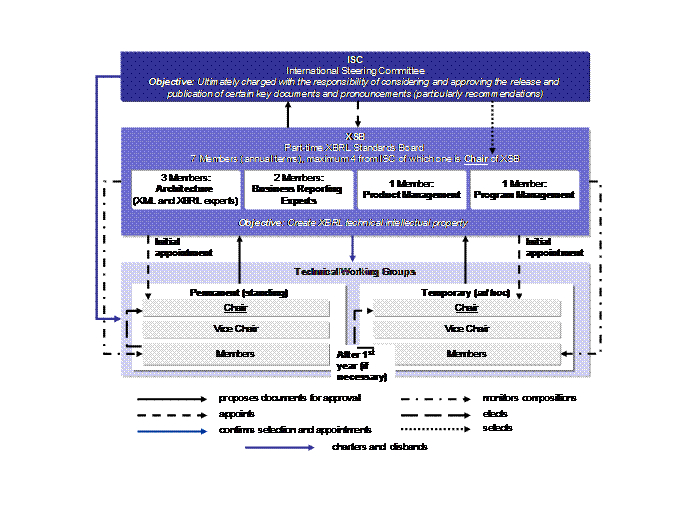
The composition of the Standards Board and its relationship with the ISC and the Working Groups is summarised in the following figure:
Figure 1: XSB Composition and Relationship to the ISC and the WGs
2.1 Blended Competencies
The Standards Board consists of 7 members, appointed by the ISC. Ideally each member should fill a specific competency-role to achieve a balanced perspective. To ensure appropriate and balanced representation it is important that the board consist of a blend of skills. The board comprises members that are technically focussed and technically competent as well as business focussed (see also Section 2.3 “Spread of membership” below).
The targeted competency mix is as follows.
Three Members: Architecture - with focus on XML and specifically XBRL technology including competencies and experiences in designing and developing service oriented architectures (SOA), database application design for business intelligence solutions (analytics, reporting).
Two Members: Business reporting management experts - with focus on the design and/or operation of end-to-end business process associated with performance reporting, including competencies and experiences in designing and managing systems from the business owner perspective, and defining the business architecture. Needs to have an understanding of the process of implementing new technology in an organization, working closely with IT teams
One Member: Product management - with focus on the gathering, analysis and prioritizing of requirements from business to functionality requirements. Experiences and competencies should include active team participation in technology projects or products from start to completed work or released product.
One Member: Program management - with focus on the design of feature sets based on functional requirements. Competencies include the ability to drive key trade off decisions, to illustrate the best sequencing of features over time from a design perspective that also meet requirements, and to evaluate the resource requirements for development and the delivery capacity of a distributed, matrix team.
All members must demonstrate clear record of working in an international setting with clear competencies of teaming, technical judgement, negotiation, and strategic planning.
2.2 Conflicts of Interest/Independence
Conflicts of interest could arise where a member of the Standards Board has a relationship with another person or entity that could be viewed as impairing the objectivity of the member in relation to a particular issue under consideration by the Standards Board. Where a member believes they may have a conflict of interest, the member concerned must inform the Standards Board of the nature of the relationship that could be viewed as affecting the member’s objectivity in relation to the particular issue under consideration by the Standards Board. This notification by a member is required to be made prior to the Standard’s Board’s consideration of the matter(s) in relation to which the member believes there is or may be a conflict of interest. The Chair of the Standards Board shall determine the future participation, or otherwise, of the member declaring the conflict of interest in the matter under consideration. If the Chair believes there is a conflict they must verbally inform the Chair of the ISC that such conflict exists and seek endorsement of any decision that is made regarding the individuals participation on the matter under consideration.
In the event of the Chair suffering a conflict or possible conflict of interest the Chair of the ISC shall determine their future participation in the matter under consideration.
At any time any member may voluntarily
recuse themselves from participation in any matter under consideration if they
feel it is appropriate to do so.
2.3 Spread of membership
The
members of the Standards Board are appointed by the ISC, after due consultation
with appropriate interested parties, primarily based on:
1.
Competencies required
2.
Ability to act independently
3.
Ability to commit the necessary time to Standards Board activities.
In making
appointments to the Standards Board the ISC will give due regard to, and as far
as possible seek to achieve, a balance of representation from different
geographies and communities involved in XBRL International. However, these
considerations will be secondary to the three criteria set out above.
Members
of the Standards Board do not necessarily need to be be Participants in XBRL
International (that is employees of firms that are members of a Jurisdiction,
individual, academic or other category of member of a Jurisdiction, where the
appropriate Jurisdiction has such category, or direct participants in XBRL
International). Members of staff (whether employed or contracted) of XBRL
International are not eligible to be members of the Standards Board.
The majority
of members of the Standards Board (i.e. at least 50% plus 1) must not be
members of the ISC, however, there must be at least one member of the ISC who
is also a member of the Standards Board at all times.
2.4 The Chair
The chair’s term is annual. The chair is selected by the ISC with consensus from the other members of the Standards Board. The chair should not serve as chair for more than 3 consecutive terms and not more than 3 terms in any period of 6 years. The chair should strive to achieve consensus of the Standards Board wherever possible. The chair has a casting vote in the event of a tie. The chair must be an ISC member.
3 Tenure
3.1 Term limits
Each Standards Board member shall serve a term of one year commencing on the date of appointment. The ISC shall not consider for re-appointment to the Standards Board anyone who has served on the Board for more than 5 terms in any consecutive period of 6 years.
3.2 Performance Evaluation
The ISC (or a sub committee of the ISC, as determined by the ISC from time to time) will coordinate evaluation of the performance of each of the Standards Board members and each of its working groups. The Chair for each working group shall oversee the evaluation process for his/her respective committee. The Chair of the Nominating Committee shall oversee the evaluation process for the entire Board.
Each Standards Board member will receive annual peer review that includes feedback from, but not limited to, other members of the Standards Board, members of the technical working groups, XBRL International staff working alongside in support of the Board, and ISC members. Formal review will be based on the performance against the competencies and stated goals and objectives of each member. Informal feedback is encouraged, can occur at any time, and should be given in a constructive manner directly to specific members. The goal is to foster an open dialogue about what is working and what is not working.
4 Pronouncements
A principal role of the Standards Board is the approval of pronouncements (such as RECOMMENDATIONs) on XBRL technical matters. “Technical matters” includes standards, taxonomies receiving technical recognition (but excluding statements about third party developed taxonomies being “fit for purpose”) and advisory notes, architectures etc. but does not include matters related to operational or organisational aspects of XBRL International such as jurisdictional development etc. It is also responsible for publishing working drafts of these pronouncements and seeking comments from a wide constituency. The Standards Board is also entitled to publish Discussion Documents, road maps for technical work product and other documents that do not bind members.
Any pronouncement that is to be submitted to the ISC for RECOMMENDATION as a Standard or as an “Approved” taxonomy or for designation as authoritative support must be approved by the Standards Board and requires the support of not less than two thirds of the appointed members of the Standards Board who are eligible to vote.
Once approved by the Standards Board, any such statement must be submitted to the ISC for approval. Upon receipt ISC members will have not less than 7 days to notify the staff of XBRL International of their approval of the statement being published.
The Standards Board shall have the authority to issue working drafts (including “Acknowledgement”s of taxonomies) and Candidate Recommendations of the pronouncements referred to for comment without having to first seek the approval of the ISC. Approval of any such working drafts requires the support of a number not less than 50% of the appointed members who are eligible to vote.
The Standards Board shall have the authority to issue Discussion Documents for comment. Approval of any such statements requires the support of a number not less than 50% of the appointed members who are eligible to vote.
The ISC may amend or rescind any decision of the Standards Board, if this decision would be in the best interests of XBRL International.”
The following tables summarise the authorities for the various stages of publication of XBRL technical material
Table 1: Authority for Publication of XII Work Product (including XII taxonomies)
|
Status |
Internal Working Draft |
Public Working Draft |
Candidate Recommendation |
Recommendation |
|
Authority |
Working Group |
Standards Board |
Standards Board |
ISC |
Table 2: Authority for Publication of Third Party Taxonomies
|
Status |
Internal Working Draft |
Public Working Draft (Acknowledgement) |
Approval |
|
Authority |
Third Party |
Working Group (chartered by the Standards Board for this specific purpose) |
ISC |
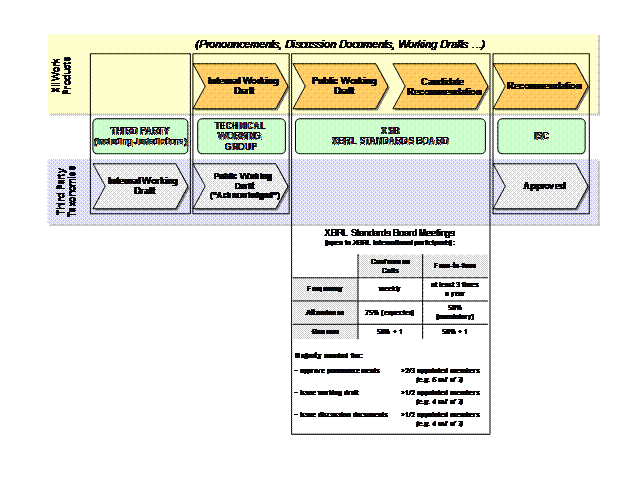
This is summarised further in the following figure
Figure 2: Summary of Responsibility and Authority in the Technical Product Process
5 Operation
5.1 Meetings
The Standards Board should meet by teleconference weekly and face to face at least three times a year but the ultimate driver is the volume of work required. Attendance at a minimum of 50% of face to face meetings is mandatory. Attendance at a minimum of 75% of conference call meetings is expected. The ability to abide by this requirement will be a factor in the selection of members of the Standards Board. Failure to satisfy this requirement may, at the discretion of the ISC, result in the removal of a member from the board. Any board member whose removal is under consideration by the ISC shall be allowed the opportunity to state any objection to removal if they so wish.
Quorum for meetings is established when 50% of the Standards Board members plus one are present. While a meeting is inquorate, discussion may take place and be minuted at the discretion of the chair but no motions may be voted on. If a meeting becomes inquorate because of the departure of a member or members no voting may take place while it remains inquorate.
No proxies will be allowed for either voting or establishing quorum.
The Chair of the Standards Board will report activities and decisions to the ISC at every ISC meeting and seek strategic guidance on intended activities where necessary.
5.2 Working Groups
The Standards Board will charter Technical Working Groups as it determines to be necessary to perform the technical work of XBRL International. There are two types of Technical Working Group – permanent and temporary (chartered for a particular project). These are referred to as “standing” and “ad hoc” herein.
· The work to be addressed by the Technical Working Groups will encompass at least the areas that are covered by the Specification, Domain and GL Working Groups as at January 2006.
· XBRL International Technical Working Groups are either standing or ad hoc working groups of the Standards Board.
· Technical Working Groups are chartered with specific goals, or in the case of ad hoc groups, specific objectives, determined by the Standards Board. Ad hoc groups are dissolved once they have achieved their specific objectives. If appropriate, successor ad hoc groups can be formed to perform a further cycle on a particular work stream.
· The Standards Board shall develop and publish criteria for the chartering and winding up of Working Groups, such criteria to be approved by the ISC. Such criteria shall include requirements such as minimum number of sponsoring participants, level of commitment required from such sponsors, continued evidence of progress being made on the work product of the Working Group etc.
· Technical Working Groups shall have staff assigned to them to assist their operation. Staffing can comprise assistance as simple as participating in working group deliberations in order to provide advice on procedure and technical matters or as large as the production of requirements and specification documents, as necessary.
· The Standards Board will define criteria for membership of the the Working Groups and the leadership structure thereof.
· The Standards Board will define criteria for establishing voting rights in a WG.
· The Standards Board will define criteria for determining quorum at WG meetings.
6 Staff Support/Budget
Sufficient XBRL International staff will be allocated to support the work of the Standards Board as necessary.
The ISC shall provide an adequate budget for the work of the Standards Board.
7 Transparency
The
Standards Board is committed to transparency in all of its operations. This
will be achieved by:
1.
Meetings of the Standards Board will be open to XBRL International
participants on the same basis as ISC meetings. Participants in XBRL
International will be asked to notify the Standards Board that they would like
to attend a meeting, as an observer, in advance. The Standards Board will have
the discretion to refuse such an application, but it is not expected that this
would arise in the majority of circumstances. As with ISC meetings it is
recognised that there may be occasions when all or part of a meeting needs to
be held “in camera” and the Standards
Board will have the discretion to determine this as and when it deems it
necessary. Materials to be discussed at board meetings
will be made available to those who have notified their intention to attend the
meeting in advance.
2.
Adequate notice will be given of all Standards Board meetings, except in
exceptional circumstances.
3.
Full minutes of all Standards Board meetings will be prepared within 5
working days for approval by the XSB and published to the XBRL membership at
large once formally approved at an XSB meeting. Where any part of a meeting is
held “in camera” full minutes of those discussions will be provided along with
the more widely published minutes to all members of the ISC. The term “full
minutes” is intended to mean that sufficient detail of the discussions held
will be provided to enable an informed reader to understand the nature of the
discussions, the contributions and views of Standards Board members, and the
basis on which any decisions taken or actions agreed are based. An archive of
the minutes of XSB meetings shall be maintained and made available to the XBRL
membership at large.
4.
In relation to those aspects of its role which relate to making
recommendations to the ISC concerning approving technical work product or in
exercising any delegated approval authority the Standards Board will
develop and publish procedures, which will be subject to prior approval by the
ISC, for dealing with such matters. The procedures will include, inter alia,
determining/defining the requirements the work product is intended to satisfy,
establishing the different stages of the process, (e.g., draft, public working
draft, RECOMMENDATION etc), the requirements to achieve each stage, the
timescales for each stage, etc. Appropriate procedures will be established for
each type of technical work product. Similar processes will be established for
recommending new technical work products or projects to the ISC for approval,
with particular focus on determining requirements and decision making criteria.
The authorities which are delegated to the
Standards Board are defined in section 4 “Pronouncements” above. The purpose of establishing transparent standard
processes is to;
·
enable the ISC to ensure that due process has been carried out either when
considering recommendations from the Standards Board or when carrying out its
oversight role where the Standards Board have exercised delegated authority
·
provide other interested parties and stakeholders with confidence in the
integrity and independence of the processes and outcomes
·
provide clear guidance to the community and other interested parties on
the basis that new work products or projects will be approved and the steps and
timescales to achieve them
5.
The Standards Board may nominate a particular member or members to act as
the key point of contact in respect of issues on which such member or members
have particular skills or interest for participants in the community and other
interested parties to raise issues with the Standards Board or seek information
or clarification from it. In the absence of a nominated individual this role
will be taken by the Chair of the Standards Board. If established for any
particular issues or issues this role will be given a high profile on the
xbrl.org website. The Standards Board will develop and publish procedures for
dealing with such issues/queries etc to ensure that they are dealt with on a
timely and transparent basis. This role will be separate from any specific liaison
or requirement gathering roles that members of the Standards Board may have
with working groups, geographic or other communities within XBRL and other
organisations.
6.
In the event of lack of
unanimity in respect of any decision, the Standards Board shall, at the request
of those holding dissenting views, publish such dissenting views along with its
decision. Any such dissenting views so published must be authored by those
dissenting.
8 Process and Policies
The Standards Board shall determine its operating procedures so long as they are not inconsistent with the terms of this document.
The operating procedures should cover inter alia the procedures for working groups and sub-committees and other items.