1. Overview
1.1. Purpose
The XBRL US Domain Working Group is leading the development of this eXtensible Business Reporting Language (XBRL) Financial Services Terms (USFR-FST) Taxonomy for the purpose of expressing common financial reporting concepts according to the Financial Accounting Standards Board (FASB) and other related/relevant accounting standards.
This Financial Services Terms (USFR-FST) Taxonomy is designed to facilitate the creation of XBRL jurisdiction and industry taxonomies focused on financial reporting. The purpose of the USFR-FST Taxonomy is to provide detail (or primary) level concepts for the consistent creation of XBRL documents for financial reporting purposes by private sector and certain public sector entities. The purpose of this and other taxonomies produced using XBRL is to supply a framework that will facilitate data exchange among software applications used by companies and individuals as well as other financial information stakeholders, such as lenders, investors, auditors, attorneys, and regulators.
The authority for this USFR-FST Taxonomy is based upon US Generally Accepted Accounting Principles (GAAP). Its development is based on input from accounting firms, technology companies and other domain experts in the field of financial reporting. In addition, the specific content of the taxonomy is based upon standards identified by the Financial Accounting Standards Board (FASB) and other related standards organizations.
The particular disclosures in this USFR-FST Taxonomy model are:
1. Required
by numerous
2. Typically represented in AICPA model financial statements, checklists and guidance materials as provided from each of the major international accounting firms.
3. Found in common reporting practice, or
4. Flow logically from items 1-3, for example, sub-totals and totals.
This USFR-FST Taxonomy is in compliance with the XBRL 2.0a Specification, dated 2002-11-15 (http://www.xbrl.org/tr/2001/).
1.2. Taxonomy Status
The USFR-FST Taxonomy is an Acknowledged Public Working Draft. Its content and structure have
been reviewed by the XBRL US Domain, XBRL Specification and XBRL
International Domain Working Groups.
XBRL Taxonomies can exist in five states insofar as XBRL International
is concerned:
- Working Draft – Draft of an International
Working Group.
- Unacknowledged - Developed externally but not
royalty-free, or not known to be specification compliant.
- Acknowledged - Developed externally,
compliant with the specification, and minimally 'advertised' by XBRL
International.
- Approved - Acknowledged, and also complying with published best practices.
- Recommended - Approved, and recommended because it is better than alternative
taxonomies for the same purpose.
The following is a summary of levels
of approval attainable within each state of Taxonomy approval outlined above:
- Internal Working Draft – Internal Working Draft
version of a Taxonomy exposed to XBRL International members for internal
review and testing. An Internal Working Draft is subject to significant
changes as initial testing is undertaken. Its structure may not be stable
and its content may not be complete.
- Public Working Draft – Working Draft version of a
Taxonomy exposed to public for review and testing. A Public Working Draft
has been tested and its structure is unlikely to change although its
contents may still change as the result of broader testing.
- Final – Final version of a Taxonomy,
designated by XBRL US as the most appropriate representation of a
particular reporting environment.
1.3.
Scope of Taxonomy
This
USFR-FST Taxonomy is released in conjunction
with XBRL International’s Global Common
Document (INT-GCD) and Accountants Report (INT-AR) taxonomies and
the following XBRL
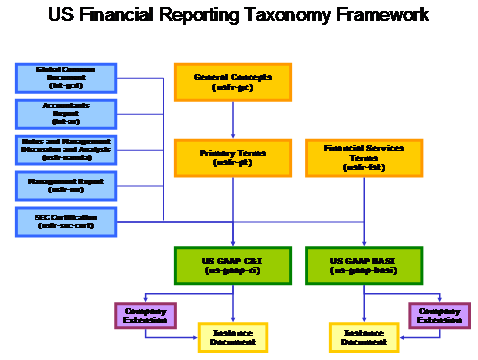
. These taxonomies are all part of the US Financial Reporting Taxonomy Framework, an XBRL taxonomy framework that enables reusability of components and provides the foundation for creating new industry taxonomies (such Insurance, Banks and Savings Institutions) going forward.
The USFR-FST Taxonomy is designed to represent detail (or primary) level business and financial reporting concepts typically found in US financial reporting environments. As such, its structure and scope is related to the other taxonomies described above, but does not incorporate any elements of the reporting taxonomies listed above. It is a stand-alone taxonomy typically used in conjunction with other taxonomies.
Taken together, these taxonomies will meet
the reporting needs of companies that meet three criteria; (i) they report
under FASB standards, (ii) are in the broad category of “banking and savings
institutions” and (iii) have relatively common reporting elements in their
financial statements. In practice, these three criteria are less likely to hold
for all companies. Additional taxonomies
are likely to be required. These
taxonomies are likely to identify the particular needs of:
- Vertical industries, for example, certain banks
or broker/dealers.
- National jurisdictions for those companies that require
a non-US GAAP standard as the core financial standards setting foundation
and may include supplementary reporting requirements or prevent use of
available options by local accounting standards setters as well as stock
exchanges etc.
- National industry or common practice, for
example, tax or credit reporting.
- An
individual company.
These
extension taxonomies will either extend the USFR-FST Taxonomy to meet the
particular reporting requirements of that industry, country or company and/or restrict by limiting the use of
particular USFR-FST Taxonomy elements.
The
inter-relationships of the various taxonomies are show in Figure 1:
Figure 1: Interrelationship of Taxonomies and Instance Document
1.4. Relationship to Other Work
XBRL utilizes the World Wide Web consortium (W3C www.w3.org ) recommendations, specifically:
- XML 1.0 (http://www.w3.org/TR/2000/REC-xml-20001006)
- XML Namespaces (http://www.w3.org/TR/1999/REC-xml-names-19990114/)
- XML Schema 1.0 (http://www.w3.org/TR/xmlschema-1/ and http://www.w3.org/TR/xmlschema-2/), and
- XLink 1.0 (http://www.w3.org/TR/XLink/).
2.
Overview of Taxonomy
The primary purpose of the USFR-FST Taxonomy is to provide common financial
services reporting terms to the USFR Taxonomy Framework which includes the
following detailed information (specific XBRL taxonomy namespaces in
parenthesis):
- Document Information (INT-GCD):
Contains information that is specific to the document being created.
For example, general information about the title of the document, its
creator, or revisions to the document.
- Entity Information (INT-GCD):
Contains information that describes the entity that issued the document.
For example, the name of the entity and the industry in which the entity
operates.
- Accountants Report (INT-
- Income Statement (USFR-GC,
- Balance Sheet (USFR-GC, USFR-
- Statement of Cash Flows (USFR-GC,
- Statement of Changes in Equity (USFR-GC,
- Comprehensive Income (USFR-GC,
- Notes to Financial Statements (USFR-NAMDA,
USFR-FST): Contains notes to the financial
statements information, such as "Significant Accounting
Policies".
- Management Discussion and Analysis (USFR-NAMDA,
USFR-FST): Contains management’s comments such as
“Segments of a Business” and “Material Changes”
- Management Report (USFR-MR):
Information contained within the Management Report.
- SEC Officers Certification
(USFR-SEC-CERT): Information contained in the Officers
Certification report as mandated by the Sarbanes-Oxley Act 0f 2002.
Reporting elements from the USFR-FST
taxonomy may be incorporated into a wide variety of other disclosures from
press releases to multi-period summaries.
2.1.
Contents of the Taxonomy
This USFR-FST Taxonomy makes available to users the most commonly disclosed financial information under the FASB Standards. This taxonomy is an expression of financial information in terms that are understandable to humans, but more importantly also understandable by a computer application.
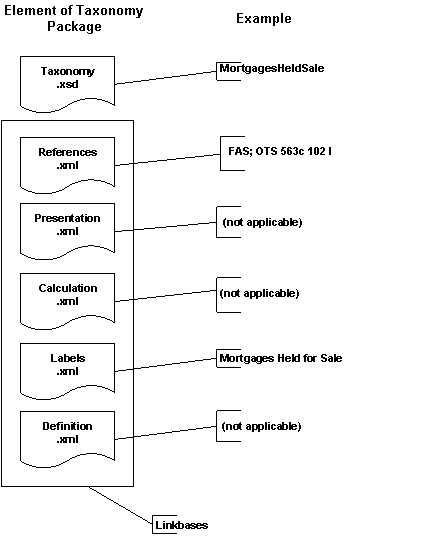
The USFR-FST Taxonomy is made up of a “package” of interrelated XML files:
- XML Schema File (.XSD file): An XBRL 2.0a-compliant Taxonomy XML Schema file.
- XBRL Linkbases (.XML files): “Linkbases” for:
- Labels
- References
- Presentation information
- Calculation relationships between elements, and
- Definitional relationships between elements.
The package is represented visually with an example based on the concept of “Total Deposits” as shown in Figure 2:
Figure 2: USFR-FST

2.2.
Taxonomy Structure
The USFR-
Given that information on the
Taxonomy is included in XML Schema and linkbase files, it is best rendered for
human interpretation in a “paper” paradigm. Users are encouraged to review
versions of the taxonomy elements in Adobe Acrobat (PDF) http://www.xbrl.org/taxonomy/us/fr/common/fst/2003-07-07/usfr-fst-2003-07-07-elements.pdf
or Excel http://www.xbrl.org/taxonomy/us/fr/common/fst/2003-07-07/usfr-fst-2003-07-07-elements.xls
formats.
2.3. Element Naming Convention
The USFR–FST Taxonomy uses a readable
2.4.
Label Languages
Currently, labels for taxonomy elements are provided in English. In the future, taxonomy labels could be expressed in additional languages as required.
2.5.
References
This Taxonomy provides references to FASB and other relevant standards. Figure 3 shows how the reference elements are used in this taxonomy, using “OTS 563c 102 i” to illustrate how a reference is matched to these elements:
Figure 3: Reference Naming Structure
|
Name: |
OTS |
|
Number: |
563 |
|
Paragraph: |
c |
|
Subparagraph: |
102 |
|
Clause: |
i |
Authoritative reference
information used throughout the taxonomy relies on a series of acronyms. The following list provides an overview of
the acronyms/references used commonly throughout the authoritative references:
(AAG) – AICPA Audit and
Accounting Guide;
(APB) - Accounting
Principles Board Opinion;
(APS) - Accounting
Principles Board Statement;
(ARB) - Accounting Research
Bulleting;
(Article 9) – Uniform
Commercial Code Article 9;
(ATB) - Accounting
Terminology Bulletins;
(CON) - FASB Statement of
Financial Accounting Concepts;
(CT) - FASB Accounting
Standards Current Text and its Appendix E;
(EITF) - FASB Emerging
Issues Task Force issue;
(FAS) - Statement of Financial
Accounting Standards;
(FASB) - Financial
Accounting Standards Board;
(FFIEC) – Federal Financial Institutions
Examination Council;
(FIN) - FASB
Interpretations;
(FR) – Federal Register;
(FRR) - SEC Financial
Reporting Release;
(FTB) - FASB technical
Bulletin;
(OTS) – Office of Thrift
Supervision Regulations;
(PB) - AICPA Practice
Bulletin;
(SAB) – Securities and
Exchange Commission Staff Accounting Bulletin;
(SAS) - Statement on
Auditing Standards;
(SOP) - AICPA Statement of
Position;
(SP) - SEC Staff Position;
(SX) - Regulation S-X;
(Topic) - Topic paragraph in
Codification of SEC Staff Accounting Bulletins (SAB) .
2.6.
Further Documentation Available
The
intent of this document is to explain the Taxonomy. This document assumes a
general understanding of accounting and XBRL. If the reader desires additional
information relating to XBRL, the XBRL International web site (http://www.xbrl.org)
is recommended. Specifically, a reading of the XBRL 2.0a Specification is highly
recommended (http://www.xbrl.org/tr/2001/).
The purpose of this document is to explain how XBRL is being applied in this
specific case, for this taxonomy.
The following documentation is available to assist those wishing to understand and use this taxonomy. This documentation is available on the XBRL International web site (http://www.xbrl.org):
Taxonomy Pa
These documents correspond to a set of interrelated files comprising an XBRL taxonomy package:
- XML Schema File (.XSD file): An XBRL 2.0a-compliant Taxonomy XML Schema file.
- XBRL Linkbases (.XML files): Linkbases for
- References
- Labels
- Presentation
- Calculations, and
- Definitions.
These files are located as follows:
http://www.xbrl.org/taxonomy/us/fr/common/fst/2003-07-07/usfr-fst-2003-07-07.xsd (Schema)
http://www.xbrl.org/taxonomy/us/fr/common/fst/2003-07-07/usfr-fst-2003-07-07-references.xml (References linkbase)
http://www.xbrl.org/taxonomy/us/fr/common/fst/2003-07-07/usfr-fst-2003-07-07-labels.xml (Labels linkbase)
http://www.xbrl.org/taxonomy/us/fr/common/fst/2003-07-07/usfr-fst-2003-07-07-presentation.xml
(Presentation linkbase)
http://www.xbrl.org/taxonomy/us/fr/common/fst/2003-07-07/usfr-fst-2003-07-07-calculation.xml
(Calculation linkbase)
http://www.xbrl.org/taxonomy/us/fr/common/fst/2003-07-07/usfr-fst-2003-07-07-definition.xml
(Definition linkbase)
“Sample Company” Instance Documents
Since this taxonomy is imported by/into other taxonomies, a stand-alone instance document is not provided. Please see taxonomies such as the US-GAAP-BASI for sample company instance documents.
3.
Items to Note in Using the Taxonomy
3.1.
Introduction
The following explanation of the
taxonomy, the taxonomies with which this USFR-
3.2.
How
to Interpret the Taxonomy Structure
The USFR-FST Taxonomy is organized
in a “flat” format. Each reporting
concept is listed individually and without further structure. Any additional
structure is intended to be provided by taxonomies which make use of USFR-FST,
such as
3.3. Equivalent facts
These exceptions require the use of
“same-as” links. The “same as” concept is part of XBRL 2.0a Specification, and
its interpretation is as follows: there will be an error if an instance document having two elements linked by a “same as”
definition relationship and which
have the same numeric context have different content values.
Specific to the USFR-FST Taxonomy, there are no equivalent facts that require the use of “same as” links.
3.4.
Namespaces
For example, the USFR-FST Taxonomy uses the component
name “Deposits” to represent the concept “Total Deposits”. If the
The way this is done is that each
taxonomy has a unique namespace. A namespace is a
Using qualified namespaces, the USFR-FST
Taxonomy “Net Interest Income” becomes usfr-fst:NetInterestIncome and the United
Kingdom Taxonomy’s would be uk-fst:NetInterestIncome. The namespace simply adds a contextual prefix to any given XML
element.
Note that these particular aliases reflect a usage convention only within the USFR-FST Taxonomy itself as an aid to communication between humans. Software applications must not depend on these particular prefixes being used; they should process namespace identifiers and aliases as specified by the XML specifications.
3.5. Entering Numeric Values into Instance Documents
Figure
5 describes how weights have been incorporated into the
Figure 5: Numeric Values and Weights
|
Typical Balance |
Enter* |
|
|
Asset |
Debit |
Positive |
|
Liability & Equity |
Credit |
Positive |
|
Revenue |
Credit |
Positive |
|
Expense |
Debit |
Positive |
|
|
|
|
|
Other Income (Expenses) |
|
Positive or (Negative) |
|
|
|
|
|
Cash Inflows |
|
Positive |
|
Cash Outflows |
|
Positive |
|
|
|
|
|
Number of Employees |
|
Positive |
*Enter means enter into an instance document.
Please Note: This information is provided for reference purposes only. The USFR-FST Taxonomy is not typically used to create instance documents directly against or solely using it. Instead, industry taxonomies such as US-GAAP-BASI combine both text-based and numeric elements and, as a result, typically are the focus of instance documents.
3.6.
Segmentation
XBRL instance documents distinguish facts relating to different segments
of an entity in nonNumericContexts and numericContexts. For example, revenues
for the entire company, and segmented into revenues for the
4. Reviewing This Taxonomy
4.1. Introduction
This section is designed to provide guidance in reviewing this taxonomy. This will assist the user of this documentation and of the taxonomy as well as assisting in providing feedback to the XBRL US Domain Working Group and XBRL International. There are three levels of review
- Global Review: A high level review of completeness.
- Detailed Review: A detailed review of accounting disclosures and completeness
- XBRL Review: A review of appropriate treatment of disclosures within the context of the XBRL specification and good practice in building taxonomies.
4.2. Global Review
This is a high level review, undertaken with the objective of ensuring the taxonomy has not omitted any key sections. This contrasts with the Detailed Review, which is concerned with a line-by line analysis. If a crucial part of the taxonomy is missing, such as a specific aspect related to a general business reporting concept, this should be picked up in the Global Review. Knowledge of GAAP and Financial Reporting is required to undertake this review. It is intended to identify missing sections of the taxonomy rather than a missing element within a section. A question that would be asked in the Global Review might be “are there XBRL elements that capture necessary general business and reporting concepts information?” rather than validating each of the individual General Concept disclosures.
4.3. Detailed Review
The objective of the Detailed Review is to ensure the taxonomy correctly captures information typically related to high-level business and reporting concepts. It has two components, the first driven from GAAP and the second driven from XBRL.
Model
Report Review
This review involves validating the elements and disclosures in the taxonomy on a line-by-line basis against commonly used business and financial reports.
The accuracy is checked by reviewing the taxonomy against:
- Model financial statements; and
- Actual financial statements
GAAP to XBRL
Reviewers should be able to identify an element in the taxonomy for every item, applying to the financial services industry as a whole, required to be disclosed under GAAP. This requires a 100% mapping from GAAP to the USFR-FST Taxonomy. This includes checking all the appropriate GAAP references.
This review should ensure that the element list is sufficiently complete in relation to all of these matters and in the context of the financial services industry, as a whole.
XBRL to
GAAP
Not all elements in the Taxonomy will map directly to a GAAP disclosure requirement. Such elements should exist in the taxonomy because it is either 1) common practice for enterprises to disclose the fact or 2) the fact is a sub-total that helps the structural completeness of the taxonomy.
4.4. XBRL Review
This review has an XBRL focus, and involves verifying some of the attributes of the elements. The principal attributes to be verified are weights, labels and data type.
Weights
Is the weight correct, so that the children would correctly roll-up to its probable parent?
Labels
Label names should be consistent. For example, equity might be labeled as “Equity”. There should therefore be no cases of “Stockholder’s Equity” or any other variations. All abbreviations should also be consistent.
Data-Types
Is the element data-type correct? Valid data types include (but are not limited to) string, monetary, date, tuple and shares.
5. Nam
5.1. Introduction
This section explains the naming
conventions created and used in the USFR-FST Taxonomy to associate digital
“tags” to concepts from the FASB Standards and other related materials. The
purpose of this “translation” is to provide a consistent, reliable,
language-independent, unambiguous way for relevant parties to use and integrate
XBRL standards into their software applications.
5.2. Key Terms
The following terms are used
throughout this section:
·
Component: A representation of a fact that
relates to the element or concept being described. This fact may represent,
among other things, an accounting term, an accounting concept, or a GAAP-defined
definition. Examples: [assets] = “Assets”; [Expenses] = “Expenses”.
·
Composite: A series of two or more components
joined together to make a complete element (“tag”) name. A composite represents
a more specific concept than a component. Also referred to as a composite
element name. Examples: [IncomeExpenses] = “Income and Expenses”; [AssetsLiabilitiesEquity]
= “Assets, Liabilities and Equity”.
·
Reference: A reference to literature that
supports the existence and necessity of a component and/or composite. Each
component and composite has at least one reference. Typically these refer to
chapter/subchapter/paragraphs/etc., as denoted in authoritative information
such as FASB and GAAP. However, other references may also be present.
·
Label: A label is text that describes a
component and/or composite to a user. A single component or composite may have
multiple labels, typically one per language, although a single language may
have multiple types of labels.
5.3. Concepts and Considerations
The
USFR-FST Taxonomy XBRL “element name” has been created using a Label CamelCase
Concatenation (LC3) convention. The base
for the element name is the label name for a given element. The label is a
natural language expression that is meaningful to experts in the domain of that
taxonomy (e.g., “IncomeExpense”, “ChangeInBalances”) for a given element. If multiple labels exist in one or more label
linkbases for that taxonomy, all element names in the taxonomy shall be derived
from a linkbase in the primary language of the taxonomy and will be consistent
with the label link having the highest assigned priority.
Specific requirements of the LC3 naming
convention are as follows:
·
The base for the element name is the label name for an
element. The label is a natural language expression that is meaningful to
experts in the domain of that taxonomy (e.g., “Revaluo Propio”, “Restatement of
Fixed Assets”) for a given element.
·
If multiple labels exist in one or more label linkbases
for that taxonomy, all element names in the taxonomy shall be derived from a
linkbase in the primary language of the taxonomy and will be consistent with
the label link having the highest assigned priority.
·
The first character of the element name must be
alphabetic.
·
The first alphabetic character of the element name shall
be capitalized.
·
Connective words in the label shall be omitted from the
element name, in order to make names shorter.
Connective words include (but are not limited to) the, and, to, for,
from, which, of
·
All special characters shall be omitted from the element
name. Special characters include, but
are not limited to; ( ) * +. [ ] ? \ / ^
{ } | @ # % ^ - _ = ~ ` “ ‘ ; : < > & $, ₤ €.
·
Element names shall be limited to 256 characters or fewer.
·
A list of standard abbreviations and rules for
substitution (e.g. “Property Plant and Equipment” always replaced by “PPE”)
will be maintained and consistently applied to labels when used in constructing
element names.
·
In the event that two or more elements share the same
element name and the element name is less that 256 characters, uniqueness shall
be accomplished by appending an additional distinguishing suffix word, or,
failing that, by appending the first duplicate name with a number, beginning
with 1 and incrementing by 1 for each element with a common name.
- In the event that two or more elements
share the same name and the element name is equal to 256 characters, the
last ten characters of the element name shall be dropped and rule number 9
shall be applied.
Composite Element Names are not Hierarchical in Nature
The order in which label “fragments”
are listed in a component in a composite element name are combined should not
be interpreted as a hierarchy. Although some composite element names may
“appear” to resemble this relationship, it is strictly coincidence and
unintentional. All components in a
composite element name are equal in stature, i.e., there is no implied
hierarchy within the composite element name. The hierarchy is expressed in the
XBRL linkbases.
6. Sample Instance Documents
The USFR-FST taxonomy is a key component used to create industry-specific taxonomies such as the US-GAAP-BASI Taxonomy. As such, it is “imported” by other taxonomies, like the US-GAAP-BASI Taxonomy, instead of being used as a stand-alone taxonomy for creating instance documents. As such, sample instance documents are not provided for the USFR-FST taxonomy.
7. Review and Testing, Updates and Changes
7.1.
Change Log
None at this time.
The following table will be used to track changes made to this document:
|
Version Number |
Version Date |
Modified By |
Changes Made |
|
1.0 |
07-Jul-2003 |
Brad Homer |
Original Version |
|
|
|
|
|
|
|
|
|
|
|
|
|
|
|
|
|
|
|
|
|
|
|
|
|
|
|
|
|
|
|
|
|
|
|
|
|
|
|
|
7.2.
Updates to this Taxonomy
This taxonomy will be updated with revisions for errors and new features within the following guidelines:
·
Since financial statements created based on the USFR-
- It is anticipated that this taxonomy will be updated as required to incorporate changes in generally accepted accounting principles and business reporting norms.
7.3.
Errors and Clarifications
The following information relating to this taxonomy will be accumulated:
- Errors which are brought to the attention of the preparers of this specification
- Workarounds where appropriate and available
- Clarification of items which come to the attention of the editors via comments and feedback
- Best practices on how to use this taxonomy to create instance documents.
If you wish to report an error, require a clarification or suggest a best practice, please provide feedback as indicated in the “Comments and Feedback” section of this document.
7.4.
Comments and Feedback
Comments and feedback on either accounting concepts contained in the USFR-FST Taxonomy or specific to the US Financial Reporting Taxonomy Framework are welcome, particularly ideas to improve this taxonomy. If you have a comment or feedback or wish to report an error, email comments to:
Jeff Naumann (jnaumann@aicpa.org)
Campbell
Pryde (cpryde@kpmg.com)
8. Acknowledgements
The
XBRL US Domain Working Group would like
to acknowledge the contributions of the following individuals for their work in
the creation of this taxonomy, and to their respective organizations who
provided the funds and time for their participation in and support of this
effort:
Name
|
Organization
|
Accounting
Jurisdiction
|
|
Rob Blake |
Microsoft |
|
|
Eric Cohen |
PricewaterhouseCoopers |
|
|
John Crish |
KPMG |
|
|
John Donovan |
PricewaterhouseCoopers |
|
|
Herm Fisher |
UBmatrix |
|
|
Terrill Garrison |
Federal Reserve System |
|
|
Clicia Guzzardo |
|
|
|
Walter Hamscher |
Standard Advantage |
|
|
|
UBmatrix |
|
|
Alvin James |
FDIC |
|
|
Sal Mileti |
Ernst & Young |
|
|
Tim Mueller |
PricewaterhouseCoopers |
|
|
Jeff Naumann |
AICPA |
|
|
|
KPMG |
|
|
Randall Puckett |
FDIC |
|
|
Pat Relich |
FDIC |
|
|
Mark Schnitzer |
Morgan Stanley |
|
|
Phil Walenga |
FDIC |
|
|
John Wisnieski |
FDIC |
|
9. XBRL International Members
A current list of corporate members of XBRL
International can be found at the XBRL International web site (www.xbrl.org).