Don’t Drive to the Moon
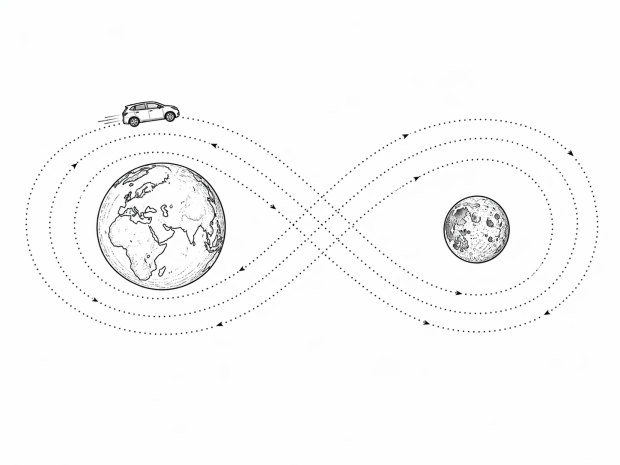
Take a Volkswagen ID.4. Lovely car. Very sustainable. Now drive it to the moon and back. Nineteen times.
You will need snacks. And… oxygen.
You’ll also need roughly 2.7 million kWh of electricity, which, by a coincidence that borders on the poetic, is about how much AI energy just two jurisdictions will waste every reporting season if regulators don’t require digital tagging of sustainability disclosures.
Let’s start small. The UK FCA expects around 515 companies to report under its new sustainability regime. On average UK companies currently provide around 9–10 pages of relevant disclosure on their TCFD obligations, which works out to roughly 15,000 tokens.
If each company tags its own report (increasingly, AI does the heavy lifting on the 80% that’s straightforward while management sweats the 20% that requires a real brain) that’s one pass per company. Total AI energy for the entire UK market: about 96 kWh. Forty loads in a tumble dryer. A year’s worth of digital sustainability reporting for the entire UK market, or one family’s socks from Christmas through to March. Prefer your energy in VW ID.4 distances? A quick drive from London to Amsterdam, more or less. Your call.
Now suppose companies just publish PDFs instead and leave users to fend for themselves. Investors still need the data. So do lenders, analysts, insurers, academics, NGOs, supply chain teams, regulators themselves. What now?
Most users will subscribe to a data provider, sure. But every provider still does the extraction independently, with its own model and assumptions. Add the analysts who’d rather ask their own AI than trust someone else’s homework. The academics building research datasets. The NGOs running their own numbers. Probably hundreds of ESG consultancies convinced their own AI is the clever one. How many different consumers will pull in all of that data? Two thousand users across the global market seems conservative. Two thousand users. 515 reports each. 15,000 tokens a pop. Fifteen billion tokens. 193,000 kilowatt-hours. Enough to drive the ID.4 to the moon and back. 1.3 times. Just for the UK. Just for ten-page reports. Every year.
Now add Europe. The EU’s CSRD sustainability disclosures are substantially larger: conservatively… 66 pages? About 103,000 tokens each. Say a thousand companies? Same two thousand users doing their own extraction. 205 billion tokens. That’s 2.5 million kWh. Seventeen more return trips to the moon. Every year.
Every last kilowatt-hour spent not on analysis but on the tedious preliminary business of turning PDFs into something a machine can actually work with. The analysis hasn’t even started yet.
And remember what these reports are about. Sustainability disclosures. The documents designed to inform and to hold companies accountable for their environmental impact. They would themselves be powering a spectacular, entirely avoidable bonfire of electricity.
It produces worse answers, too. Two thousand users independently scraping the same PDF means two thousand slightly different interpretations, none of them signed off by management.
One digital disclosure, taxonomy-aligned and management-verified, gives the market a single version of the truth, ready for any AI or any other analytical tool to consume at near-zero cost. Ok… just a few loads of laundry.
The UK and EU are just two jurisdictions. Japan, Brazil, Singapore, Canada and dozens more are making the same choices right now. We haven’t even touched on the financial disclosures! All in all, it’s an awful lot of lunar travel.
Don’t drive to the moon. Tag the data.
Sources and Methods… of sorts. You realise this is just illustrative, right?
| Item | Value | Source | Notes |
| UK TCFD report length | ~9.5 pages avg. | Analysis of existing UK TCFD filings using GPT-5 / Codex | FCA scope is effectively TCFD compliance. Average across 515 companies is likely to be 10 pages per company. Some companies provide a lot more. |
| UK TCFD token count | ~15,000 tokens | GPT-5 / Codex analysis of 25 representative filings | Of course, token counts vary by model, encoding, and document formatting. |
| CSRD report length | ~66 pages | Conservative estimate from ESRS requirements | Early filings suggest wide variance. 66 pages is a floor for these large companies. |
| CSRD token count | ~103,000 tokens | Extrapolated via tokenomy.ai | Based on page-to-token ratio calibrated against actual filings. |
| Energy per token | We’ve used Global average energy, using GPT-5. | tokenomy.ai estimator | GPT-5 model, Global Average Grid Carbon Intensity. Varies significantly by model, hardware, and data centre. |
| UK reporting companies | 515 | FCA CP26/5 | FCA’s own estimate of in-scope companies. |
| EU CSRD companies | 1,000 | Current estimate | Nope. We don’t know where Omnibus will land either. |
| PDF-consuming users | 2,000 | Illustrative estimate. Could be many times more! | Includes data providers (each extracting independently), investors, analysts, lenders, academics, NGOs, regulators. Conservative for a global user base. |
| VW ID.4 efficiency | 5.25 km/kWh | Rated efficiency | Real-world efficiency is typically lower, especially when it’s cold… which it is on the way to the moon. |
| Earth–Moon distance | 384,400 km | Mean Earth–Moon distance | One way. Return trip = 768,800 km. |
| Tumble dryer load | ~2.4 kWh | Typical heat-pump dryer | Condenser dryers use roughly double. |