Next Generation XBRL – The First Public Working Draft

The first Public Working Draft (PWD) of Project Tavi is now available. Approved for publication by the XBRL Standards Board, this is the first public release of the next generation XBRL specification. It brings a simpler approach to modelling and digitisation of reports of all kinds and we would like your help to shape it.
‘Project Tavi’ is a temporary name for this effort. We will announce a more formal name at Data Amplified 2026 in just a few weeks time. The specification is an initial PWD which means that it remains entirely subject to change. Indeed, some parts have yet to be written. We are publishing it because it is sufficiently developed to be useful, and because broader input now will help us get the direction right.
Earlier this year, we outlined our goals for modernising XBRL through the work then known as OIM Taxonomy. Project Tavi carries that work forward, with a scope that encompasses both taxonomies and the data they describe.
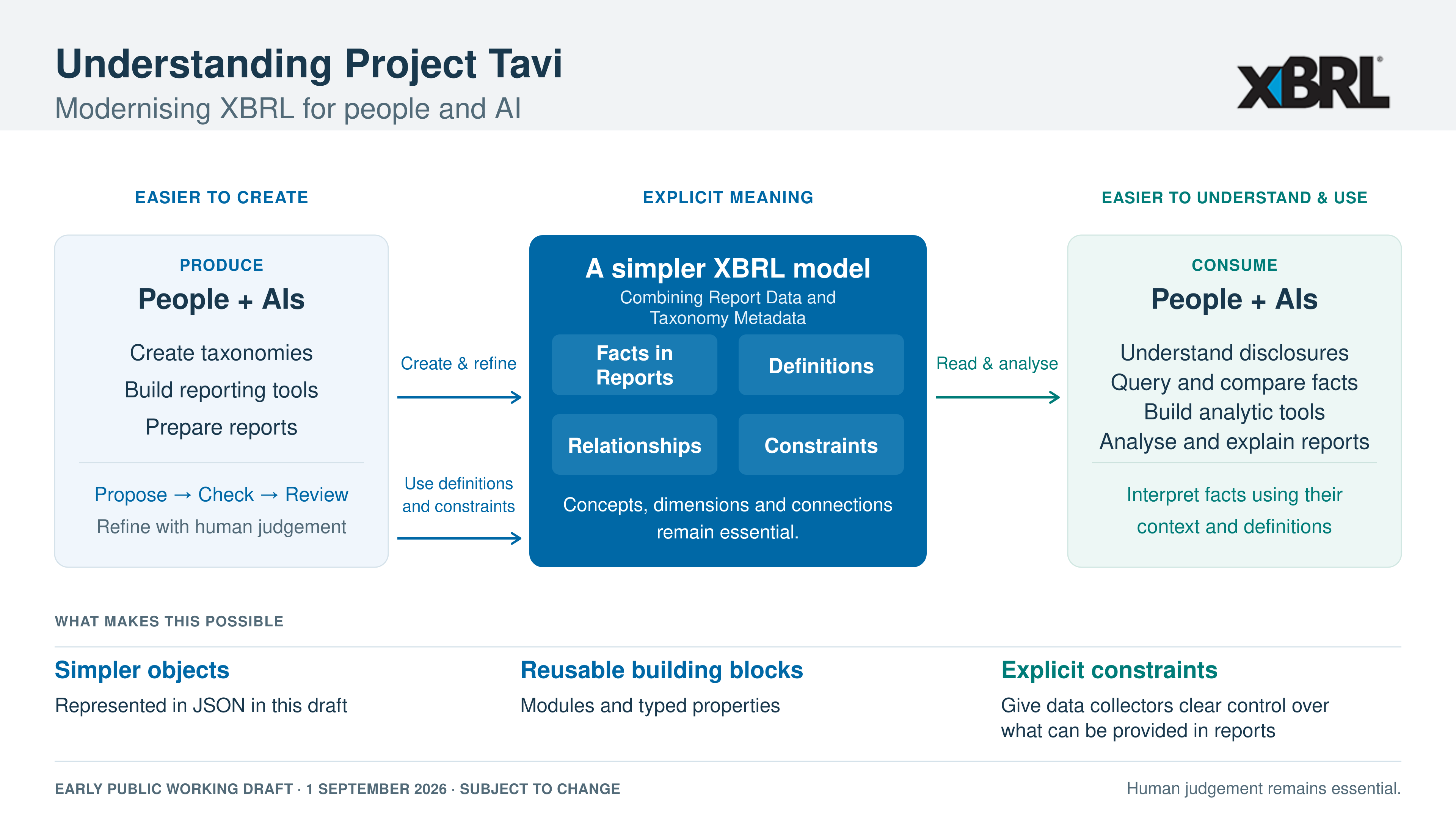
Today’s XBRL taxonomies use XLink, a technology we adopted more than twenty-five years ago for perfectly good reasons that no longer apply. XLink makes XBRL difficult to learn. Developers have to understand a considerable amount of technical machinery before they can work with the reporting definitions it carries. With today’s XBRL processors that’s just background syntax, and irrelevant to most users. However, it’s not irrelevant to LLMs and other forms of AI: in order to get them to consume XBRL data and metadata it’s necessary to do some pre-processing. One of the goals of Project Tavi is to ensure that the AI tools available today (and tomorrow) can easily consume, and help prepare, digital reports.
Project Tavi defines taxonomies using a simplified data model, represented for now in JSON, with far fewer moving parts and much less indirection. This makes their structure easier to understand and allows ordinary developer tools to work with them.
The simplified data model is also more accessible to AI tools. A suitably capable general-purpose AI model can read one of these taxonomies, answer questions about it and use it to work with associated data. Making the definitions more accessible opens up new possibilities for how people and machines interact with digital reports of all kinds.
Plenty will change, but concepts, dimensions and data constraints do not go away. Implementing them properly still takes time and understanding. That is as it should be: they express the meaning of reporting, and digital reporting cannot work without them.
The Working Group is also proposing simpler, more streamlined terminology and will, in due course, work to provide a syntax-neutral, abstract representation of the model.
There are practical simplifications elsewhere, too. The existing XBRL 2.1 stack relies on registries such as the Units Registry, Data Types Registry and Link Role Registry, each with its own custom XML format. Project Tavi uses XBRL taxonomies themselves to capture these registries, reducing the number of separate formats that developers and maintainers need to understand and support.
XBRL International members can further explore the way that the specification works using the supporting schema materials and draft conformance suites available within the Working Group’s gitlab repository. The specification also includes an example base model and an example import model. We encourage you to experiment, including with LLM coding tools, while remembering that the specification will change.
XBRL International does not recommend that vendors invest development resources in new specifications until they reach Candidate Recommendation status. Project Tavi is not there yet. At this stage, the examples and supporting materials offer a way to understand the possibilities with relatively little effort, and to contribute feedback that will help guide further development.
We are not deprecating the XBRL 2.1 stack and have no plans to do so. It will continue to be supported and where necessary, expanded. A huge number of production systems rely on it and will continue to do so, potentially for a very long time. No specification is being withdrawn or is scheduled for withdrawal. Existing taxonomies and filings remain valid under the existing specifications. There is no migration deadline, and XBRL International cannot, and would not, require anyone to use the new framework.
XBRL International members that are vendors or develop software internally are welcome to attend a technical briefing on Project Tavi in late September or early October. Details will be added to this page shortly.
Huge thanks go to all of the members of the Working Group that has been focussed on this modernisation and has been meeting, weekly, sometimes twice weekly for a very extended period.
We welcome broad feedback. Is this heading in the right direction? What is missing? What can be trimmed? Please remember that this is an initial release. Please read the Public Working Draft, but perhaps, most practically, start from some of the examples. Feedback can be provided to oim-feedback@xbrl.org.